How did we get here?
- All brush heads approved for competitive play must utilize Oxford 55 420 denier mustard yellow nylon as the brush head fabric, as it was this fabric that was tested in Kemptville, Ontario and was found to have the most desirable trade-off of minimal impact on the trajectory of a stone, versus reasonable improvement to the carry of a stone.
- The existing rule that prohibited brushing a stone from any direction other than completely across the face of the stone was dropped, because the testing in Kemptville found that the brushing angle of attack made little difference in the trajectory of a stone. This meant that “corner sweeping” was no longer banned.
- World Curling, based on the study results from the National Research Council in Ottawa, created a specification for the testing of foam used in brush pads. That specification contained a minimum and maximum amount of compression that a compliant brush head could have. That is, to be approved the foam could not be:
- so pliant that it would be easy for an athlete to fully compress the pad, resulting with the brush head itself being in contact with the ice, nor
- so stiff that the brush only contacted the very top of the pebble while sweeping.
The foam specification was chosen based on an underlying assumption that the brush head assembly would distribute the force produced by the athlete down the handle evenly across the full contact area of the brush pad. That assumption appears as one of the specific points in the specification document.
Foamgate
Since 2016, manufacturers of brushing equipment have developed numerous new designs to create brushes that are more effective, and weigh less, while still satisfying the requirements of the World Curling specification. But what this past season’s experience demonstrated was three main points:
- the existing World Curling specification for foam, by itself, is only tangentially related to the behaviour of a brush when used on the ice surface;
- differences in behaviour were independent of the brush head fabric, as all testing conducted by both World Curling and at the University of Saskatchewan used brush heads wth the standardized Oxford 55 420 denier mustard yellow nylon fabric; and
- as a whole, new brushing products are made available in the marketplace without sufficient on-ice testing to demonstrate their suitability in actual brushing situations by competitive athletes.
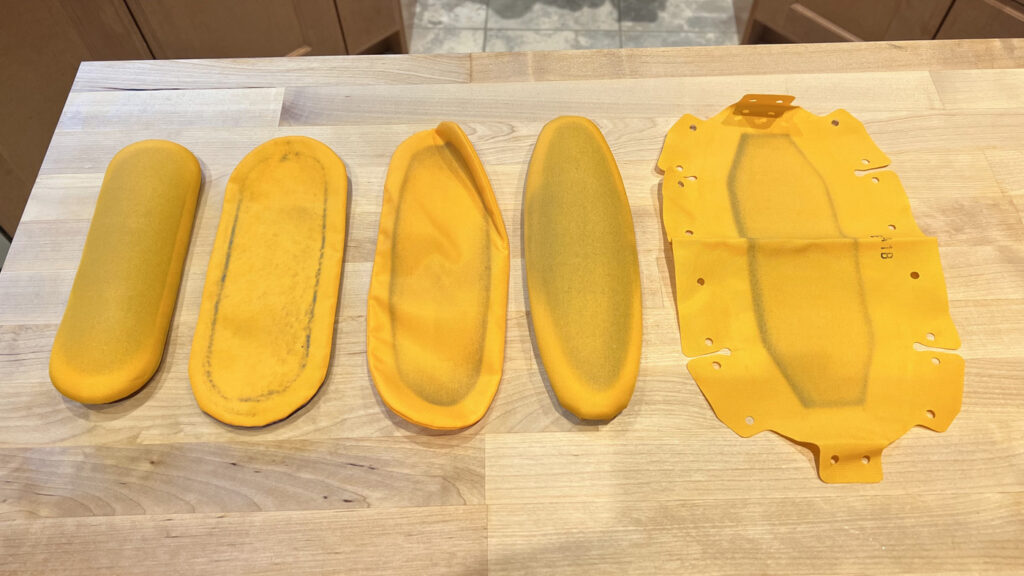
The accumulation of dirt on different brush heads demonstrates clearly their asymmetric pressure distributions. From left to right, Goldline Air X, 2023 IcePad, Balance Plus RS XL, Goldline Oval, and End Game.
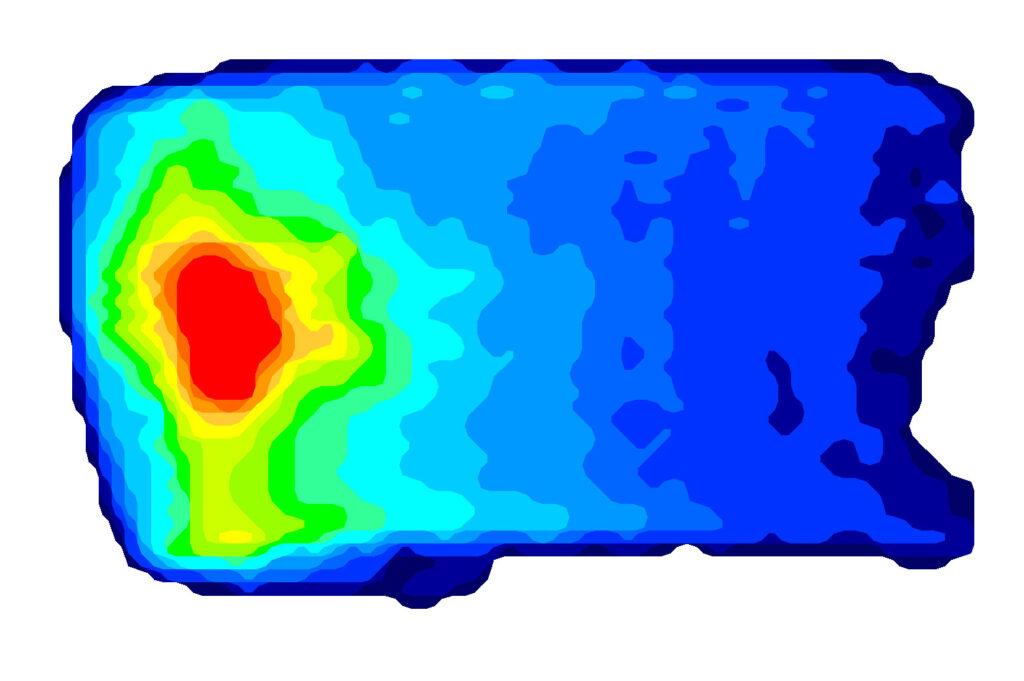
Still image of a video capture of a brush under load passing over a sensor mat (from left to right) in the BENlab at Dalhousie University. The different colours indicate different pressures (red is highest, dark blue is lowest). Note the reduced pressures captured by the mat at the end of the stroke, typical of the oscillation of vertical force during a brush stroke.
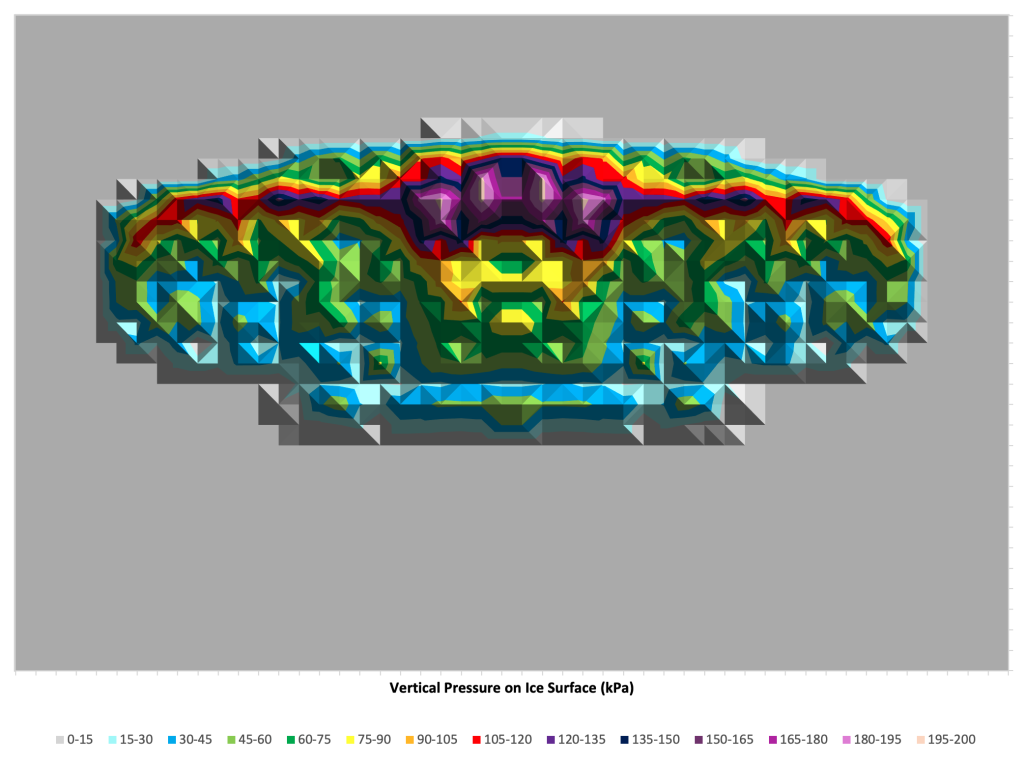
Pressure mat readings taken from a brush under load from a static position, again illustrating the asymmetric distribution of pressure, particularly around the handle mount and on the brush pad’s leading edge.
Latest research
In addition to the recent on-ice testing done at Morris, Manitoba by World Curling, two research projects continue to look at elements of brushing and understanding the underlying physics of the sport. One of these projects concerns the study of brush heads and their construction, and the resulting pressure distribution when under load, which I’ve written about previously. This work involves myself along with professors John Newhook, Michel Ladouceur, and Ryan Frayne of Dalhousie University. We intend to continue this work through this coming year in order to test the equipment that World Curling approved for the 2025-2026 season, with the goal of providing some insight into what a new, improved brush specification might look like.
The second project, which I mentioned in a prior article, concerns an in-depth study of the physics of curling, including the characteristics of ice, stones, and brushing. This work is being performed at the College of Engineering at the University of Saskatchewan by Sean Maw and his research team of staff and graduate students; I am absolutely delighted to act as a consultant to this project.
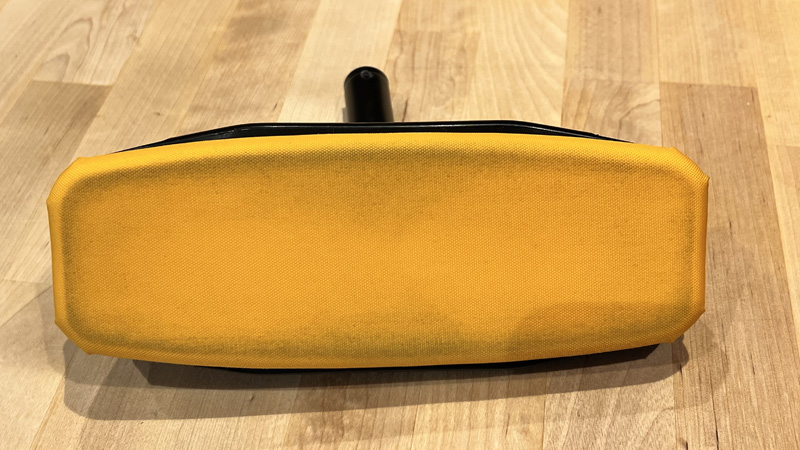
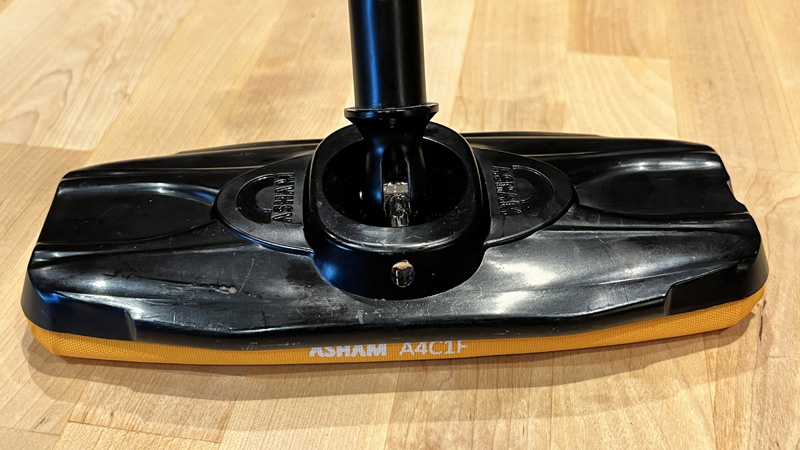
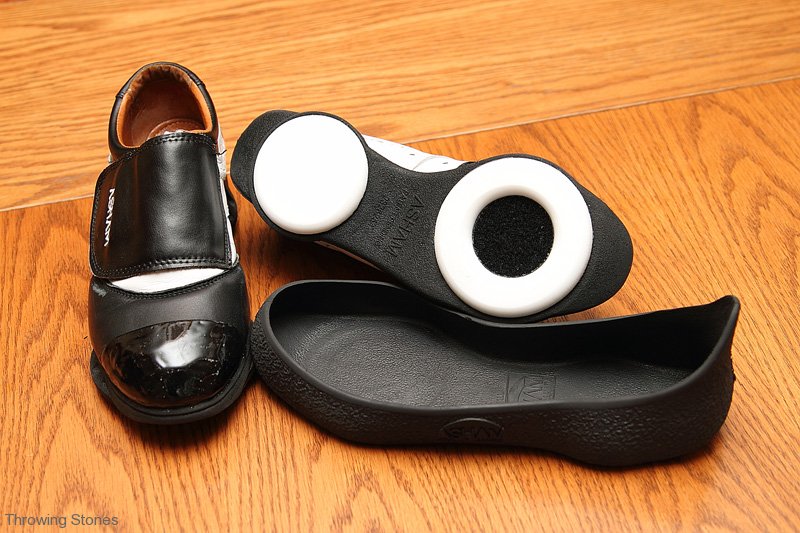
Like the Balance Plus RS, IcePad, and End Game heads above that utilize replaceable sleeves, the integrated Asham Velocity brush head (with velcro-backed brush pad) also exhibits uneven pressure distribution around the edges of the brush pad.
Sean delivered the project’s initial findings to World Curling earlier this month. Sean’s work is truly exciting in that his results, and the technology used to produce them, are groundbreaking, involving the use of high-magnification macro photography along with high-resolution infrared imaging that is able to discern temperature changes with individual pebbles. The results are planned for future publication so I can’t go into details regarding the results, but I can say that Sean’s work, and that of his graduate students at Saskatchewan, give us an entirely new understanding of the physics of the sport, and particularly of the differences between ordinary brushing and “knifing”. I would like to offer my sincere congratulations to Sean, Grant Harris, Corin Acton, and Derek Elvin for making an outstanding contribution to our knowledge behind the physics of curling.
Thoughts on what's to come
In no particular order, here are some of my thoughts on what is to come over the next 12 months or so.
- Given the de-certification of a number of competitive brush heads from Balance Plus, Goldline, and Hardline (now Goldline since their recent acquisition) it will be interesting to see what equipment becomes the choice of the various competitive teams.
- We need to better understand the impact of different force profiles on brushing outcomes. It is unsurprising that greater forces yield greater effects on a stone, but we need to better understand the relationship between brushing force and its impacts on both carry and trajectory.
- Following the announcement by World Curling on 20 June, I noticed that several commentators either panned the results or opined that only elite players would notice differences amongst the various brushes that, though no longer approved for competitive play, would remain available for recreational use. This is a false narrative. With my young women’s team, using a Goldline “black” foam Impact brush would permit my lightweight female athletes to brush “low side” (against the curl) and make the stone “fall back” (against the curl) about 14 inches on a draw-weight shot on regular club ice at Toronto Cricket. That result pales in comparison to the testing done in Saskatchewan by a certain competitive men’s team, where using the Goldline “black” foams allowed them to make a stone “fall” against the curl by 3-4 feet on a draw, reminiscent of the original “Broomgate” in 2015. Nevertheless, being able to manipulate trajectories in this way, even with lightweight athletes, is not, in my view, what is best for the game, either at the competitive or recreational levels.
- Both myself and my research colleagues remain concerned about the use of knifing as a brushing tactic. We are aware that several of the top men’s teams believe that they can cause a stone to slow if they use knifing as a brushing tactic at the latter stages of a shot, which again is arguably contrary to the spirit of the game. It is premature to issue a call for a ban on knifing at present, but knifing is going to be studied in more detail over the next 1-2 years.
- We know that the ability to accentuate curl through brushing is dependent on “ice conditions”, which may include all sorts of variables including relative humidity, dew point, water quality, pebble characteristics, ice and air temperature, the roughness of the stones’ running bands, and potentially other factors. This phenomena remains an important research topic.
- I am somewhat concerned about compliance with the 2025-2026 brushing device moratorium after the results of the testing in Morris in May and the withdrawal of specific foams from the list of World Curling-approved devices in June. I think there is opportunity for inadvertent or deliberate use of non-approved equipment now that some specific brushing equipment has been dropped from the approved equipment list. As a software developer over my career, I completely understood the need and importance of properly and correctly identifying each software component for testing and verification. Kudos to Goldline who, as one example, date their Impact brush heads with a manufacture date stamp. I hope this practice becomes more prevalent across the industry to ensure that teams are able to correctly distinguish between what equipment is permitted in competition and what is not. Unfortunately, as a coach over the last 23 years I have borne witness to a variety of brushing equipment violations, most recently at the 2025 OUA Women’s University championships in Sudbury. The manufacturers could assist in this problem by labelling each of their brushing components clearly and uniquely so that it is crystal clear to the U15, U18, U20, or university/college competitors, and the umpires at their events, what equipment is permitted in competition.