Coming soon: the Throwing Rocks Podcast
Coming soon – a new podcast that targets coaches and U25, U20, U18, and U15 athletes: The Throwing Rocks Podcast. We’ll include topics such as coaching, youth athlete development, high performance for U25 athletes and teams, equipment, and the science of curling. The pod will include segments on news, interviews, technical content, and listener questions, and will be available wherever you get your podcasts. Got a content idea? Have a question? Interested in a specific topic? Send me a DM on Instagram, Facebook, or via email to glenn@glennpaulley.ca.
First look: Hardline Chameleon brush
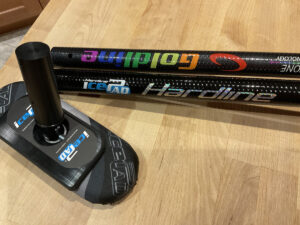
This past week, Goldline Curling Supplies introduced the latest brush in the Hardline lineup: the Chameleon brush, which features a dynamic reflective paint on a prismatic (straight), carbon-fibre handle. The Chameleon offers a high-performance, prismatic alternative to Hardline’s recreational Hybrid Helium fibreglass/carbon fibre composite handle. Hardline’s Hybrid Helium handle is also prismatic (and, notably, inexpensive), but is significantly heavier than the other models at 260 g. Chameleon handle characteristics The Chameleon’s handle is a close cousin to Goldline’s Impact carbon-fibre handle. Both are prismatic handles weighing 165 g and both feature Goldline’s “Grip-Zone Technology” for added grip for the curler’s bottom hand, though the “Grip Zone” designation is omitted from the Hardline handle. At 165 g, the new Hardline handle is very competitive in the High-Performance space, with only the Balance Plus LiteSpeed handle being lighter at 141 g. The nominal handle diameter is the de-facto adult standard of 1 1/8 inches. It is unknown if Goldline will offer a
In brushing, isolate the chassis
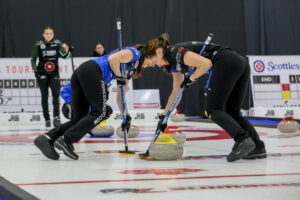
One of the critical biomechanical skills to develop in brushing is to ensure that neither the shoulders, nor the hips, “bounce” as one strides down the sheet. One can term this as “isolating the chassis”: the shoulders, back, and hips (the “chassis”) should remain relatively still, while the athlete uses their arms, shoulders, and back muscles to push and pull the brush head, while the legs propel the athlete to keep up with the stone. Why is this important? It’s because vertical oscillation (bouncing) of the shoulders and/or hips will result in a loss of vertical force as the shoulders and/or hips are raised. The effect is less pronounced with the shoulders, in part because the hip/pelvic area constitutes a greater percentage of the athlete’s body mass. The cause of vertical oscillation is usually variable flexion in the knees: the hips will dip if the knees are bent, but this hips will rise if the legs are subsequently straightened during
The research behind instrumented curling brooms
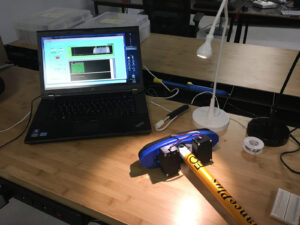
Author’s note: This is joint work with John Newhook, Department of Civil and Resource Engineering, Dalhousie University. This article is an updated version of an article previously published on the Ontario Curling Council website on 29 December 2014. Over the past several years I have had the privilege to work on a number of different engineering initiatives related to the sport of curling. One of these is the development of an instrumented curling broom, a device that permits the measurement of force and stroke rate of a player, in real time, while brushing a curling stone. In this article, I’d like to present a brief overview of the body of work surrounding the study of brushing performance in curling, and briefly describe two research initiatives that are helping to increase our understanding of how we can improve brushing performance in athletes of all ages and abilities. CurlSmart prototype instrumented curling brush, developed by Dr. John Newhook, Department of Civil Engineering,
World Curling alters stone placements for mixed doubles in 2026-2027
While we are still awaiting the publication of the new 2026-2027 World Curling rule book, Laurie St-Georges, the Director of Competitions of Curling Quebec, has posted the details of a mixed doubles rule change regarding the initial placements of stones in an end. Rather than the three placement positions used in prior seasons, beginning in 2026-2027 there will be four: the closest at a position 4′ 6″ in front of the rings, and the highest at a position 10′ 6″ in front of the rings, with corresponding changes to the distance from the centre line for the location of power play stones. (Click on the image at right to download the sheet layout in PDF). Making this information available before publication is intended to permit curling centres and their ice technicians to implement the new placement positions when installing their ice for the coming season. My thanks to Laurie for making this information available.
Dryland Training for Open Brushing Footwork
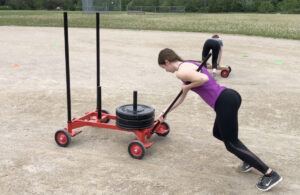
This article is joint work with John Newhook of Dalhousie University. A previous version of this article was published on the Ontario Curling Council website on 12 October 2018. In a previous article we described a simple, wheeled apparatus that an athlete could use to practice closed brushing footwork in the off-season. The closed footwork trainer assists an athlete in (1) keeping their hips closed to the trajectory of the stone while brushing, (2) holding their body upright with a considerable proportion of their body weight on their arms, and (3) practicing half-moon movements with both feet in order to keep their feet behind the hips, in order to maximize the amount of body weight on the hands, which will translate on the ice into helping maximize the amount of vertical force on the brush head. In this article, we describe a dryland trainer for open brushing footwork. The unit includes several features that offer versatility in training, and we