First look: Hardline Chameleon brush
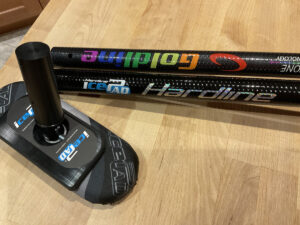
This past week, Goldline Curling Supplies introduced the latest brush in the Hardline lineup: the Chameleon brush, which features a dynamic reflective paint on a prismatic (straight), carbon-fibre handle. The Chameleon offers a high-performance, prismatic alternative to Hardline’s recreational Hybrid Helium fibreglass/carbon fibre composite handle. Hardline’s Hybrid Helium handle is also prismatic (and, notably, inexpensive), but is significantly heavier than the other models at 260 g. Chameleon handle characteristics The Chameleon’s handle is a close cousin to Goldline’s Impact carbon-fibre handle. Both are prismatic handles weighing 165 g and both feature Goldline’s “Grip-Zone Technology” for added grip for the curler’s bottom hand, though the “Grip Zone” designation is omitted from the Hardline handle. At 165 g, the new Hardline handle is very competitive in the High-Performance space, with only the Balance Plus LiteSpeed handle being lighter at 141 g. The nominal handle diameter is the de-facto adult standard of 1 1/8 inches. It is unknown if Goldline will offer a
The research behind instrumented curling brooms
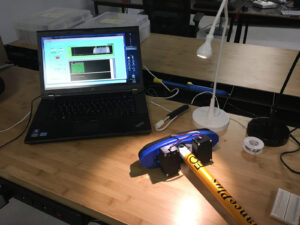
Author’s note: This is joint work with John Newhook, Department of Civil and Resource Engineering, Dalhousie University. This article is an updated version of an article previously published on the Ontario Curling Council website on 29 December 2014. Over the past several years I have had the privilege to work on a number of different engineering initiatives related to the sport of curling. One of these is the development of an instrumented curling broom, a device that permits the measurement of force and stroke rate of a player, in real time, while brushing a curling stone. In this article, I’d like to present a brief overview of the body of work surrounding the study of brushing performance in curling, and briefly describe two research initiatives that are helping to increase our understanding of how we can improve brushing performance in athletes of all ages and abilities. CurlSmart prototype instrumented curling brush, developed by Dr. John Newhook, Department of Civil Engineering,
Dryland Training for Open Brushing Footwork
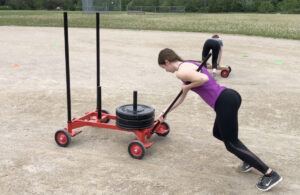
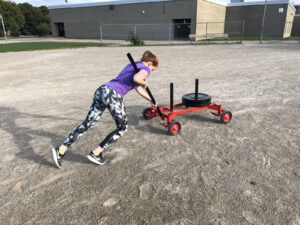
This article is joint work with John Newhook of Dalhousie University. A previous version of this article was published on the Ontario Curling Council website on 12 October 2018. In a previous article we described a simple, wheeled apparatus that an athlete could use to practice closed brushing footwork in the off-season. The closed footwork trainer assists an athlete in (1) keeping their hips closed to the trajectory of the stone while brushing, (2) holding their body upright with a considerable proportion of their body weight on their arms, and (3) practicing half-moon movements with both feet in order to keep their feet behind the hips, in order to maximize the amount of body weight on the hands, which will translate on the ice into helping maximize the amount of vertical force on the brush head. In this article, we describe a dryland trainer for open brushing footwork. The unit includes several features that offer versatility in training, and we
Building a dryland closed footwork trainer
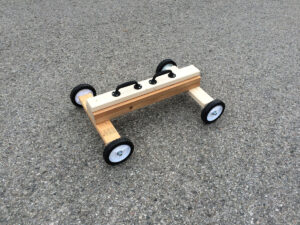
Since publishing the first article about the footwork trainer in June 2016, a number of people have asked for more detailed specifications and additional photographs so that they can construct their own. The trainer itself is simple to construct. The parts list is as follows: two 30-inch wood pieces of 2×6 glued and screwed together using 3-inch brass wood screws; one 30-inch piece of 2×4 attached to the top, again using 3-inch brass screws; two 18-inch 2×4 pieces for the trainer’s wheelbase. Note that the length of these pieces depends on the thickness of the wheel hubs of the wheels you’ll be using. You might find a length of 16.5 inches works better with metal hub wheels that are 1.75 inches wide. two 24-inch long, 1/2 inch threaded rods that serve as the axles, along with appropriate 1/2 inch nuts, washers, lock-washers, and locknuts; four standard 7-inch lawnmower wheels, purchased from Home Hardware. 8-inch wheels will also work – they’ll
Dryland training for brushing footwork
This article is a revision to an article that originally was published on the Ontario Curling Council website on 11 June 2016. In the Curling Canada High Performance Program coaching manual, under “Technical Development: Sweeping”, you will find the following quote attributed to Darryl Horne: Without doubt sweeping is the most under-coached, under-practiced, under-appreciated, and under-rated aspect of the game. In my experience in working with U15, U18, and U20 teams over the past 14 seasons, a common development issue with athletes is in mastering the biomechanics necessary for brushing effectively, that is insuring that the forces the athlete develops through the brush handle are optimal to the task. To assist athletes with learning the correct footwork for brushing in the closed stance, in the spring of 2016 I built a “footwork trainer” (see video at right) that athletes could use through the spring and summer in order to gain sufficient speed, stamina, and muscle memory in order to achieve
Applying toe-dip to a curling shoe
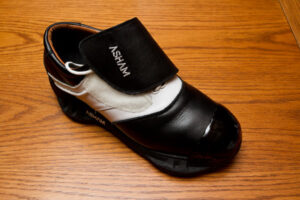
This article was originally written on 7 December 2012 and published on the Laurier Golden Hawks High-Performance Curling website. During a curling delivery the trailing (hack) leg can produce such significant drag that it can impact the ability of the curler to achieve what coach Bill Tschirhart calls an optimal “window of velocity” during the slide, and hence can impact both the speed and accuracy of the curling stone. Consequently, many curling shoes arrive from the manufacturer (Asham, Goldline, Balance Plus) with a toe coating on the hack shoe, made from a tough, hard resin that has a much lower coefficient of friction on the ice than leather. That toe coating is commonly referred to as a “toe dip” and in this article I will illustrate how to apply a toe dip to a shoe that doesn’t have one from the manufacturer. In this case, I’ll apply a toe dip using “Tuff Toe” onto a pair of two-tone Asham “Slam”