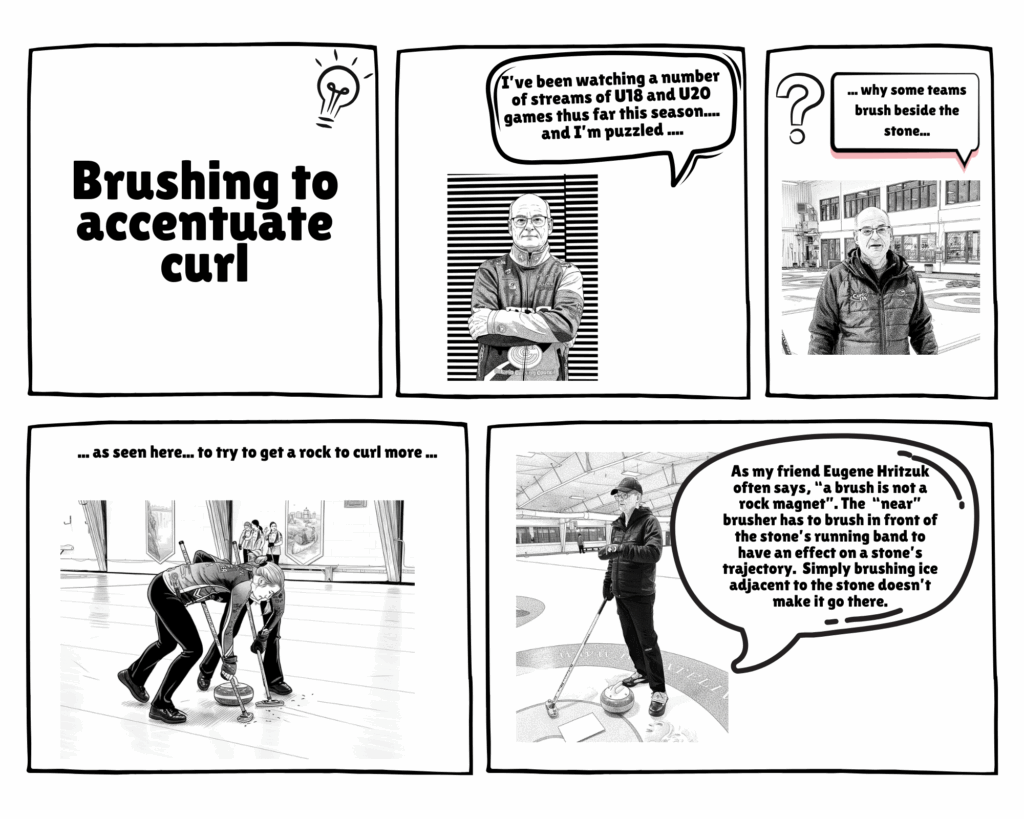
A brushing tactic I continue to see being used by younger teams is to brush the ice adjacent to the stone when trying to ‘carve’ or accentuate curl. I’m not sure where this tactic began, but there is no point in brushing ice that the running band of the stone will not pass over as the stone continues its trajectory.
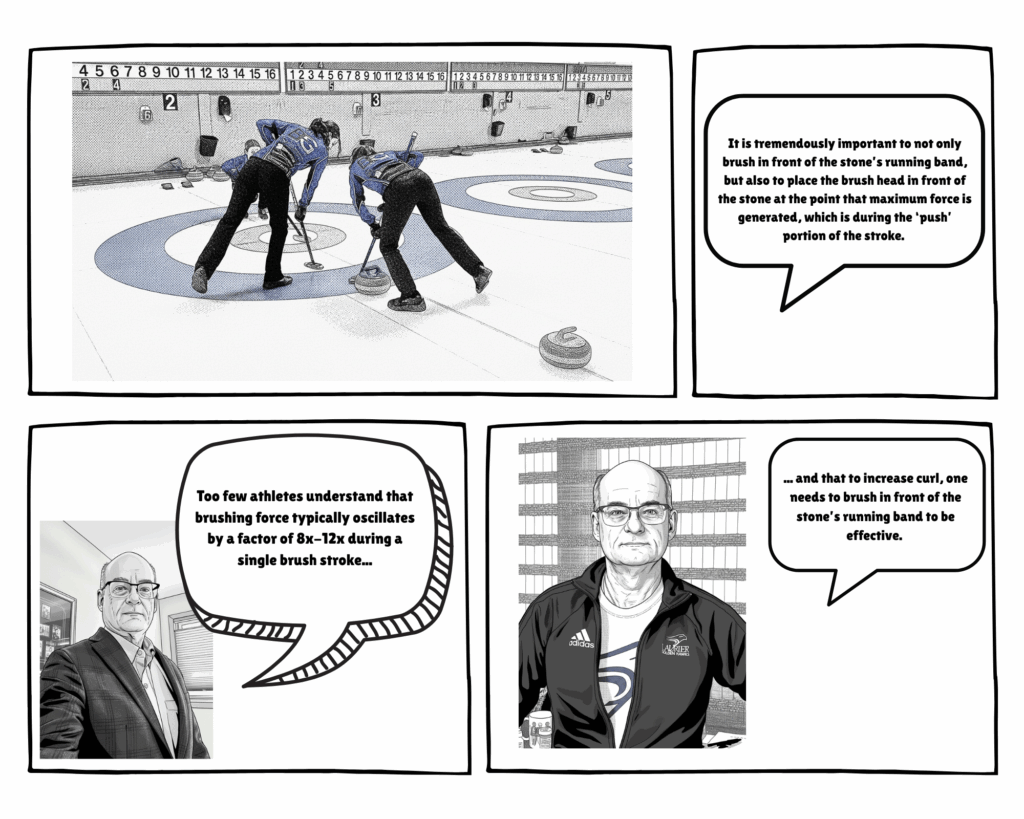
Brushing to increase curl requires brushing ‘high-side’ (in the direction of the stone’s rotation). Precisely where the stroke begins and ends for optimal effect depends on a number of factors, the most important being the velocity of the stone and the force profile of the athlete(s) doing the brushing. But there are several other variables that may play a role, including the roughness of the stone’s running bands, the ice conditions, and environmental factors (temperature, humidity, dew point) to name just a few. These variables are not completely understood, and we know from testing – at different clubs with various conditions, and with different athletes – that brushing to accentuate curl does not work all the time.
For these reasons it is difficult, if not impossible, to prescribe specific brushing tactics that will work for all teams in all situations.
Nevertheless, one has to brush in front of the stone’s running band to have any influence on trajectory of a curling stone. As my friend Eugene Hritzuk so forcefully states, “a brush is not a rock magnet” – brushing a portion of the ice surface adjacent to a stone’s running band doesn’t make the stone move towards it.
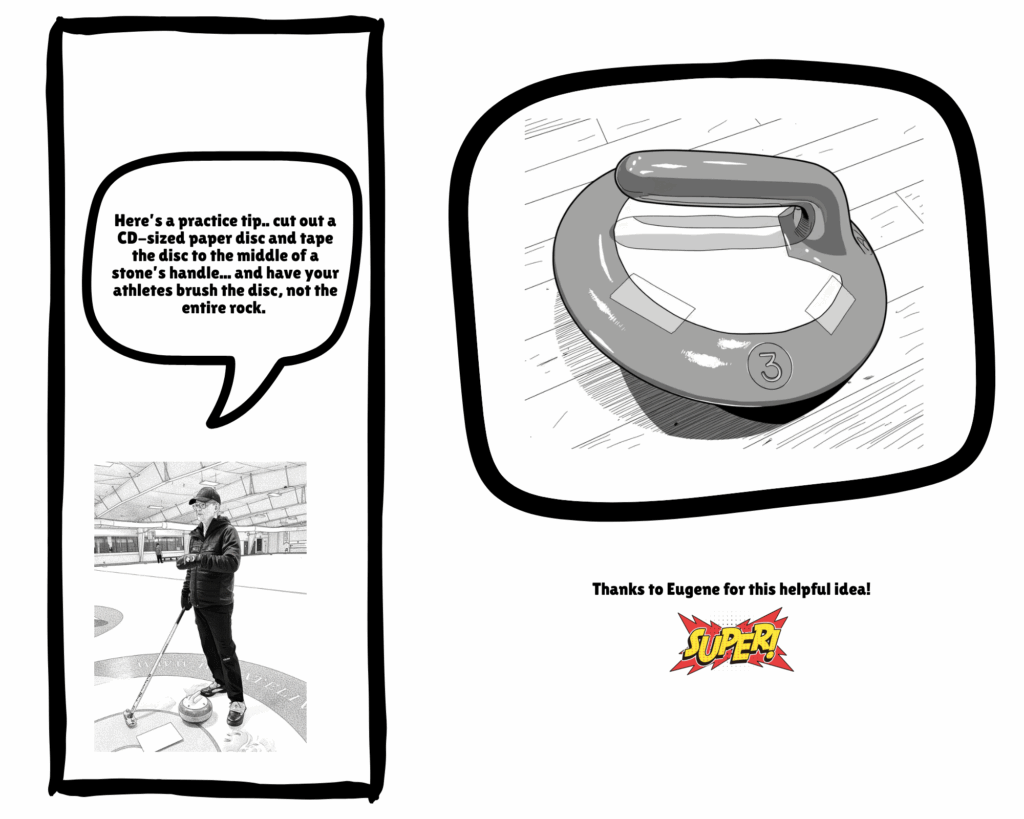
Well said. I have drawn 5 inch diameter circles, getting two per lettered sized page, with an indentation for the handle. Then photocopying as many as I need, cutting them out and taping them, with regular scotch tape on the top of the stone. This provides a clear guide to the area of the other side of the stone that brushing can impact.
Brushing tactics over the past few years have improved. But I still see brush head placement is problematic, even with some of the elite curlers.
I found that a very effective strategy for understanding and improving brush head placement is to video shots being brushed, and then playing them back to the players for feedback. I am often surprised at what curlers think they’re doing when brushing, as compared to what they are actually doing.