What is ocular dominance?
Ocular dominance is the tendency of the brain to prefer visual input of one eye over the other. While like many other mammals human beings have binocular vision with which to judge distances, humans almost universally prefer visual input from one eye over the other. According to Wikipedia, about 70% of people are right-eye dominant, and 29% are left-eye; why this is so is still not understood. In everyday circumstances most individuals don’t give their ocular dominance much thought; but in sport, eye dominance can play a significant role, especially in highly accurate tasks such as aiming. Sports such as darts, archery, billiards, shooting, and curling can be impacted by eye dominance, particularly when the athlete’s dominant eye is the opposite of their dominant (throwing) hand, which is sometimes termed cross-dominance.
Celeste Gauthier, who throws 3rd stones for Team Émilie Lovitt, throwing an out-turn draw. Note that Celeste’s left eye is directly above the centre of the stone; Celeste is right-handed but left-eye dominant.
Testing for ocular dominance
This video demonstrates the Miles and Porta tests for determining eye dominance.
In Bill Tschirhart’s A Pane in the Glass article on eye dominance, Bill notes that in many cases an athlete will determine, on their own, the appropriate mitigations necessary to deliver a stone so that the stone is delivered “on target”. While I agree with the statement, I would also say that in many of the cases where I am asked to help an athlete struggling with their delivery, particularly with their line, a contributing (and confounding) factor in the analysis is the eye dominance of the player. The Miles test is an easy, straightforward way of testing an athlete to determine their eye dominance, in addition to other methods.
Making a curling shot with cross-dominance
It isn’t straightforward to make prescribed statements regarding an athlete’s cross-dominance because cross-dominance is not a black-and-white issue. Some athletes are mildly cross-dominant, whereas others are severely cross-dominant (for me personally, I belong in the latter group). Regardless of the situation, when using a classical flat-foot, no-lift delivery, what we want to avoid is any lateral motion with the stone during the drive phase (the backwards and forwards motions during the delivery). Lateral deviations from the line of delivery are very difficult to “fix”, which is why we moved from the “lift” to “no-lift” delivery almost 30 years ago.
Assuming the stone does not deviate from the line of delivery, then a player has roughly three options to make a shot:
- The athlete is able to adjust their position in the hack, or position the stone, such that their dominant eye is aligned with the centre of the stone, and the relative position of the upper body and the stone remain fixed and on the line of delivery throughout. This is usually straightforward for an athlete whose eye dominance is the same as their dominant (throwing) hand. As roughly 90% of people are right-handed, and 70% are right-eye dominant, this works for the majority of players.
- The stone begins its travel on the line of the delivery and the athlete adjusts their body position during the initial forward movement of the “drive” phase, so as to align their dominant eye with the centre of the stone. That alignment usually takes place just before the athlete begins the “slide” phase, approximately at the near back line.
- The stone begins its forward motion on the line of delivery and the athlete’s forward motion is such that the dominant eye is not centred over the middle of the stone; in other words, the two lines are parallel, and parallax now becomes an issue. To make the shot, the athlete “triangulates” (Bill Tschirhart’s term) the geometry with their eyes, focusing on another point in order to “hit the broom”.
For a coach tasked with assisting an athlete suffering from competitive breakdown, these various adjustments can be confounding in the analysis of the athlete’s delivery, and can be exacerbated by the extent to which the athlete suffers from ocular cross-dominance. These issues can also be dependent on the physiology of the athlete; for example, athletes with very broad shoulders may not be able to position the stone during the setup to get anywhere near their dominant eye.
Tools for analysis
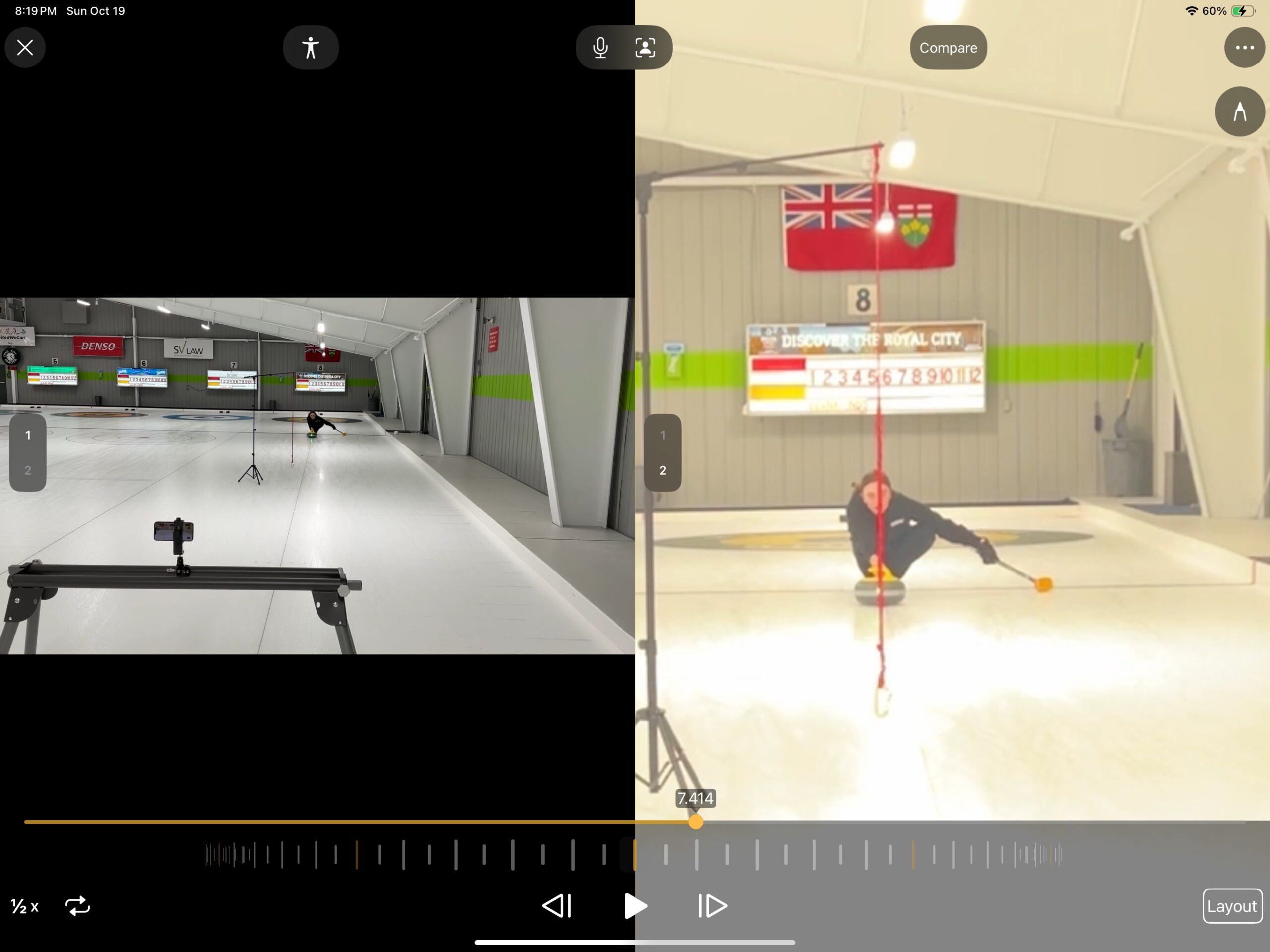
When analyzing an athlete’s delivery a useful bit of kit are a laser and some cones in order to create the “gauntlet drill“. However, when diagnosing problems with a cross-dominant athlete, it can be helpful to augment the basic gauntlet drill and add a multiple camera setup along with a plumb line to track the athlete’s body position through the delivery, rather than rely only on the laser to track the position of the stone. This is the setup I saw demonstrated for the first time in Edmonton in 2022 by coaches Jeff Hoffart and Curling Canada’s Viktor Kjell. In that demonstration they used Switcher Studio to synchronize the video; here, I’m using the OnForm app and its recently-introduced MultiView camera mode.
View of Celeste’s delivery from the side. Unlike Switcher Studio, OnForm “stiches” and syncs the cameras within the app, but exports the videos separately.
View of Celeste’s delivery from the front, with the iPhone mounted directly over the laser line. Apologies for the overexposure on the iPhone camera.
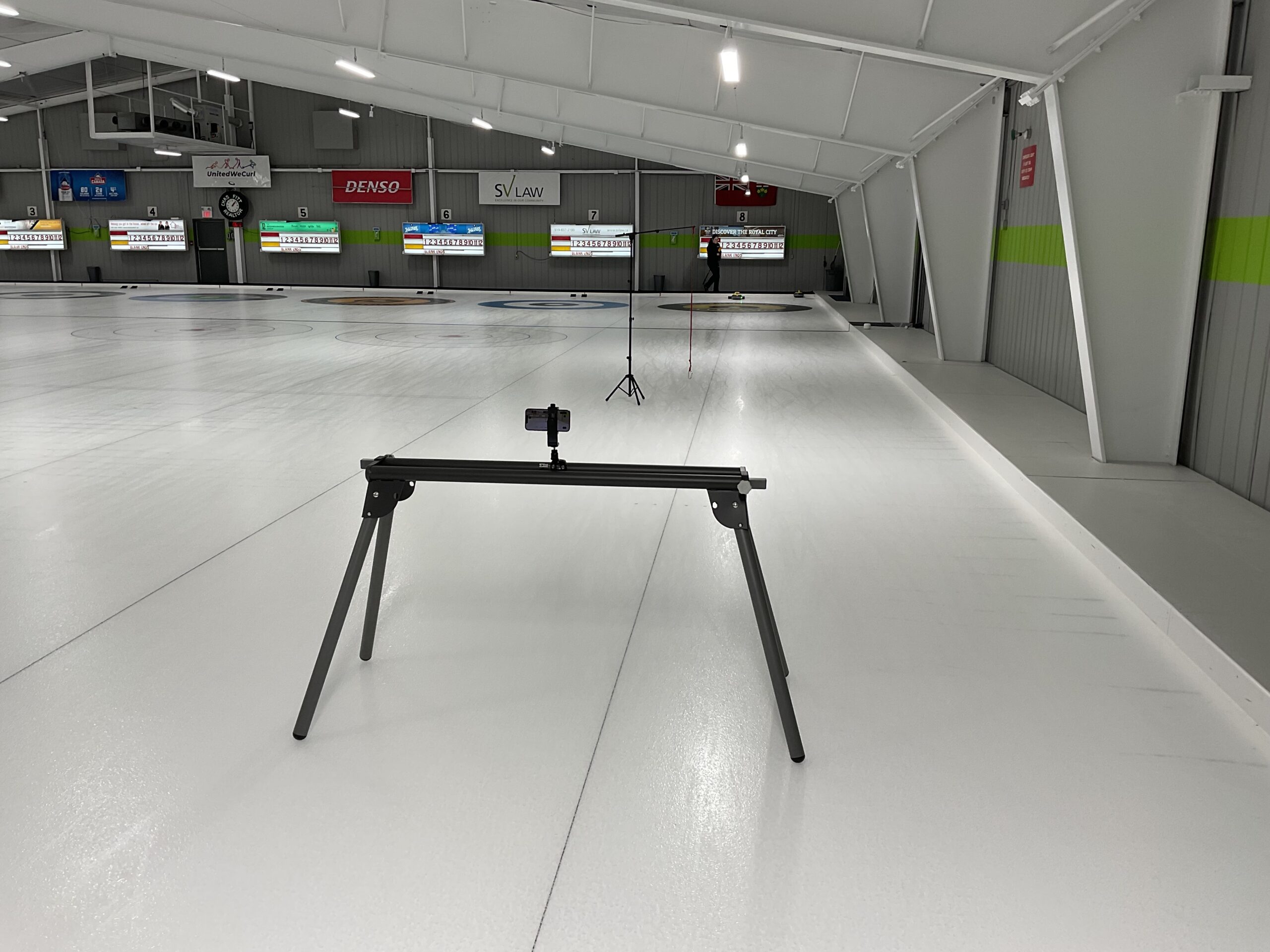
View of equipment setup on the sheet, with the laser located on the far tee-line.
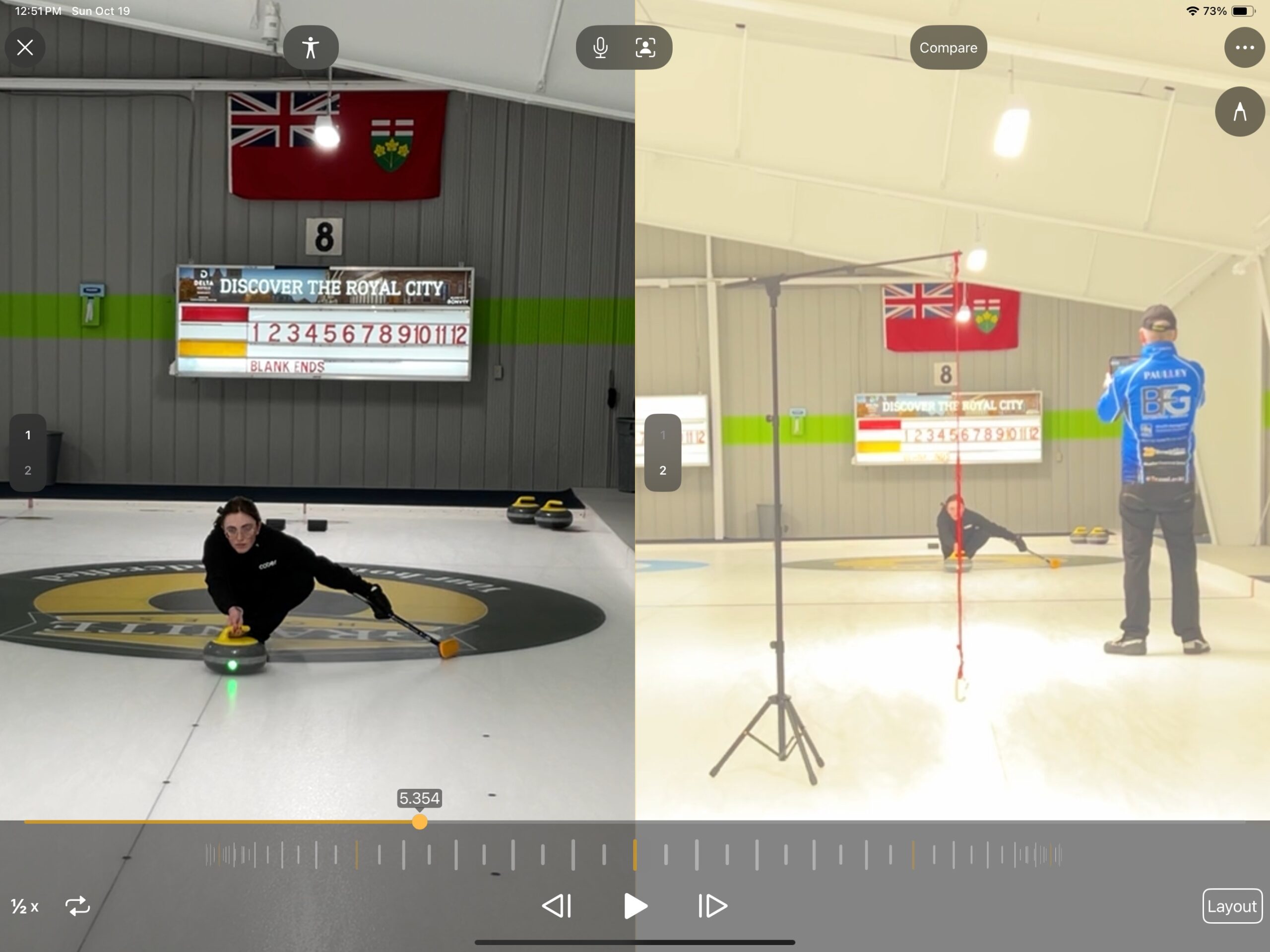
Screenshot of OnForm Multiview output. With two cameras, one can take video from multiple angles with the stationary camera recording the precise view of the LOD from the front.
Analyzing Celeste's Delivery
We held this practice session after noticing some inconsistencies in Celeste’s delivery, particularly with her clockwise release that potentially were related to Celeste’s cross-dominance. In practice, we recorded her delivery at different targets, on both sides of the sheet, with both rotations and at different velocities.
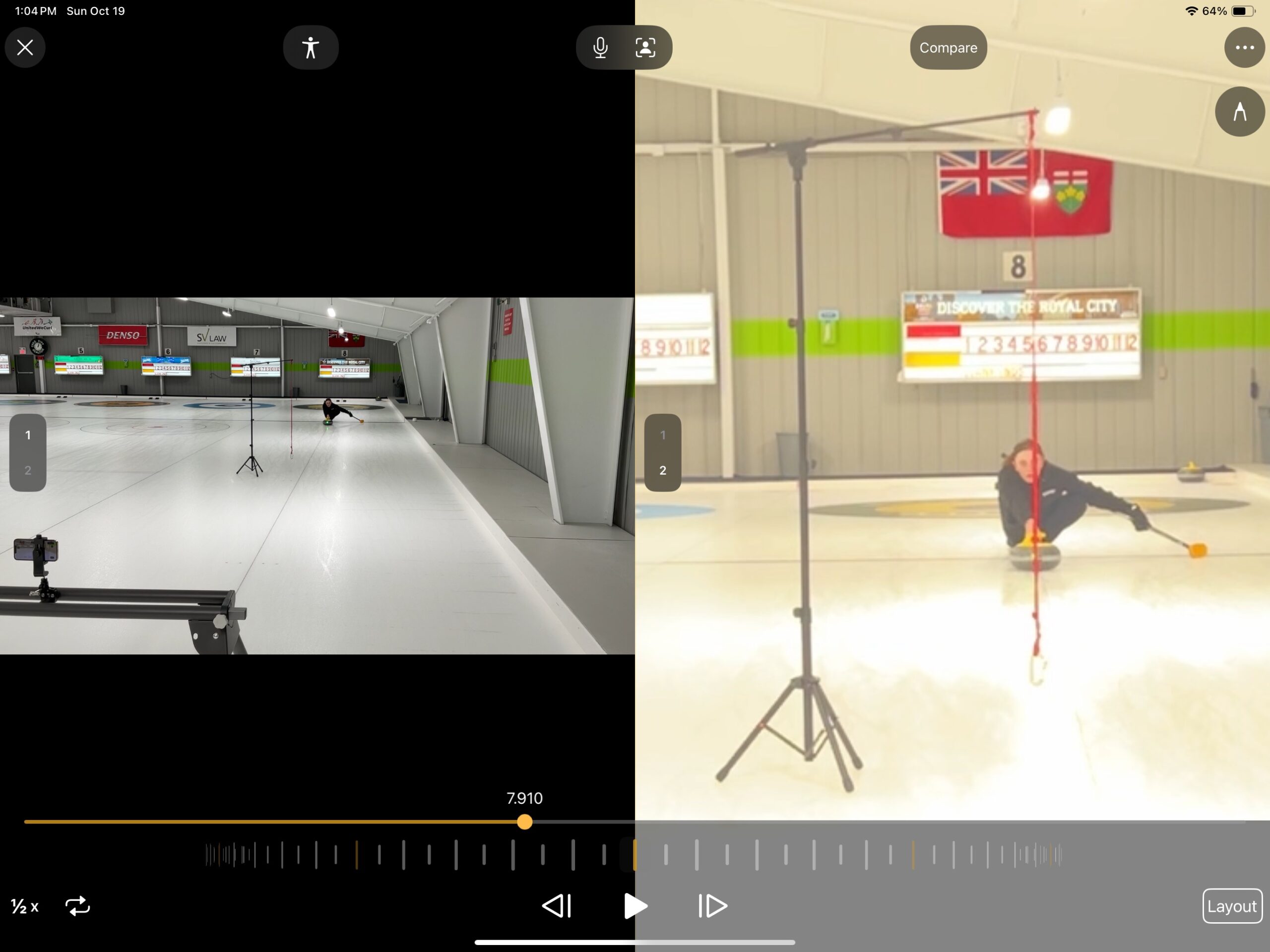
As seen in the still image at right, Celeste’s LOD is perfectly on-line. As she is cross-dominant, Celeste applies delivery strategy #2 (from above) and adjusts her body position slightly to the right as she begins her drive forward, so that by the time she is in the slide phase the stone is aligned underneath her left eye. The reader can verify her rightwards movement by watching the video of her delivery above in slow motion.
That Celeste has to make a minor, and not major, adjustment to her body in the drive phase is due to her setup. The line of delivery (LOD) begins at the centre of the left hack, to which the laser is pointed. The stone never leaves the line of delivery through the entire throw. Anchoring the LOD in the centre of the throwing hack is now the preferred position as per Curling Canada, unless an adjustment is required due to an athlete’s physiology or other factors, including eye dominance.
Summary
As it turns out, Celeste’s throwing inconsistency stemmed from two separate and unrelated issues which were straightforward to diagnose with this apparatus.
Video is an essential element of coaching in curling, whether it be an athlete’s delivery or their brushing technique. OnForm permits the coach to record with more than one camera, and at multiple angles, to provide a comprehensive record of a player’s delivery. For coaches I can offer the following tips:
- Record your athletes’ deliveries when they are throwing well, so that you have a video record of a well-thrown stone with which to compare once any of your athletes begin to suffer from competitive breakdown.
- You are likely to learn at least as much by viewing your athlete’s delivery from behind, instead of from just the front. Multiple camera angles are tremendously useful, and not every camera need be mounted on a tripod.
- Eye dominance can be a confounding factor when trying to analyze a delivery. Know the eye dominance of your athletes before you begin suggesting any changes to their delivery.
- When working with an athlete, record their deliveries with both turns and at different velocities, which will help to diagnose balance and/or timing problems that may be attributed to their setup.