Increasingly, this season I’m witnessing the adoption by Canadian Junior and U18 teams of a brushing tactic used by some teams – mostly, but not exclusively, women’s teams – on the Grand Slam circuit. I’ve nicknamed that tactic “bunny-hop” brushing as it involves the near brusher jumping during the “push” portion of each stroke from a snowplough position. Most often I see the bunny-hop used on guards and draw-weight shots, where the tactic is employed between the far hog line and where the stone comes to rest.
Typically, the bunny-hop is used when the stone requires additional carry, though sometimes the tactic is also used when trying to both extend the carry of a stone and, at the same time, accentuate curl by brushing in the direction of the stone’s rotation.
Carole Howald of Team Tirinzoni uses the “bunny-hop” brushing tactic vs Team Homan in the final of the 2025 AMJ Campbell Players’ Championship.
Rationale
The idea behind the “hop” is to maximize the vertical force generated at the beginning of the “push” portion of a stroke by jumping slightly in the air. In normal brushing it is extremely difficult for an athlete – any athlete – to achieve a vertical force value during the push portion of the stroke that is greater than their body weight. Typically, a top female player will a achieve a push force equivalent to 80%-85% of their body weight (note that in physics and engineering force is measured in Newtons; here we convert force values to their gravitational equivalent in kilograms to simplify the discussion).
In the 3000 or so brushing bouts that John Newhook and I have recorded since 2013, only one (male) athlete could exceed his body weight during the push portion of a stroke: a barely significant value of 101%.
The “bunny hop” tactic is designed to increase the force developed during the push portion of a stroke to a value that is higher than what the athlete would produce otherwise. However, while the “bunny hop”, if executed well, can lead to greater vertical force during the push portion of a stroke, the tactic is not without tradeoffs. Describing those tradeoffs is the purpose of this article. To do so, I am ably assisted by Sarah Leung, who throws lead stones for Team Émilie Lovitt.
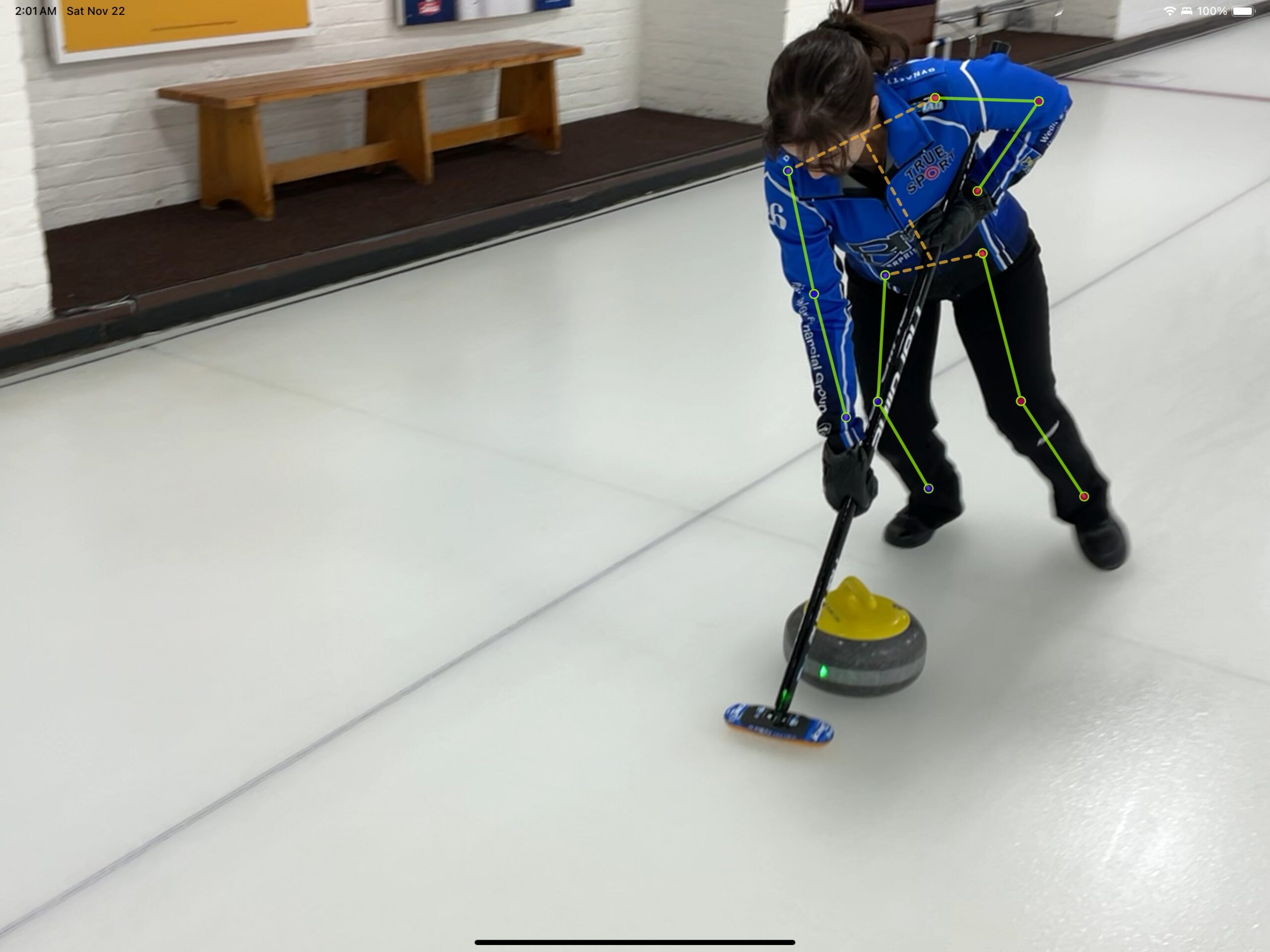
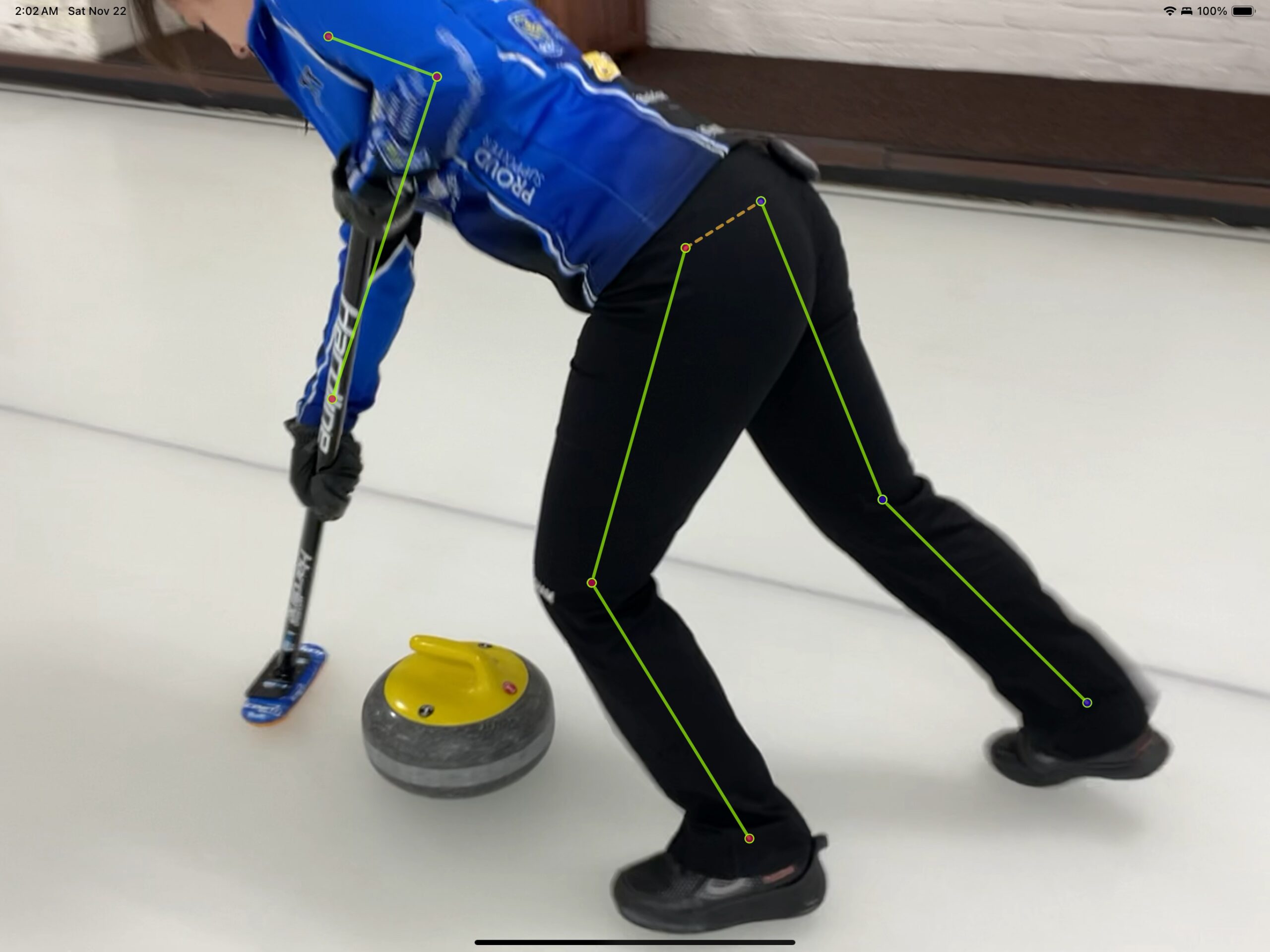
A comparison of the two techniques
Sarah is an athletic 5’7″ athlete who can generate a mean brushing force of 26.1 kg when brushing in a snowplough stance, which is almost 43% of her body weight. That performance easily places Sarah in the top quartile of female U20 athletes (Sarah aged out of Juniors just this season) and is better than the male U20 average. Sarah’s force profile in a snowplough position, shown at right, was captured by John Newhook’s CurlSmart instrumented brush recently at a team practice held at the High Park Club in Toronto. The reader will note that I “clipped” the signal from the brush for analysis for the latter four seconds of the shot, a Zone 3 guard. I did this to compare with Sarah’s results when performing the bunny hop on a subsequent throw, where she started performing the “hop” near the far hog line.
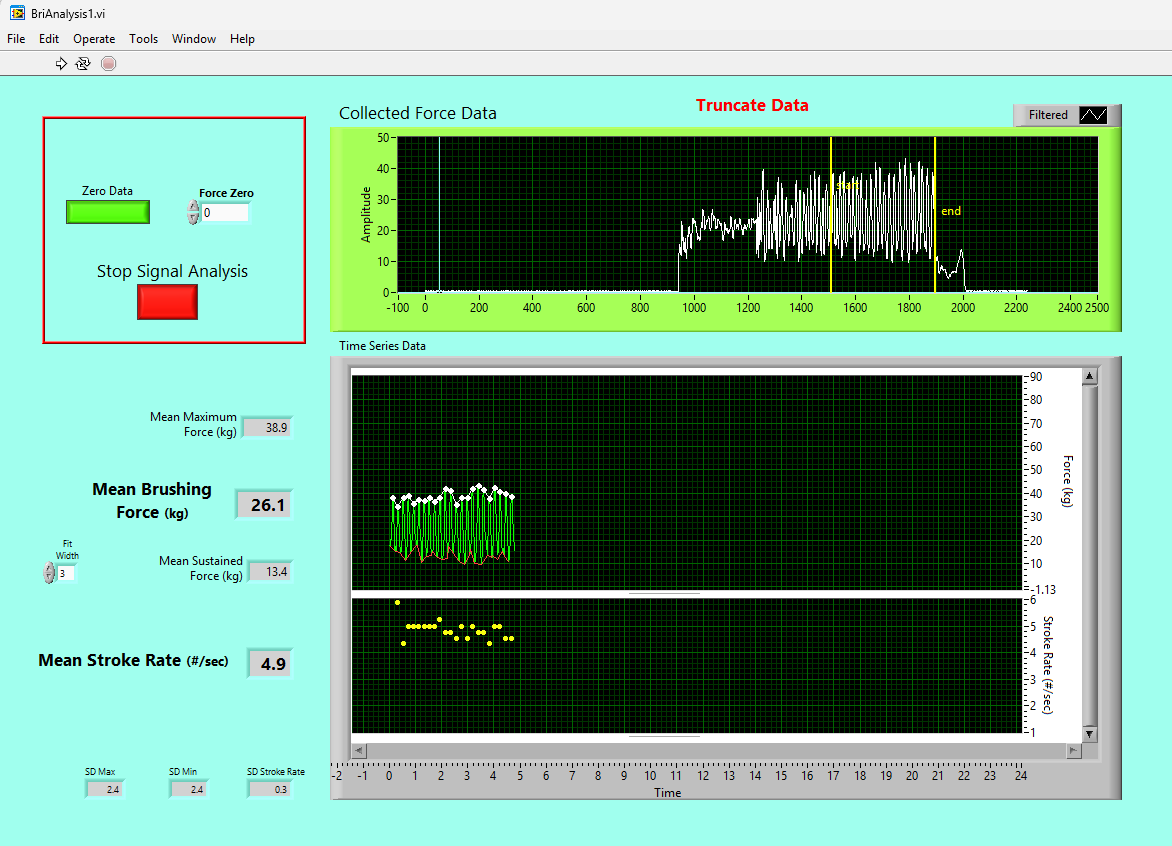
Sarah Leung’s force profile when brushing a Zone 3 guard in a snowplough stance, yielding a mean maximum force of 38.9 kg, a mean sustained force of 13.4 kg, and a mean force of 26.1 kg.
Sarah’s force profile for the subsequent “bunny hop” bout is shown at right. The reader will note the increase in the height of the force envelope. Sarah’s mean maximum force increased during the final seconds of the shot to 44.7 kg, an increase from the 38.9 kg mean maximum force for the profile captured earlier; a 5.8 kg, or 14.9% increase.
However, while mean maximum force did increase as desired, there are two substantive tradeoffs:
- Sarah’s mean sustained force, which is typically the point at which the brush transitions from the “push” portion of the stroke to the “pull” portion of the stroke, dropped to 3.6 kg from 13.4 kg, a drop of 9.8 kg or 272%. In fact, the reader will note that it appears that the sustained forces during the latter part of the bout dip below zero. Indeed this is the case; the CurlSmart brush is recording the lifting of the brush head off of the ice surface – a consequence of the jump – as a negative vertical force value.
- Sarah’s mean stroke rate also decreased, from 4.9 Hz to 3.5 Hz, a drop of 1.4 strokes per second because Sarah has to time her brush strokes to match the lower frequency of her “hops”.
As a result of these tradeoffs, during the end of the shot Sarah’s mean brushing force dropped from 26.1 kg to 24.2 kg, a loss of 1.9 kg or 7.2%.
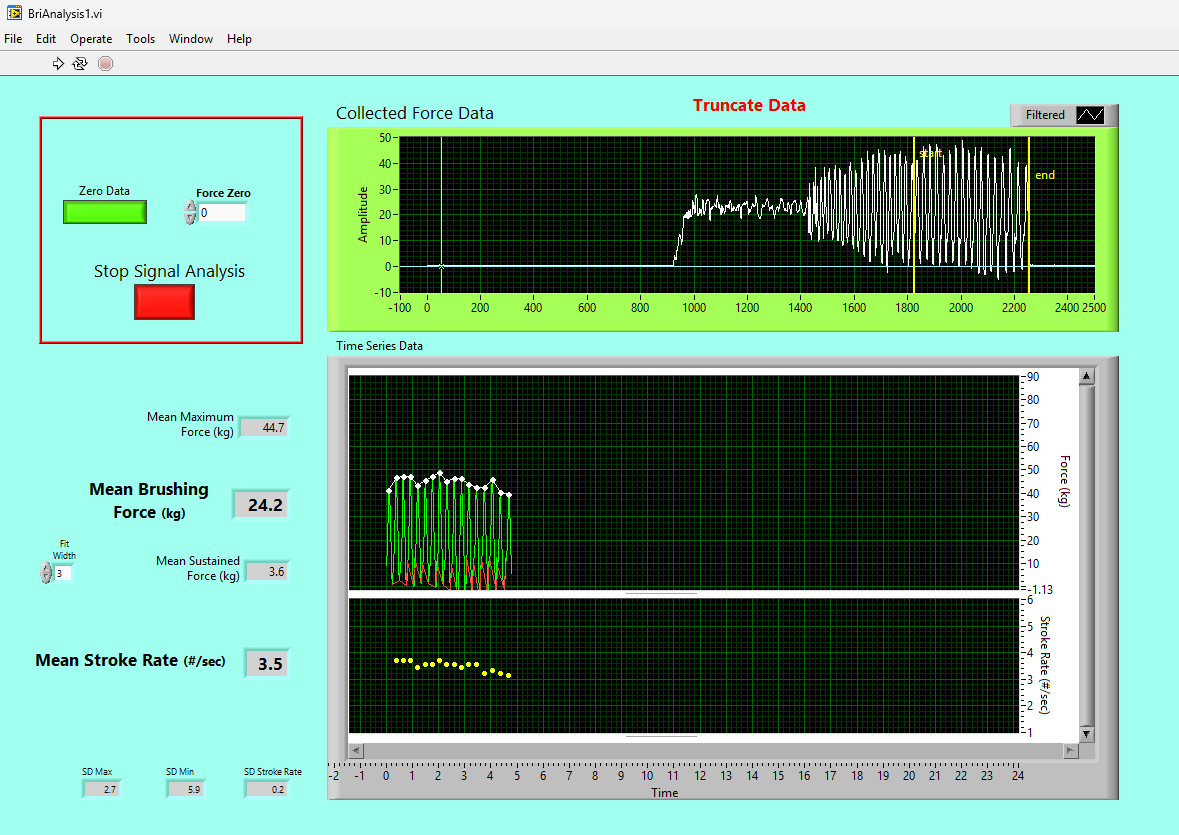
Sarah Leung’s force profile when performing the “bunny hop”. Her mean maximum force has increased to 44.7 kg but her sustained force becomes negative, overall yielding a mean sustained force of only 3.6 kg.
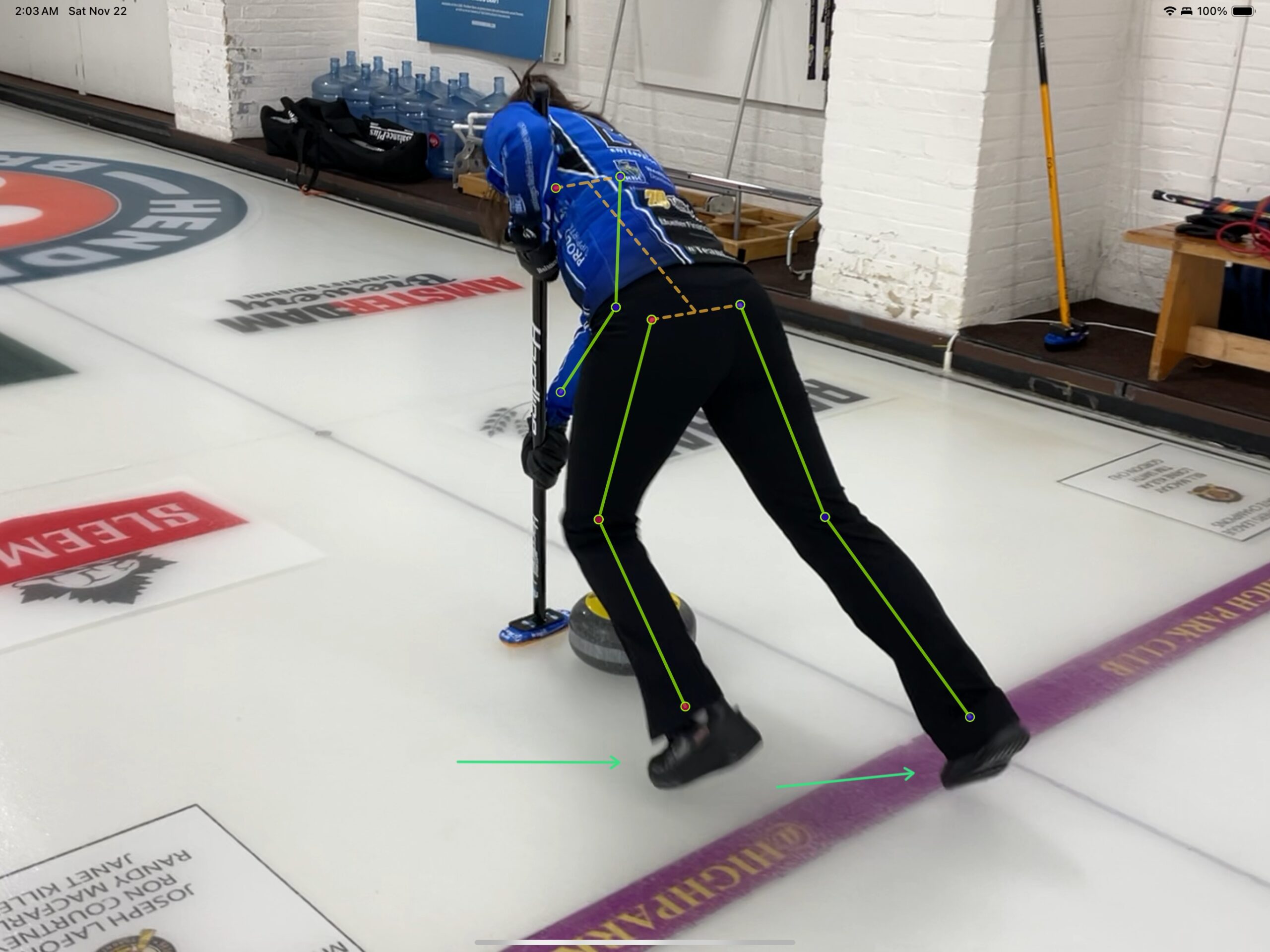
Sarah performing the “bunny hop”. Note that both feet are in the air.
Summary
We know from prior studies of brushing performance that carry distance is positively correlated with mean brushing force. So it would appear that for Sarah the adoption of the “bunny hop” during a guard shot is counterproductive since her mean force is lower by 7.2%. Moreover, because her stroke rate also decreases to 3.5 Hz, Sarah gets fewer overlapping strokes in the front of the stone. This will also negatively impact carry distance because fewer overlapping strokes will lead to less of a raise in pebble temperature to lower the coefficient of friction of the ice. Sarah would be better off improving her biomechanics of her snowplough brushing stance to raise both her maximum and sustained forces through strength training and slightly improved footwork, rather than rely on the “hop” to increase her mean maximum force alone. I will add that it takes a great deal of practice and athleticism to be able to perform the hop when maintaining the feet behind the hips.
Obviously Sarah’s trial at practice constitutes but a single example; we are aware of no published studies or even informal investigations into the merits of the bunny-hop tactic in different situations. Nevertheless, Sarah’s results are what I expected; a slight increase in maximum force, but accompanied by a much lower sustained force and a slower stroke rate to match the movements of her feet.
As we have consistently mentioned, teams should adopt brushing tactics that work for them, rather than simply copy what other teams may be doing. We note that many U20 and U18 women’s teams frequently brush with their feet directly underneath their hips, often using a slider. These biomechanics are not optimal for generating vertical force. Moreover, when players implement the “hop” they are frequently doing so with their feet underneath them, which reduces the amount of vertical force that can be generated for both portions of a brush stroke. Using good fundamentals: keeping shoulders higher than hips, maintaining a plank posture with the feet behind the hips, and keeping the brush head underneath the upper portion of the chest, will help an athlete develop the highest mean force at the time it is most needed.
Finally, I’ll make the following points:
- Not all instrumented brushes may be able to indicate the “lifting” of the brush head during the technique. Instrumented brushes that use load sensors, or that filter the measurements captured by the instrumented brush head through software post-processing, may mask the lifting of the brush by the athlete.
- Nonetheless it is likely, in many cases, that when the bunny-hop is executed the brush head will lift. Technically this is “dumping” – not finishing the brushing with a final movement of the brush to the side. It is hard to see how this could be called anything but dumping, which is against the rules (Rule 11(8)(b) in Curling Canada’s Rules of Curling for Officiated Play).
- It is also likely, especially if the athlete is wearing a slider, that the jumping itself is causing abrasion, or even damage, to the pebble. I don’t have the photography equipment in Waterloo to be able to determine the extent of any damage, but I’m convinced that it’s occurring.