Frequently, the athletes that I work with on brushing – over 550 since the 2014-2015 season – complain about the CurlSmart instrumented brush for two reasons:
- it’s, well, heavy. Including the 9V lithium battery, the CurlSmart brush head weighs 534 g, somewhere between 2x and 3x the typical weight of a commercial brush head due to its steel plate construction.
- The black Cordura nylon fabric on the brush head, which we use for its durability, doesn’t have nearly the same “feel” as a World Curling-approved brush head.
Cordura nylon is used on the CurlSmart brush because replacing the fabric on the brush head is a fairly involved procedure that requires disassembling the head, stapling in the new fabric, and reassembling. Moreover, replacing the fabric usually merits a subsequent calibration test of the brush to ensure that the procedure did not impact the brush’s accuracy.
Nevertheless, we chose to replace the black Cordura nylon with SportLite+ fabric from Balance Plus in order to give athletes a better “feel” when using the CurlSmart brush in training.
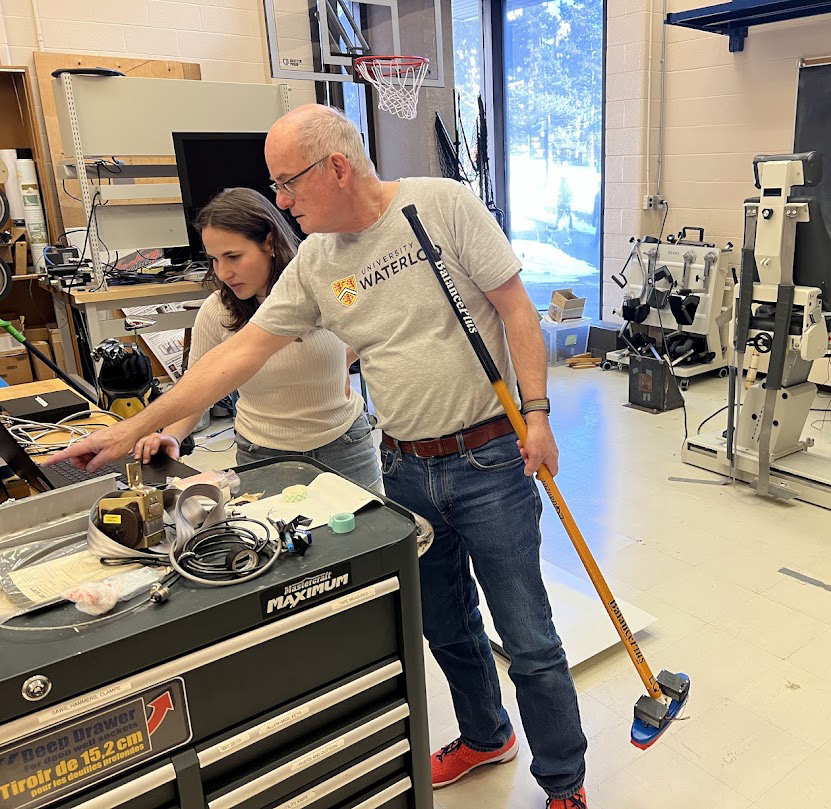
Verifying force plate results in the lab with University of Waterloo Engineering PhD student Bianca Simone. Photo credit: Dr. John McPhee, Canada Research Chair in System Dynamics, University of Waterloo.
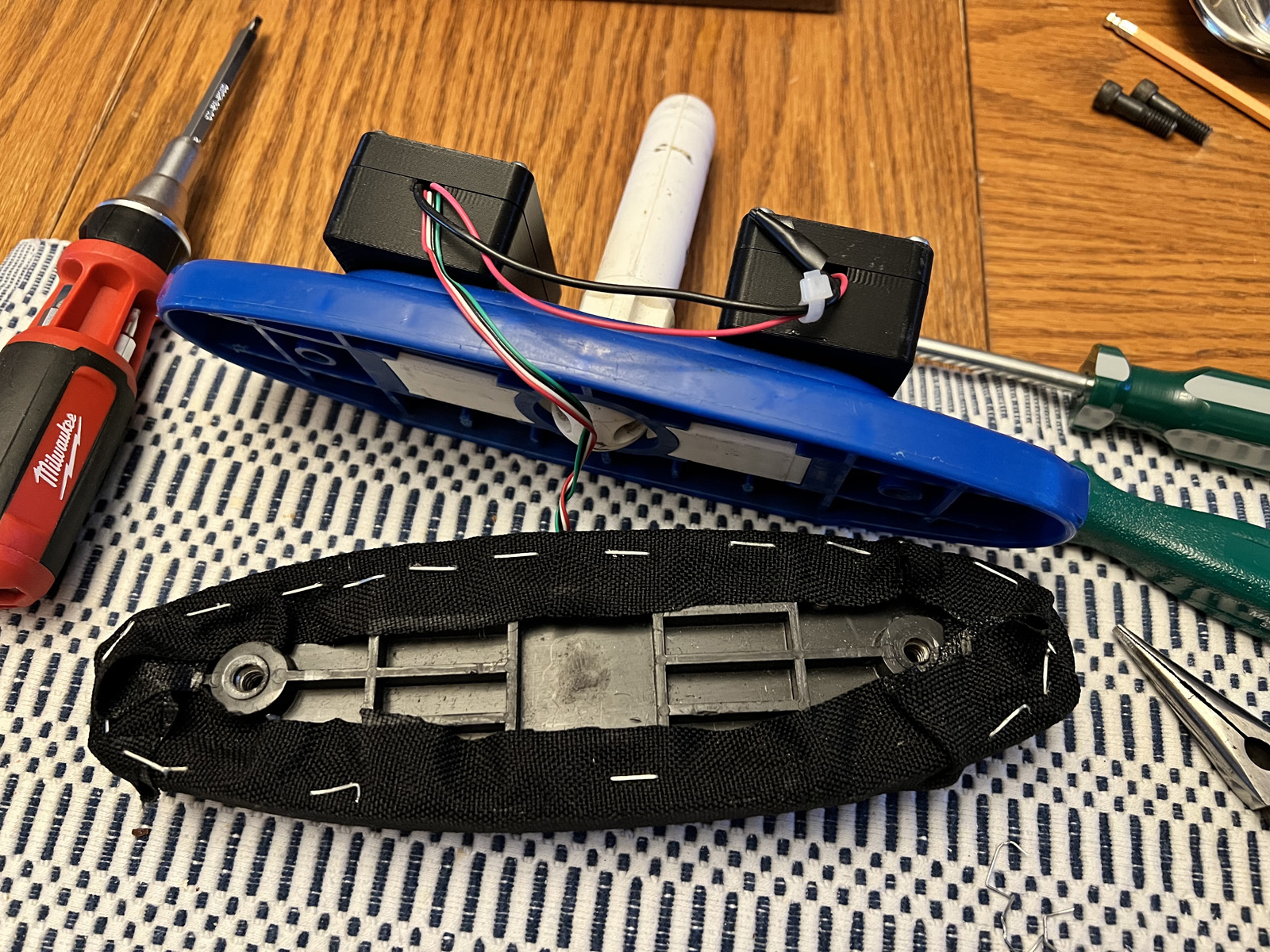
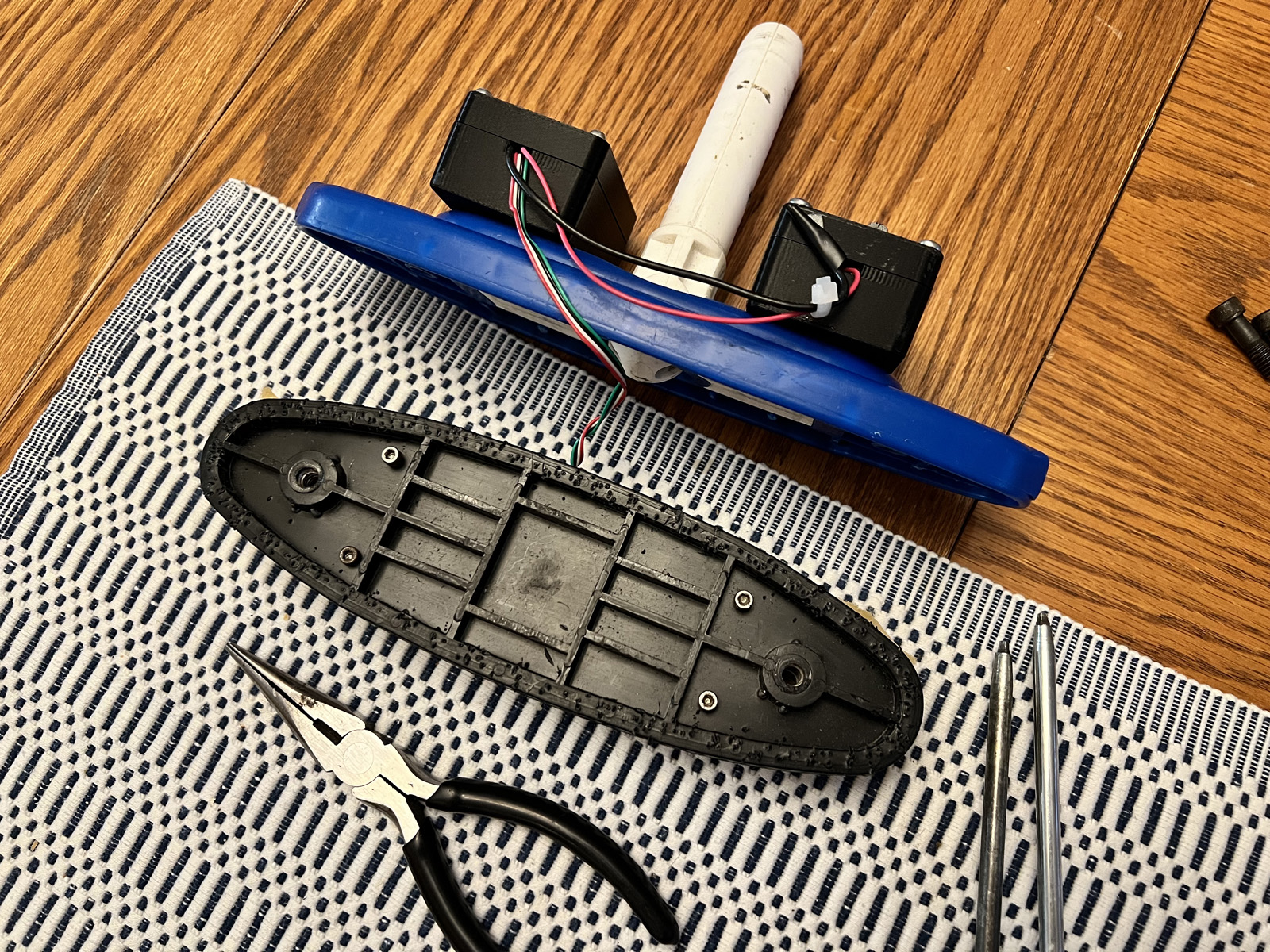
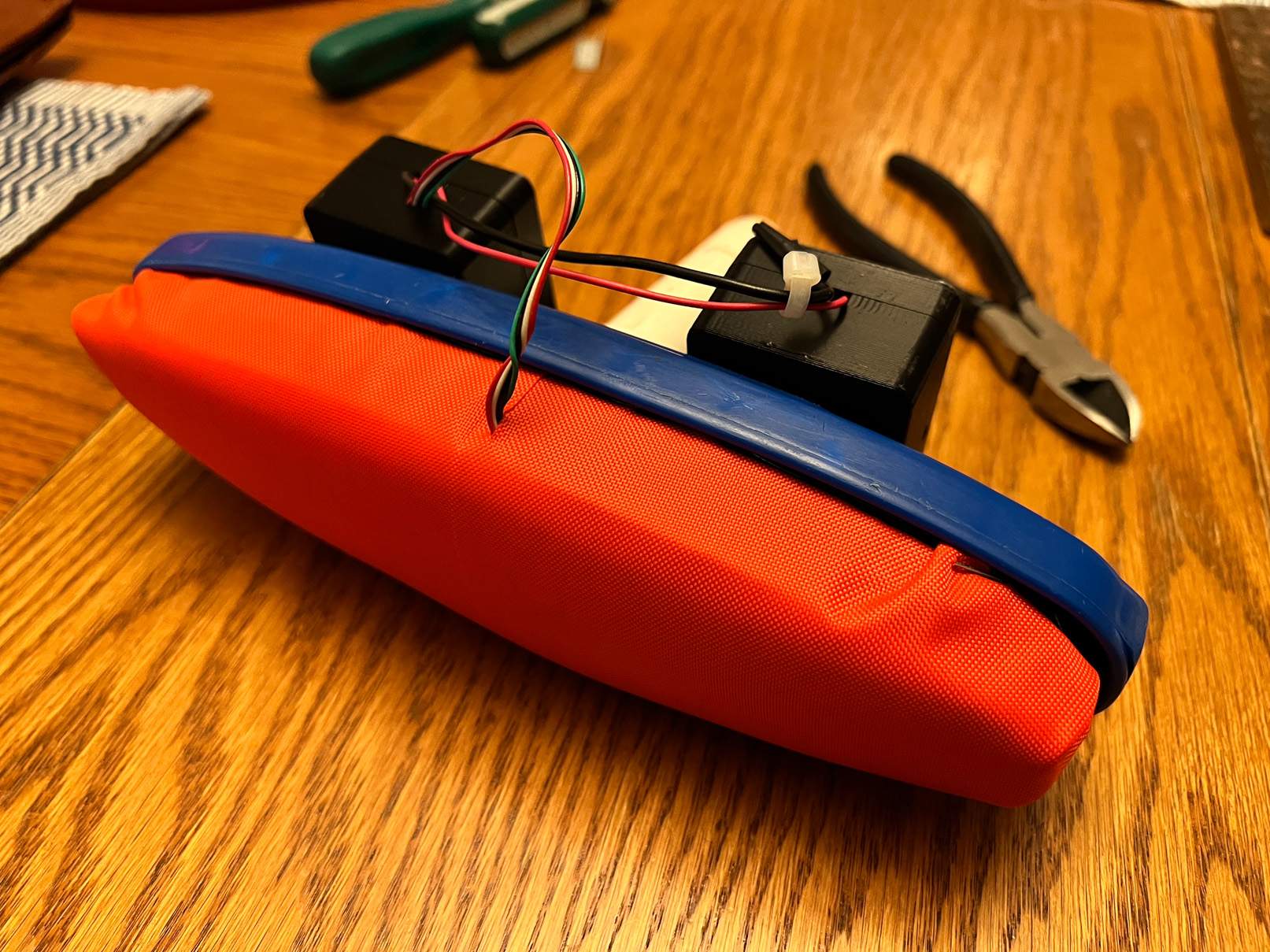
Replacing the black Cordura nylon fabric on the CurlSmart brush with orange SportLite+ fabric from Balance Plus. We are grateful to Dale Matchett of Balance Plus for the sample of SportLite+ fabric to use with the brush.
Calibration setup
As John Newhook and I work with Canadian high-performance teams, including teams in Curling Canada’s National Team Program, we take accuracy very seriously. With high-performance athletes we are frequently looking for fine-grained improvements in single-digit percentages, which is nonetheless important because we know from prior work that, for example, carry distance on a draw-wight shot is proportional to the mean vertical force applied through the brush handle.
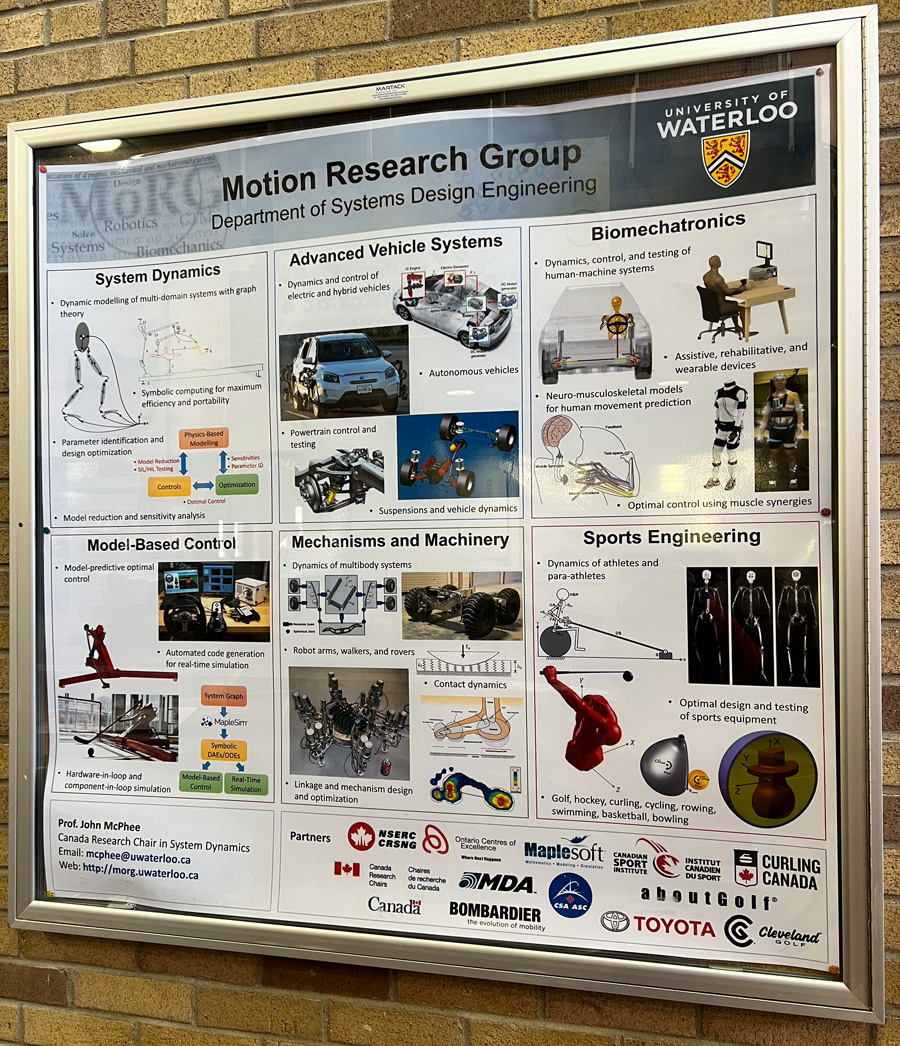
To ensure the brush’s accuracy we reached out to Dr. John McPhee, Canada Research Chair in System Dynamics at the University of Waterloo, to request access to one of his laboratories with which we could test the CurlSmart brush for accuracy once the fabric was replaced. We are grateful to Dr. McPhee, and to his graduate student Bianca Simone, for their assistance in doing the calibration work.
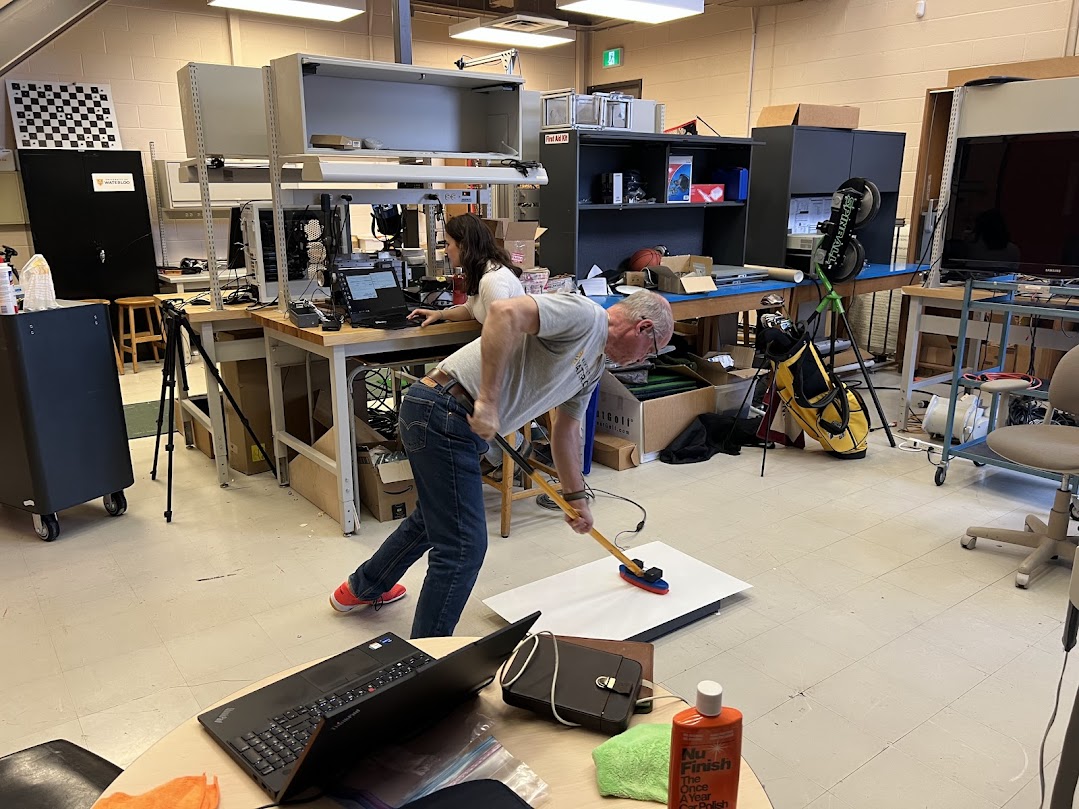
In this bout, maximum effort is applied but the brush is purposefully held at a shallow angle with my top hand near my waist, rather than under my armpit. It is clear from the photograph how the handle bends when brushing in this position, and as such that force does not contribute to vertical force over the brush head.
Photo credit: Dr. John McPhee, University of Waterloo.
For the calibration work we utilized the lab’s Bertec FP5060-06-PT-2000 model force plate, which has a maximum load capacity of 10,000 Newtons. Bianca Simone configured the force plate to record at 100 Hz, the same sampling rate used by the CurlSmart brush. For ease of understanding, the CurlSmart brush output is automatically converted to kilograms. Consequently, the Bertec force plate’s output was similarly converted from Newtons to kilograms to match the output from the brush.
I personally served as the test subject (age: 65; weight: 78.5 kg; height 180 cm) since we were testing the brush rather than any athletes. After recording a few test bouts to ensure that everything was working correctly we proceeded with generating five calibration bouts with varying degrees of effort and varying brush handle angles. We recorded the brush output using the existing brush calibration constant of 0.083, derived from our last calibration experiments performed at Dalhousie University’s BEN lab in the School of Health and Human Performance.
Calibration results
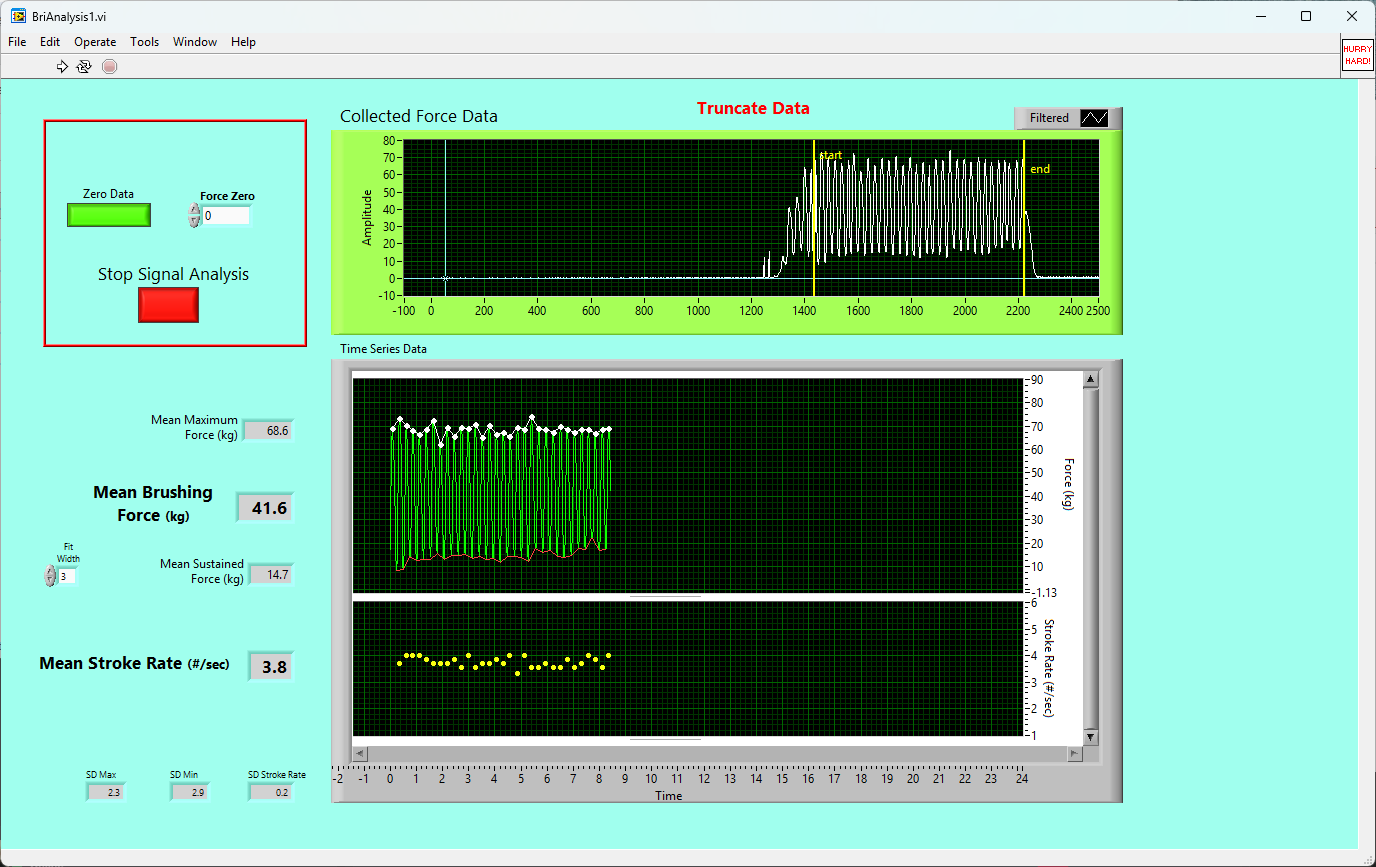
CurlSmart results of this 100% effort bout. Mean maximum force of 68.6 kg, mean sustained force of 14.7 kg, mean force of 41.6 kg, and mean stroke rate of 3.8 Hz.
Click on any of the images for a larger view.
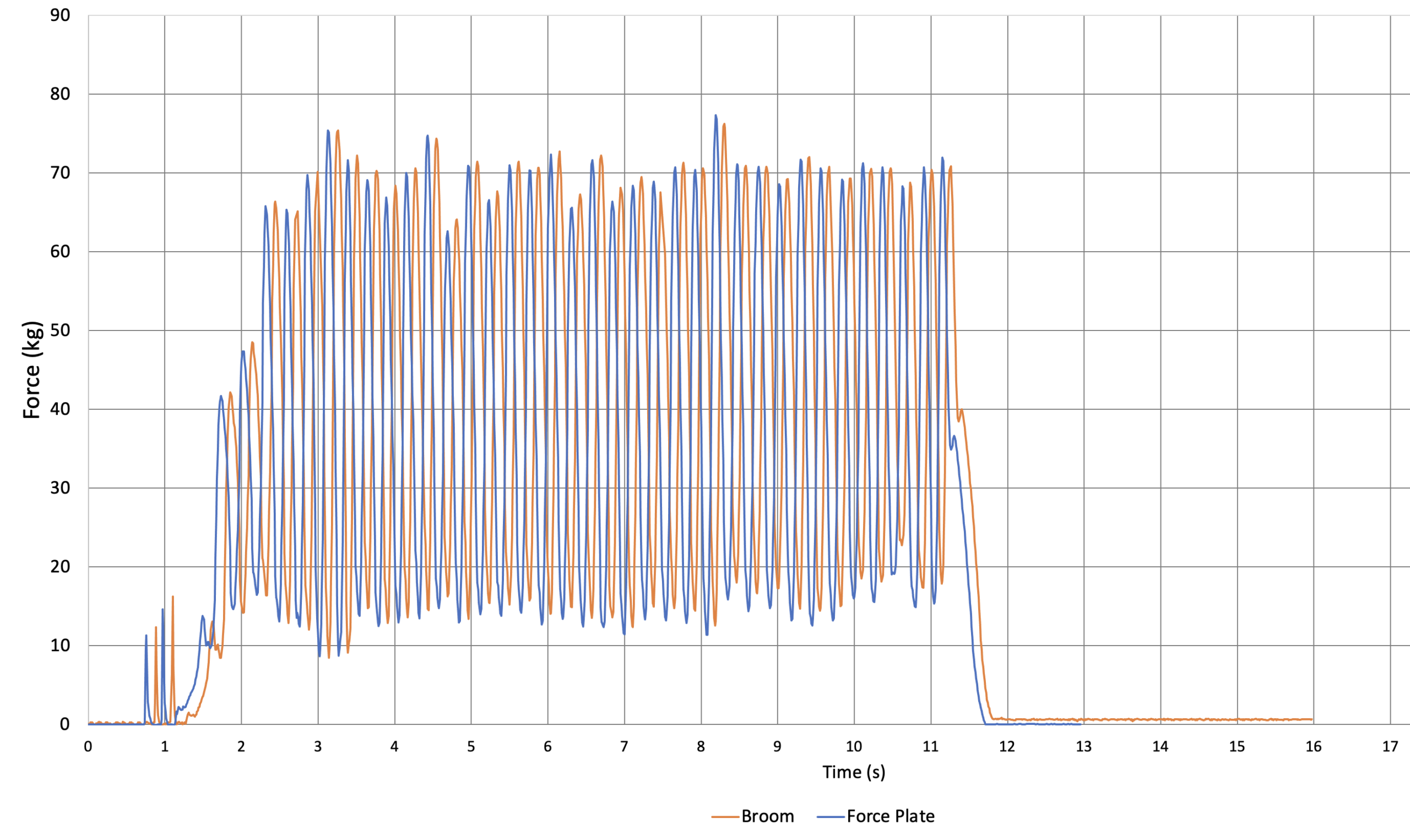
Comparison of CurlSmart output for this bout to that recorded by the force plate. The time series is deliberately offset by approximately 1/10 second so that one can more easily compare the force values recorded by the brush with those recorded by the force plate. This plot uses a brush calibration constant of 0.85 that results in an error of 1.4% for the maximum force value attained during the bout.
Before anyone gets too excited about the numbers I produced during this trial (normalized mean maximum force of 87%; normalized mean sustained force of 18.7%; normalized mean force of 53%) I must mention that brushing in the sport of curling is all about movement. It is much more diffiicult to produce high force values when one is moving with the stone down a sheet of ice than it is to brush a Telfon sheet in a laboratory while maintaining a stationary stance.
As expected, curve fitting for each of the bouts needed some minor customization of the calibration constant from the original value of 0.083. The greatest difference was in the case of a steep brush angle and a small amount of force (equivalent to approximately 20 kg), where a calibration factor of 0.092 was required. Three other bouts are illustrated below, again with the time series deliberately offset for ease of study.
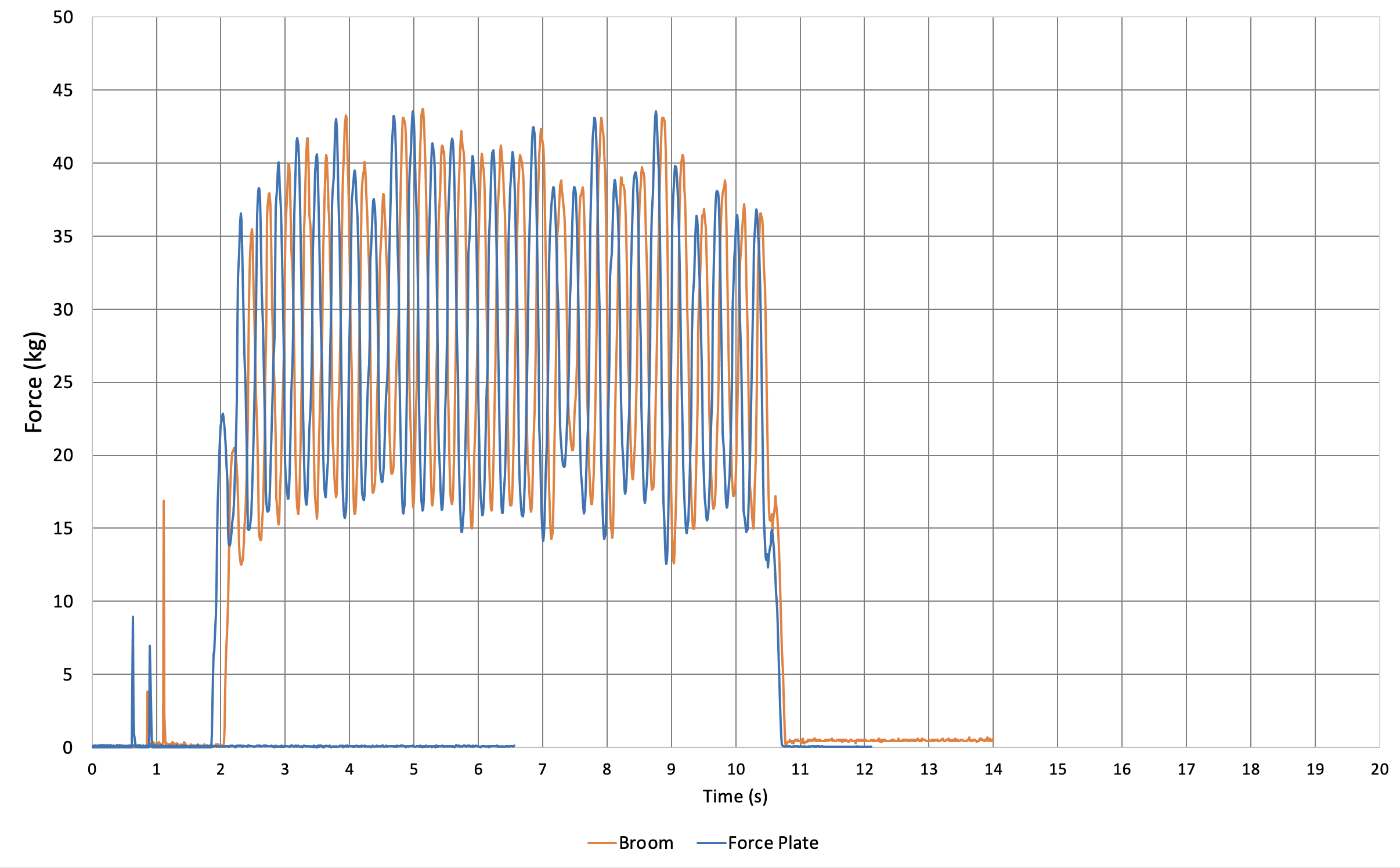
Bout utilizing a shallow handle angle with full 100% effort. Note the difference in force output from the plot above which used a much steeper handle angle. The force plate and CurlSmart curves were matched using a calibration factor of 0.082.
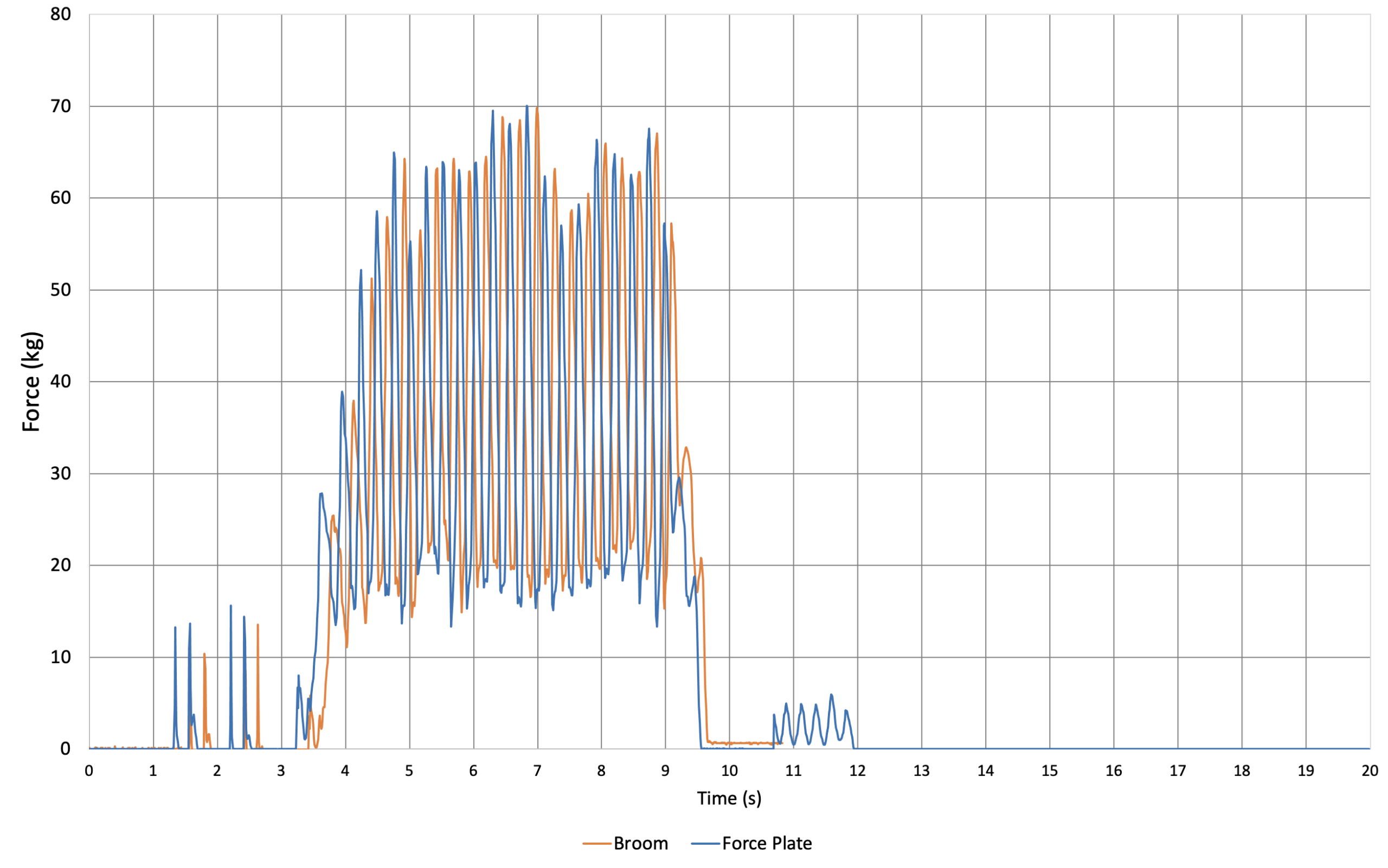
Bout utilizing a steep handle angle at approximately 75% effort. The force plate and CurlSmart curves were matched using a calibration factor of 0.084.
After doing some analysis of the five bouts and the calibration factors used for each, we decided to treat the steep handle angle/minimal force bout as an outlier that would rarely be seen with competitive athletes. Given the minor adjustments to the other four bouts, we have settled on a calibration factor of 0.084 for the new brush head configuration, slightly more than a 1% difference from the previous constant of 0.083. At the new setting, each of the four bouts with higher force values have an error of less than 1 kg for the maximum forces attained, ranging from 0.39 kg to 0.89 kg.
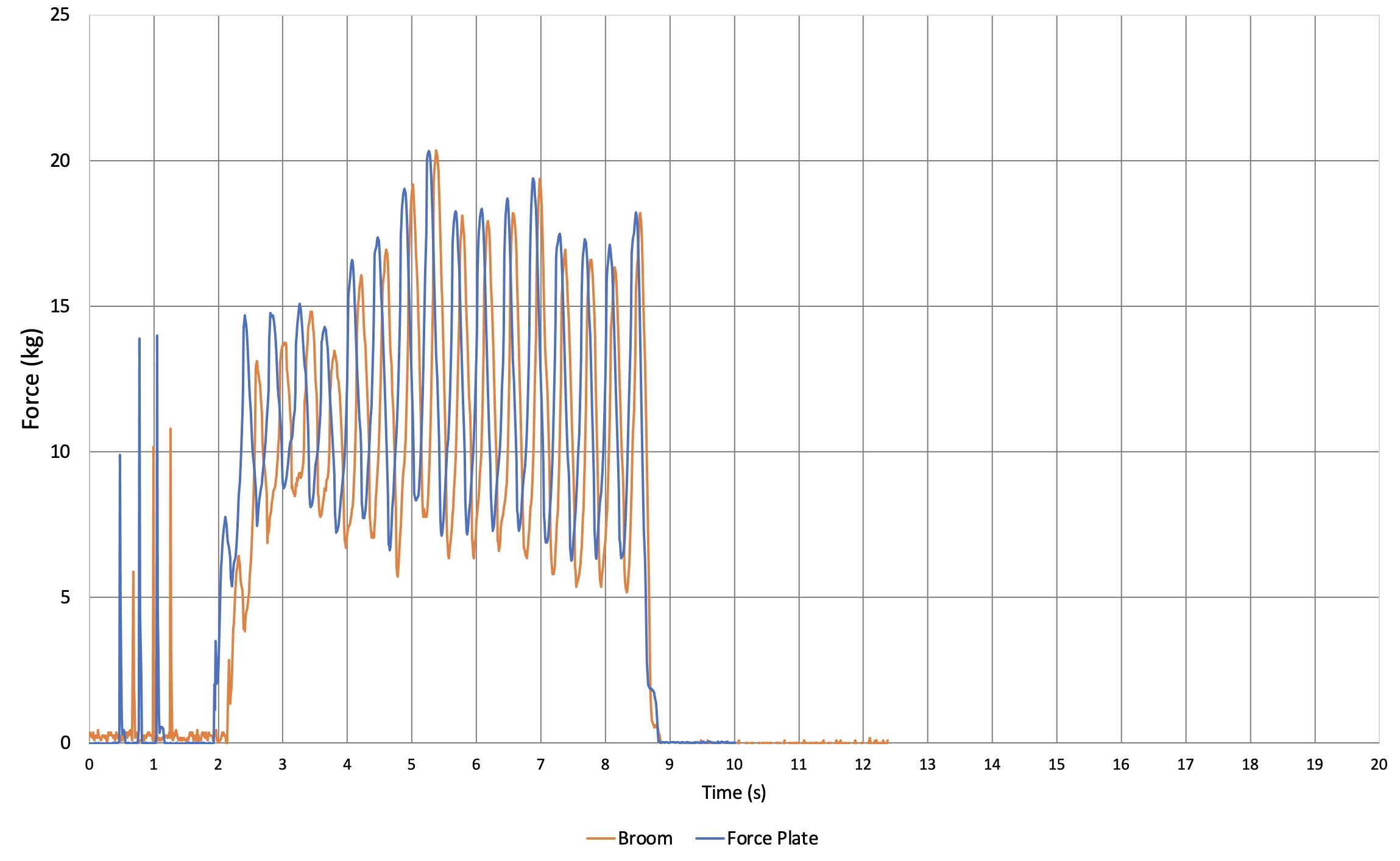
Bout utilizing a shallow handle angle at approximately 25% effort. The force plate and CurlSmart curves were matched using a calibration factor of 0.089.
Acknowledgments
As mentioned previously, we are grateful to Dale Matchett of Balance Plus for the bolt of SportLite+ fabric that we are using with the CurlSmart brush, at least for the moment on a trial basis.
We would also again like to thank Dr. John McPhee of System Design Engineering at the University of Waterloo for his assistance in the calibration effort, and I would like to especially thank John’s graduate student from the department’s Motion Research Group, Bianca Simone, for her kind help and collaboration.
Finally, as always I would like to thank my friend and research colleague, Dr. John Newhook of Dalhousie University’s Faculty of Engineering, for the use of this CurlSmart brush and all of the engineering guidance that he supplies.