On the afternoon of February 19, 2026 I met with Sean Maw and his research team from the University of Saskatchewan, along with Rob Gordon from World Curling, at the Nutana Curling Club in Saskatoon, SK to conduct some preliminary work into the brushing tactic of knifing, and to continue a profiling survey of a selection of Nutana’s curling stones.
Curling stone profiling
One of the many variables to be considered when doing on-ice testing of curling equipment – particularly brushes – is the characteristics of the curling stones being used in the tests: both mass and the roughness of their running bands. Mass is trivial to measure with a standard weigh scale; but having a quantitative measure of a stone’s running band requires a surface roughness profilometer, such as the Mitutoyo SJ-410. The video at right illustrates the output of the SJ-410 on a single path across a curling stone’s running band.
To produce a profile of a stone, the profilometer is used to create eight separate measures across the stone’s running band at equal intervals around the band, every 45 degrees. The eight profiles can then be assessed for anomalies and then statistically analyzed (other work [1] has averaged the different paths across a running band to come up with a single metric for the stone). At Nutana, Sean Maw’s undergraduate research assistants Mahrin Sarhat, Carson Rerup, and Gabrielle Kaban profiled a number of stones for analysis. The trio has been profiling a selection of stones at Nutana systematically over the season to document how the running bands change through usage over time.
The profilometer data taken from the Mitutoyo SJ-410 is important for our ability to correlate brushing results from different time periods, since stones will wear over time, or may again be sandpapered by the ice technician at a subsequent date. In addition, stone profiles become important if we are to be able to correlate brushing results from experiments performed at different curling centres. This work is likely to be of significant interest to ice technicians across Canada, if not internationally, to provide greater insight into stone maintenance and the requirements/parameters for periodic sandpapering to ensure optimal playing conditions.
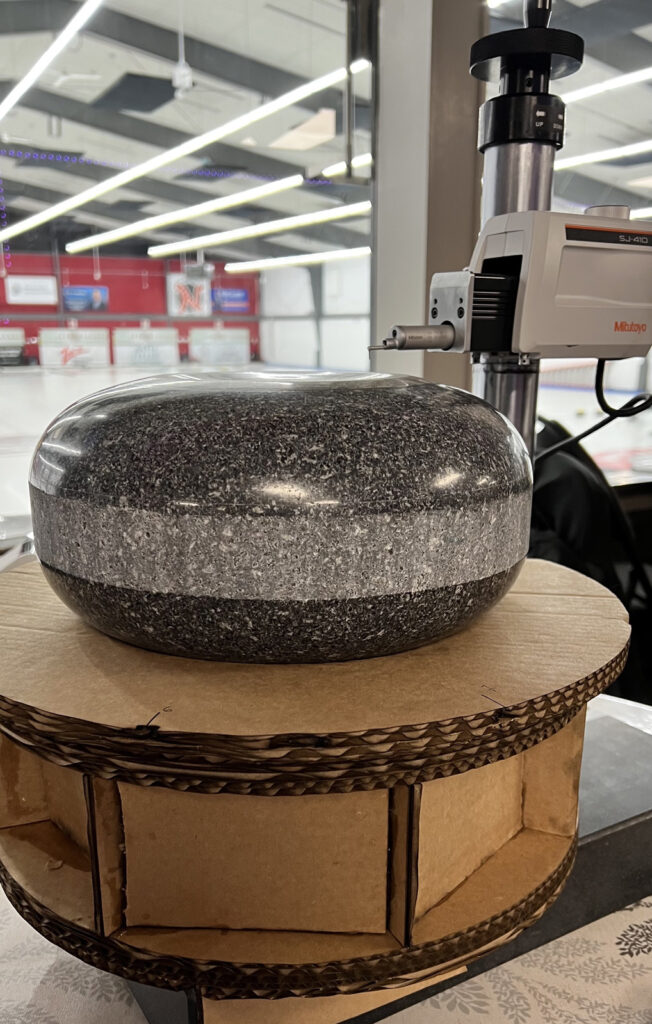
A closeup of the frame used to support a stone during profiling.
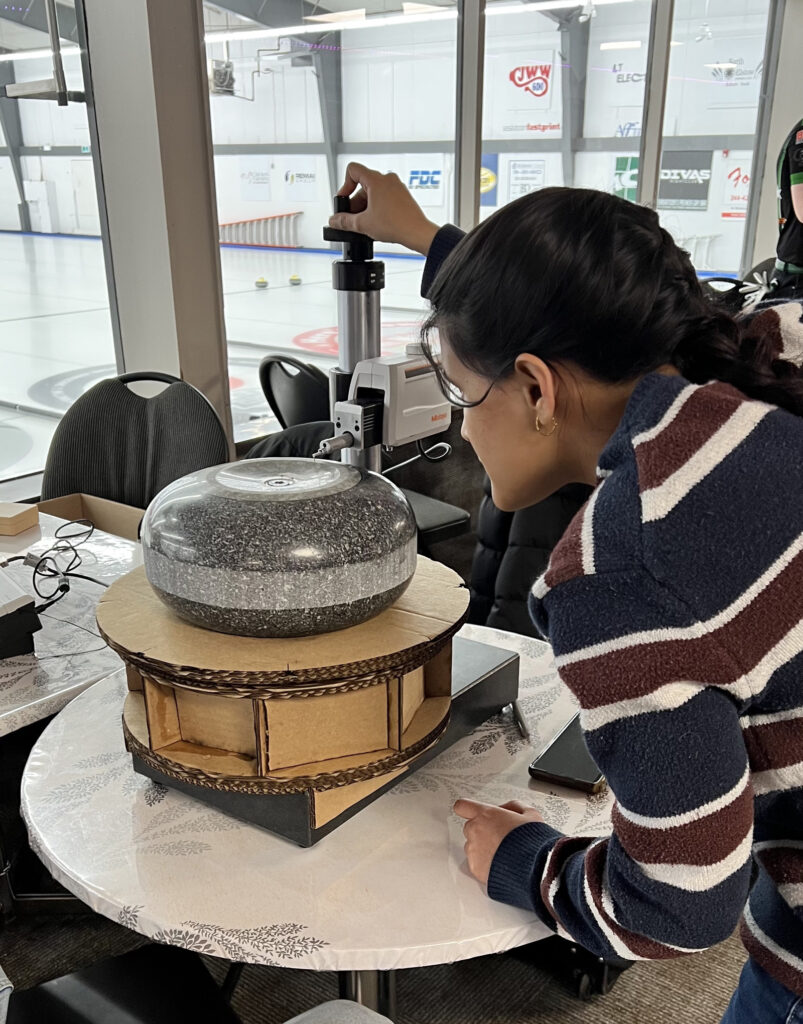
Undergraduate student Mahrin Sarhat aligns the stylus of the Mitutoyo SJ-410 profilometer before another pass is made over this stone’s running band.
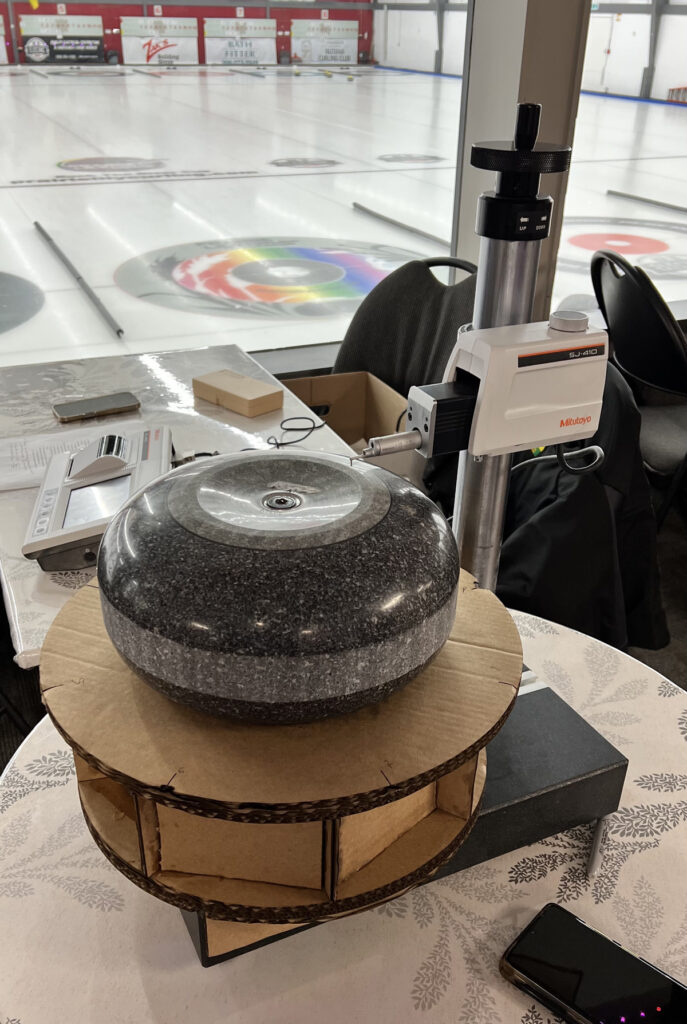
Curling stone with frame and Mitutoyo SJ-410 profilometer setup.
Documenting the effects of knifing on pebble
The second goal of our research day at Nutana was to begin to document the effects of knifing on pebbled ice when the intent of the single brushing stroke – sometimes termed a “squidge” – is to deliberately slow a curling stone. We are aware of several teams that have used this brushing tactic and believe that it works, which is why World Curling banned the single-stroke brushing tactic in the weeks prior to the Cortina Olympic Games.
Nevertheless, despite the anecdotal evidence which prompted the rule change by World Curling, we do not have scientific evidence to quantify and substantiate the effects of such a brushing tactic; hence this preliminary study. To help us with this work, we invited three Saskatchewan athletes to provide their brushing skills for the afternoon: former Saskatchewan men’s champions Rylan Kleiter and Trevor Johnson of Team Kleiter, along with recent national U18 champion Renée Wood from the Sutherland Curling Club in Saskatoon. Regrettably, Renée had to cancel at the last minute.
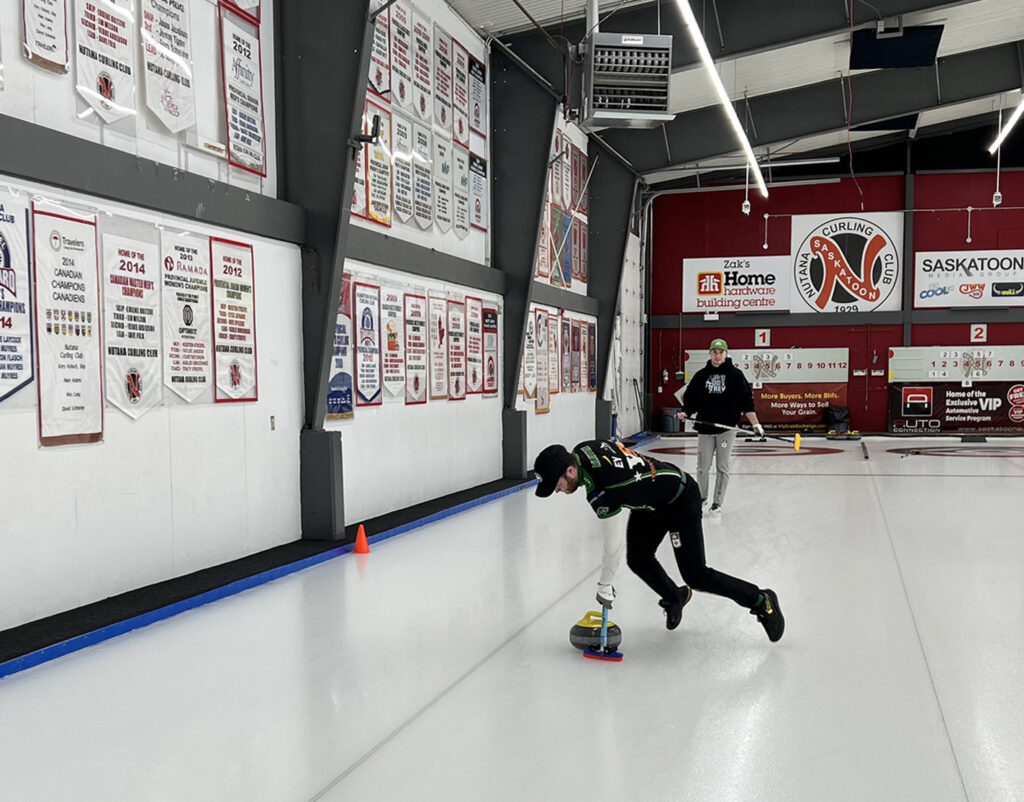
Our testing was divided into two parts. First, Rylan and Trevor were assessed for their brushing forces with various brushing techniques using a CurlSmart instrumented brush. Second, both Trevor and Rylan provided trials of different types of brush strokes (“normal” brushing while moving, knifing while moving with feet on the ice, knifing a single stroke while stationary, and knifing while performing an aggressive “bunny hop” from a standing start) which were recorded using both video and a highly-sensitive FLIR SC645 infrared camera. Tests were conducted with Hardline brushes and Oxford 55 420D yellow mustard fabric approved by World Curling for competitive play.
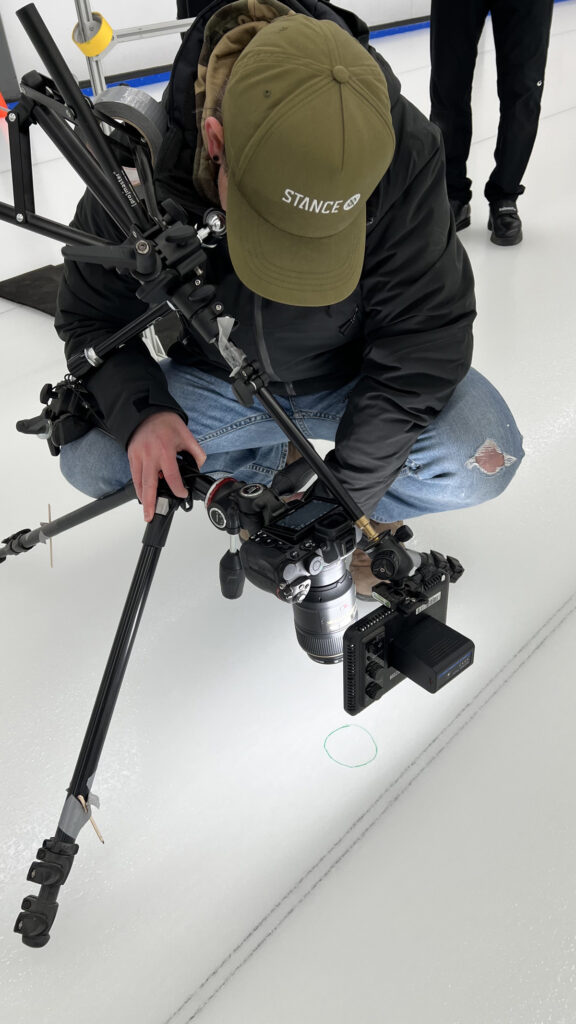
Left: Saskatoon-based professional photographer Derek Elvin photographs an outlined, circular patch of pebble with a full-frame Nikon camera with 100mm macro lens and a customized lighting setup.
Above: testing Rylan Kleiter’s brushing performance with a CurlSmart instrumented brush. Photo credit: Rob Gordon of World Curling.
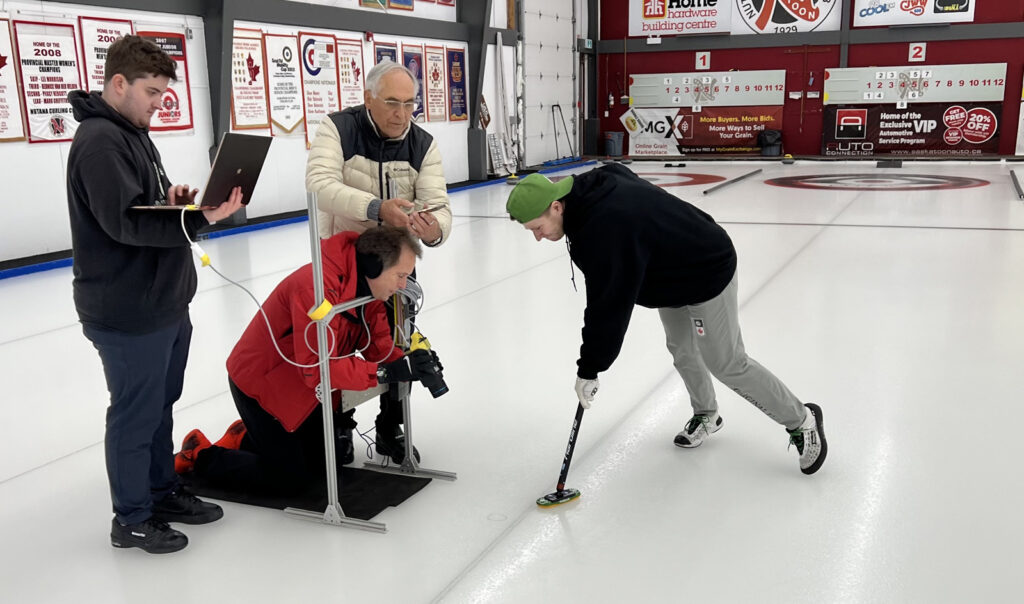
Trevor Johnson of Team Kleiter performs a single “squidge” stroke over a patch of ice while filmed by Eugene Hritzuk, while Sean Maw and undergraduate research assistant Corin Acton record the infrared (IR) heat signature from the stroke.
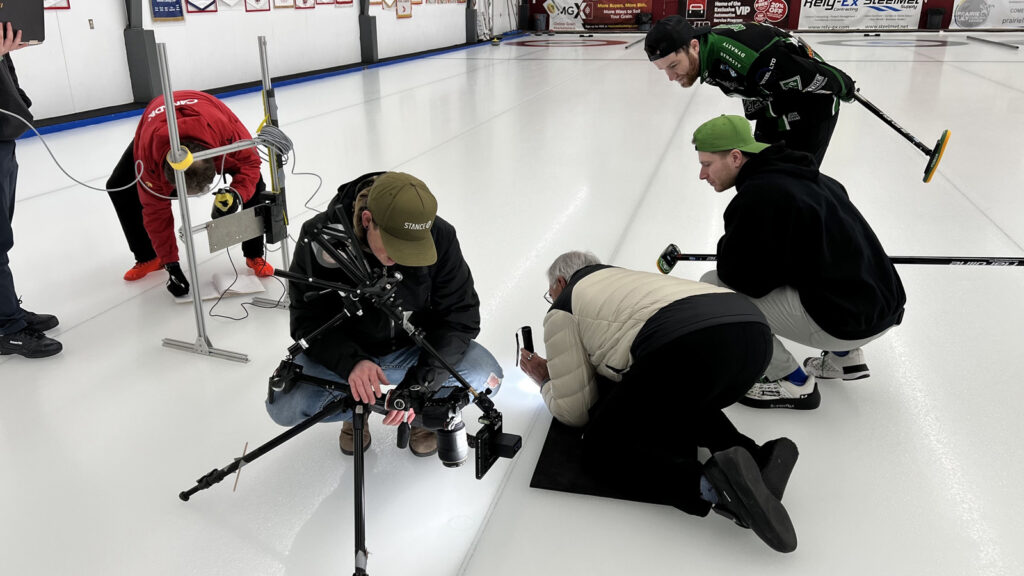
While Derek Elvin photographs the previous trial, Eugene Hritzuk scans for the next patch of ice for the subsequent trial while Trevor Johnson and Rylan Kleiter of Team Kleiter look on.
Undergraduate research assistant Corin Acton manages the infrared (IR) data collection for this project. Ordinarily the IR camera is usually mounted on a stationary tripod, but for safety reasons for these trials we resorted to hand-holding the camera. A challenge during data collection is to avoid having the brush strike the camera (or its mount); another challenge is to filter out frames where the brush head or handle are present, as the “warm” brush washes out the rest of the image. After data capture, Corin and Dr. Maw discuss different ways to produce the desired statistics from each bout, using ImageJ software and some supplementary image processing.
Sean writes: “In general, we have two approaches to IR data analysis: i) take averages of areas (vertical boxes, horizontal boxes) and ii) track the value of a pixel from a pebble head across a series of images. The area analysis works well, but it underestimates heating effects because such averages include temperatures of base ice. Tracking the values of pixels across images is great, but one has to be careful about spurious effects (like a broom being in an image) and unless you evaluate dozens of individual pebble heads, you might not get representative ones. Extracting these types of data from the images for a given experimental condition, we then combine (average) the data across multiple trials of the same condition. We do the same for other conditions (e.g. different brushing styles) and then compare conditions. Results using these procedures have been encouraging thus far.”
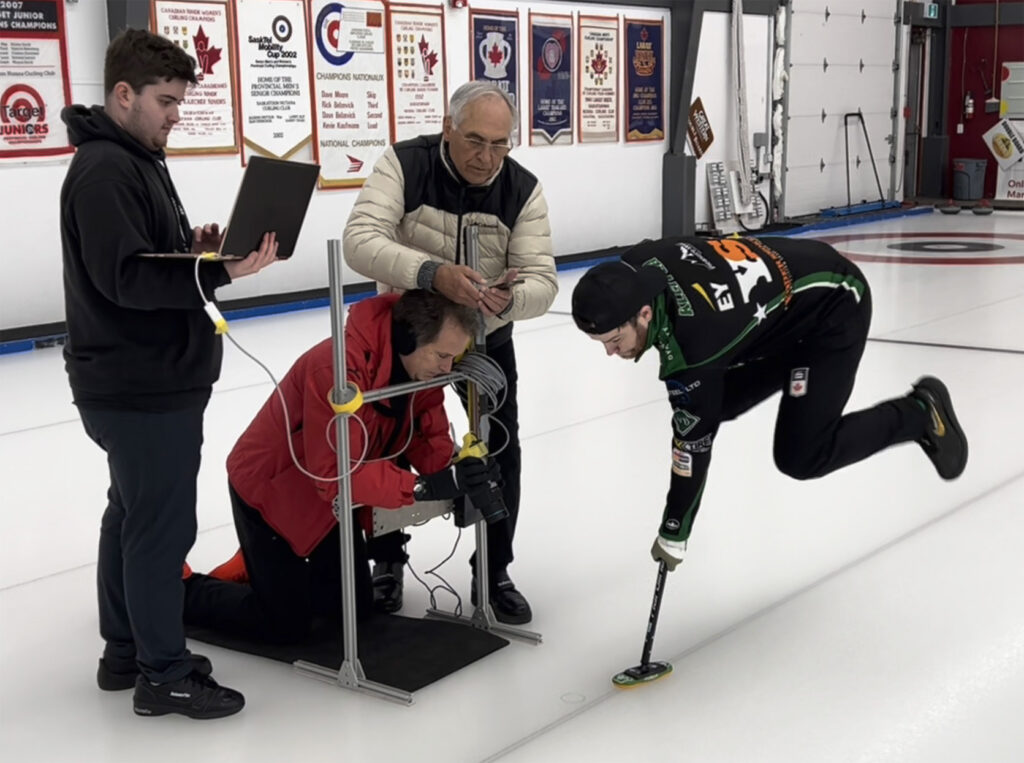
Rylan Kleiter attempts to duplicate the aggressive “hop” technique while knifing.
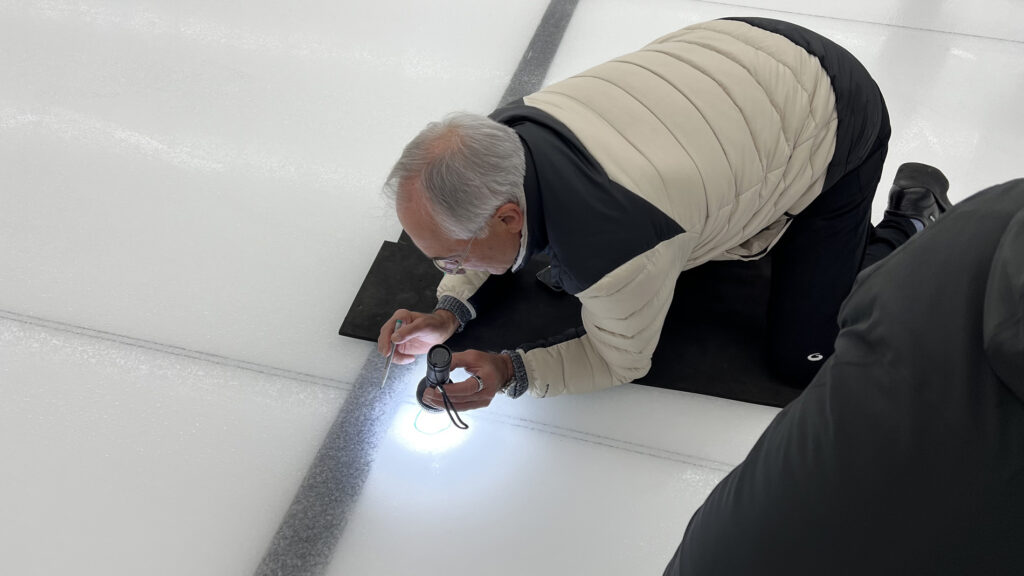
With a flashlight, Eugene Hritzuk scans for a suitable patch of nipped pebble for the next brushing trial.
Our hope with this analysis is that we can provide some additional insight into brushing effects, and provide support to World Curling through the anticipated equipment and specification changes through the next year and the next Olympic cycle.
Acknowledgements
Our thanks to Rylan Kleiter and Trevor Johnson of Team Kleiter for their invaluable assistance in providing us with experimental data for analysis. Thanks as well to the Nutana Curling Club in Saskatoon, especially head ice technician Lawrence Kucheran, for hosting us while performing this work.
References
[1] Kameda, T., D Shikano, Y Harada, S. Yanagi, and K. Sado (November 2020). The importance of the surface roughness and running band area on the bottom of a stone for the curling phenomenon. Scientific Reports 10, 20637 (2020). https://doi.org/10.1038/s41598-020-76660-8.