Zeroing a PT-2 Smartbroom
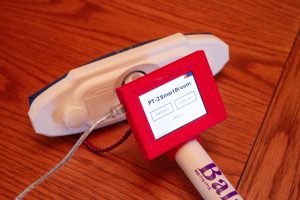
Even though the PT-2 has been discontinued by Canadian Curling Tools in favour of their new “Smartbroom” device, a number of curling associations and individual coaches continue to use PT-2 instrumented brushes with their teams. A characteristic of the PT-2 that coaches must be aware of is the frequent need to “zero” the PT-2 brush to ensure that the force readings from the brush are as accurate as possible. The need for this is because the PT-2’s load sensors are cemented into the brush’s EQ brush pad, and over-tightening of the bolts that fix the brush pad in place can result in skewed measurements. As I’ve been asked a few times about the zeroing method for the PT-2 I decided to post this article. PT-2 documentation is no longer available on the Canadian Curling Tools website. To zero a PT-2 brush, follow these steps: Ensure that the brush head is plugged into the PT-2’s display unit, and the unit is
Brush head mass – a short survey
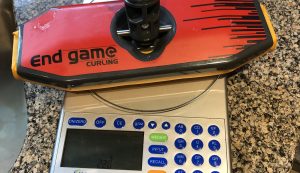
During my talk at the online Adapting/Thriving 2021 Conference presented by the Ontario Curling Council, and other provincial sport organizations, I made several statements regarding potential parameters to the selection of a brush, among them being the size of the brush pad and its contact area with the ice. Even though WCF-approved brush heads and pads all utilize the same Oxford 55 420D yellow nylon fabric, and are tested by the National Research Council for compliance with World Curling Federation specifications, there are differences amongst the available products. Some brush pads have an integrated design, comprising the base, foam, and fabric as a single unit, whereas other brush pad designs use separate components so that the Oxford 55 fabric can be replaced independently of the foam or base. Perhaps the most interesting brush to do this is the End Game brush from Madison, Wisconsin, where the replacement fabric comes simply in die-cut sheets of Oxford 55 nylon. With the End
How far can one carry a stone via brushing?
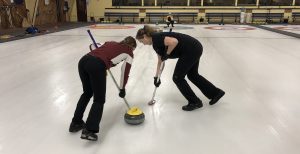
After questions regarding directional brushing, perhaps the second-most often asked question I receive is the question of how much distance brushing can add to the trajectory of a stone. While it is tempting to consider a cut-and-dried response, the issues involved in brushing are both complex and incompletely understood, since we are still researching the physics behind what makes a curling stone “curl” in the first place. Experienced players know that under some conditions it seems that brushing can carry a stone a significant additional distance, yet at other times it doesn’t seem to matter how hard one brushes, the impact upon the stone’s travel is minimal. Answering the question of brushing impact involves an analysis of three significant variables: the characteristics of the ice surface, and the corresponding environment within the arena; the characteristics of the curling stones themselves, and how they were thrown; and the abilities and techniques of the player(s) involved in brushing. Let’s look at these

Summer training plans for front-end players
As I write this, I am a mere four weeks from returning to the ice at the Curling Canada NextGen camp, to be held at the K-W Granite Club here in Waterloo. The OJCT Tour will begin Labour Day weekend – just six weeks away. With the competitive U21 season in Ontario so compressed – 12 weeks between Labour Day and U-21 qualifiers – the summer months are THE time to improve one’s fitness, enhance flexibility, and permit injuries to heal. Between the demands of post-secondary school and the competitive season, there will be little time to improve one’s fitness during the fall semester. Rather, the best one can hope for is to maintain the elevated fitness levels achieved during the summer months through the competitive season. Every competitive player should have a summer training plan designed by a qualified personal trainer or kinesiologist. While a “generic” training plan is slightly less costly, ideally a customized plan designed for you
The technique of brushing
While attending the Level 3 Technical coaching course in Napanee the last weekend in October, Brian Savill gave us a one-hour “Sweeping Update”, summarizing the latest research undertaken at the University of Western Ontario on the mechanics of brushing and its best practices. I’d like to summarize Brian’s remarks here. There is some other online material available about the UWO study, including a useful article by Scott Arnold of the World Curling Federation. Qualities of effective sweeping To be effective, sweeping requires the optimization and balance of the following factors: Downward pressure Brushing technique: Orientation of the broom Brush-head speed Length of brushing stroke Proximity of the brush to the stone Orientation of the two sweepers, both to maximize effect and minimize the risk of touching any stone Weight judgment Communication amongst all four players Footwork: Being able to keep up with the stone, even if thrown with peel weight Negotiating around guards while still sweeping Effective footwork in both
It’s the end of May – now what?
It’s the last week of May. You put your brush and your curling shoes away six weeks ago after the end of another season. Six weeks of, hopefully, rest and recuperation away from the curling rink. But it’s important to stay active over the summer months to stay in shape. Last week I stumbled over an article by P. J. Wren entitled Shape Up for Winter Sports and published in Alive magazine. In that article, Wren describes a variety of simple exercises that can help avoid delayed-onset-muscle-soreness (DOMS) at the beginning of the season: DOMS is that nasty aching and stiffness that you experience a day or two after either learning one of these new sports, or after the first day of performing the sport after an extended break. In addition to muscle soreness, DOMS is also responsible for making you wonder, “How am I ever going to get back up again?” as you sit down gingerly at the breakfast