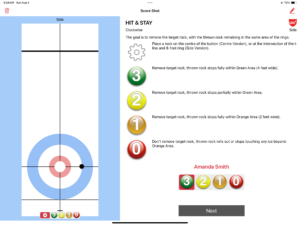
Curling Canada’s Singles App
Curling Canada’s Singles app, a free application for both Apple and Android devices, permits an athlete or a coach to evaluate their shot-making skills and record and review results through a season. In addition, athlete and team scores can be compared to other athletes across Canada. In my experience, the existence of the Singles app is unknown to many coaches, especially U15 or U18 coaches who are new to coaching; hence this article. The Singles application leads an athlete or coach through specific shots whose number and level of difficulty are pre-determined by the age range(s) of the athletes: U15, U18, U21, or U25+. The application supports two distinct operational phases: competition and practice. For competition, the athletes “compete” through a series of shots with the thrower accumulating points for shots made (one or two of their teammates brush, and another holds the broom). Shot-making points are accumulated through the exercise and the athlete with the highest number of points
Some thoughts on practice for student-athletes
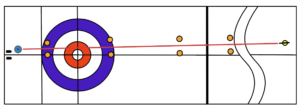
To achieve sufficient skill as a competitive student-athlete, coaches will often recommend or insist that athletes spend a certain amount of time practicing on their own. Sometimes this practice will be done with a partner, perhaps even with the entire team, or sometimes the student-athlete may prefer to work on their own. The point here is that the practice is self-directed – it’s not undertaken with the supervision of a coach. So what should this practice look like? I think that many student-athletes have actually little idea about what a self-directed practice should entail. When I’m at my local club I frequently see the following: If the practice involves multiple teammates there is often far too much unproductive chit-chat. Sometimes those conversations can be helpful, say to address a team dynamics issue, but far too often I will overhear conversations that would better be held off the ice, rather than use expensive ice-time. If you feel somewhat guilty reading this,

Visualization of stone rotations for athlete feedback
This article is joint work with John Newhook of Dalhousie University in Halifax. It is well known that the number of rotations given to a stone, particularly at guard or draw weight, will impact both the duration of the shot and the stone’s trajectory as it travels down the ice. Upon release, a stone will have its maximum angular, or rotational, velocity (think number of rotations per second). Just as the speed of the stone slows with time, from this point until it stops, so does the stone’s rotational velocity. A “soft”, or gentle, application of angular acceleration (torque) to the handle upon release, with a relatively few number of rotations, tends to cause the stone to curl more, and sooner. Often such a release will cause the stone to “dig in” and fall short of the intended target. In extreme cases – a “straight” or “lazy” handle – the stone can actually stop rotating completely before it comes to
Delivery mechanics and take-out weight
One article that Bill Tschirhart left out of the book “A Pane in the Glass” is this one, entitled “The Physicist, the Exercise Physiologist, and the Coach“. In it, Bob Comartin of the CCA Performance Enhancement team discusses the physiology and technical mechanics of the delivery with Jerome Gazdewich, a Level 3 CCA-certified instructor from the Pointe Claire Curling Club in Pointe Claire, Quebec (a suburb of Montreal). The article is a great read and gives some interesting insight into the mechanics of adapting a delivery to take-out weight, particularly with junior girls, since Jerome’s frame of reference involves his high-performance coaching of a junior girls’ rink in Pointe Claire. The bulk of the material concerns precisely how additional force is generated out of the hack to deliver a stone with take-out weight, and provides some solid evidence for why it is important to keep the toe of the hack foot from contacting the surface of the ice prior to
Curling shoes: choosing a slider
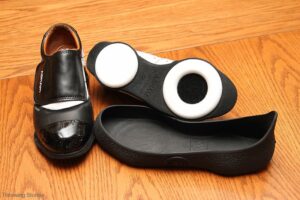
A curler has two primary pieces of equipment: a brush, and a pair of curling shoes. In golf, multi-million advertising dollars are spent each year by golf shoe manufacturers such as Footjoy (recently sold to interests in South Korea) to convince golfers that one golf shoe matters over another. I would argue that in curling, a shoe – particularly what type of slider is used – matters considerably more. Unfortunately, in both golf and curling it is difficult to buy shoes on the “try before you buy” plan. Hence in this article I’ll try to document the range of options for curling shoes. Proper curling footwear offers a considerable advantage over slip-on sliders, tape, or other temporary means of enabling a slide delivery. A proper curling shoe will assist with balance, reduce the amount of effort required to throw hit weight, permit more consistency by allowing a longer and more stable slide with each throw, and permit better grip, and
The Junior hack
This afternoon I helped Jason Rice and John Tartt run a Club Coach refresher course at the Guelph Curling Club. During the course I got some interest in the Junior program at Elmira and, in particular, the Junior hack we use for 7- and 8-year-olds. I realized that I didn’t have any photographs of the Junior hack posted on Throwing Stones, so here they are. As you can see from this photograph: the Junior hack is constructed of 2×6 cedar planks, held together by a combination of 3 1/2 and 4 1/2 inch galvanized bolts, and attached to the side boards of the curling club adjacent to sheet 1. The hack consists of a single Marco hack on each end, which when mounted sits directly on the center line. I went with a single hack design simply to save on weight, to reduce the amount of torque on the structure when it’s in use. Attaching the hack to the side