

First look: Hardline Chameleon brush
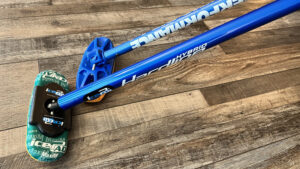
This past week, Goldline Curling Supplies introduced the latest brush in the Hardline lineup: the Chameleon brush, which features a dynamic reflective paint on a prismatic (straight), carbon-fibre handle. The Chameleon offers a high-performance, prismatic alternative to Hardline’s recreational Hybrid Helium fibreglass/carbon fibre composite handle. Hardline’s Hybrid Helium handle is also prismatic (and, notably, inexpensive), but is significantly heavier than the other models at 260 g. Chameleon handle characteristics The Chameleon’s handle is a close cousin to Goldline’s Impact carbon-fibre handle. Both are prismatic handles weighing 165 g and both feature Goldline’s “Grip-Zone Technology” for added grip for the curler’s bottom hand, though the “Grip Zone” designation is omitted from the Hardline handle. At 165 g, the new Hardline handle is very competitive in the High-Performance space, with only the Balance Plus LiteSpeed handle being lighter at 141 g. The nominal handle diameter is the de-facto adult standard of 1
Why bunny-hop brushing may not be the advantage you think it is
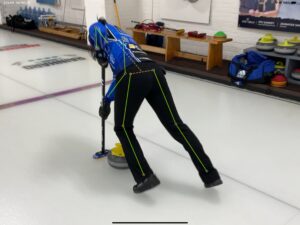
Increasingly, this season I’m witnessing the adoption by Canadian Junior and U18 teams of a brushing tactic used by some teams – mostly, but not exclusively, women’s teams – on the Grand Slam circuit. I’ve nicknamed that tactic “bunny-hop” brushing as it involves the near brusher jumping during the “push” portion of each stroke from a snowplough position. Most often I see the bunny-hop used on guards and draw-weight shots, where the tactic is employed between the far hog line and where the stone comes to rest. Typically, the bunny-hop is used when the stone requires additional carry, though sometimes the tactic is also used when trying to both extend the carry of a stone and, at the same time, accentuate curl by brushing in the direction of the stone’s rotation. https://youtu.be/o2woYB05zdU?&t=1843 Carole Howald of Team Tirinzoni uses the “bunny-hop” brushing tactic vs Team Homan in the final of the
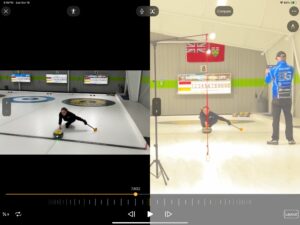
Delivery by athletes with opposite ocular dominance
What is ocular dominance? Ocular dominance is the tendency of the brain to prefer visual input of one eye over the other. While like many other mammals human beings have binocular vision with which to judge distances, humans almost universally prefer visual input from one eye over the other. According to Wikipedia, about 70% of people are right-eye dominant, and 29% are left-eye; why this is so is still not understood. In everyday circumstances most individuals don’t give their ocular dominance much thought; but in sport, eye dominance can play a significant role, especially in highly accurate tasks such as aiming. Sports such as darts, archery, billiards, shooting, and curling can be impacted by eye dominance, particularly when the athlete’s dominant eye is the opposite of their dominant (throwing) hand, which is sometimes termed cross-dominance. Celeste Gauthier, who throws 3rd stones for Team Émilie Lovitt, throwing an out-turn draw. Note

Foamgate, existing, and forthcoming research
At this point, many competitive curlers in Canada should be familiar with the recent announcement from World Curling about the withdrawal of specific foams in a small selection of brushes from World Curling’s approved equipment list for competitive play for the upcoming 2025 – 2026 season. World Curling came to their decision based on the outcome of brush testing in Morris, Manitoba during the Victoria Day weekend, along with feedback from the researchers on World Curling’s equipment advisory group, of which I am a member. To a significant extent, World Curling really didn’t have a choice but to try to address the concerns first brought to their attention with the players’ manifesto that was put together just prior to the Grand Slam event in Guelph this past January at the WFG Masters. The players who signed onto the manifesto were concerned that the brushes approved for competitive play this past season
Curling brushes – Try before you buy – Part Quatre
This article is joint work with Dr. John Newhook of Dalhousie University. This past weekend featured Provincial men’s and women’s championships in most of the Canadian provinces, and what was interesting to me was the number of teams who switched to Balance Plus brush heads for their respective territorial championships. As one example, Saskatchewan hosted the combined men’s and women’s provincial championships in Kindersley. All four of the teams in the men’s and women’s CURLSASK finals are regularly Hardline users (if not sponsored by the company). However, during Provincials two of the teams – Steve Laycock on the men’s side, and Nancy Martin on the women’s side – switched to using Balance Plus RS or RS XL brush heads with prismatic Hardline Hybrid handles. This situation was the reverse of a number of instances last season that saw teams (Kaitlyn Lawes in particular) use Balance Plus LiteSpeed handles with an
Curling shoes: choosing a slider
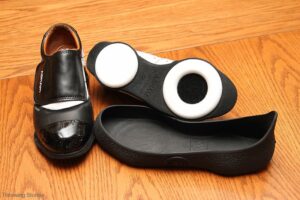
A curler has two primary pieces of equipment: a brush, and a pair of curling shoes. In golf, multi-million advertising dollars are spent each year by golf shoe manufacturers such as Footjoy (recently sold to interests in South Korea) to convince golfers that one golf shoe matters over another. I would argue that in curling, a shoe – particularly what type of slider is used – matters considerably more. Unfortunately, in both golf and curling it is difficult to buy shoes on the “try before you buy” plan. Hence in this article I’ll try to document the range of options for curling shoes. Proper curling footwear offers a considerable advantage over slip-on sliders, tape, or other temporary means of enabling a slide delivery. A proper curling shoe will assist with balance, reduce the amount of effort required to throw hit weight, permit more consistency by allowing a longer and more