In recent years we have witnessed the application of both computer video analysis coupled with powerful analytics engines to provide insight into strategy and tactics in a variety of sports. As examples, five sports that have seen a lot of analytics applied to them are football (soccer), NFL football, basketball, baseball, and ice hockey. It is no surprise that these sports are in leadership positions since they are large enough to afford the data science expertise and computer technology to analyze the massive amounts of data that are captured during a game.
Ice hockey lagged the other major sports in analytics. However, most, if not all, NHL teams now have data scientists on their staffs, and NHL teams use a variety of tools (such as NHL Edge) and software providers to provide insights into shooting, passing, goaltending, puck possession, power play, and defence strategies. Academic researchers have also been part of the mix: as an example, my friend Tim Brecht, recently retired professor of Computer Science at the University of Waterloo, has published a number of papers in the last few years on the analytics of puck possession in ice hockey.
In curling, to my knowledge most of the analytics applied to the sport has been fairly rudimentary: winning/losing percentages and analysis of scoring (hammer efficiency, steal defence, and the like). In the past year, improvements to Curling I/O’s software that provides summaries of game statistics for Curling Canada and the other member associations across the country make the computation of scoring analytics considerably easier than in the past (more on this in a subsequent post).
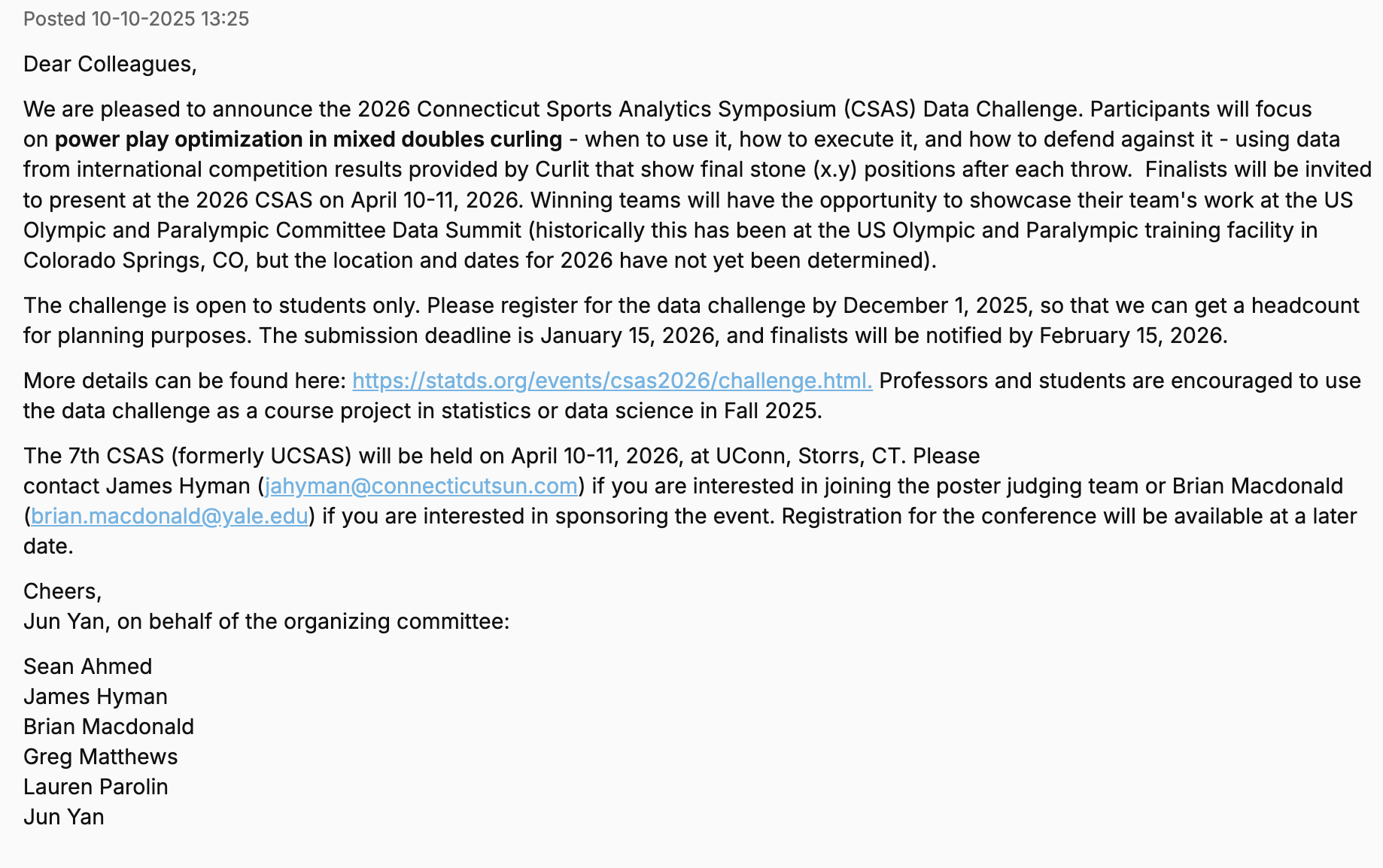
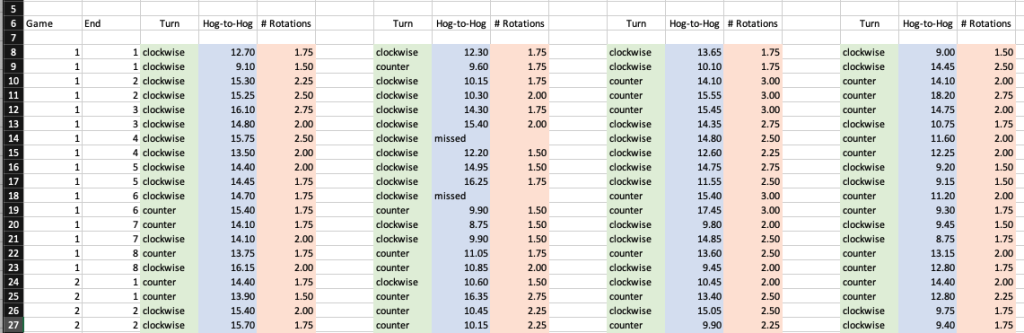
Recently Tim alerted me to what I believe is one of the first academic conferences devoted to the analysis of shot-making in curling, with the subject being the use of the power play in mixed doubles. The 2026 Connecticut Sports Analytics Symposium (CSAS) announced their data challenge for their upcoming conference in April: Power play optimization in mixed doubles – when to use it, how to execute it, and how to defend against it. Shot-position data from international competition results is provided by CURLIT (Curling Information Technology, Ltd). The challenge is open only to students, with the winners being invited to showcase their results to the USA Olympic Committee sometime in 2026.
My thanks to Tim for sending this my way.
Be interesting to hear of the results of this Glenn. I have developed an extensive set of data related to the PowerPlay and specifically those three questions. The analytics journey in the curling space is only touching the tip of the iceberg in my humble opinion.
I had every reason to believe that you had data concerning power play strategy, Perry, and I thought this post might evoke a comment from you. I think (hope?) that this initiative may be just the beginning…. once access to shot data becomes more prevalent then it can be studied in a myriad of ways that can bring quantitative insight to strategy, not only in mixed doubles of course but in four-person or para play. I could dream about having the wealth of data and tools used by NHL teams. But we have to start somewhere.