This guest article by Ontario’s Maurice Wilson is the first of a two-part series on delivery mechanics and mastering weight control. Portions of these two articles were previously published on the former Ontario Curling Council website.
Hit for show, draw for $$
Today’s curling champions must have a complete array of skills, but first and foremost in that composite there must be great draw weight, or at the very least a world class finesse game. This skill development begins with acquiring accuracy through practice, but is refined by the advancement of precision in the finesse skills. In this context, accuracy refers to the proximity of a measurement to the true value of quantity, while precision refers to the proximity of several measurements to each other. So in curling terms, placing three shots in row on the button (that is the target) exhibits both good accuracy and good precision. However, three rocks left in the back four-foot when the target is the button is good accuracy but the precision is left wanting.
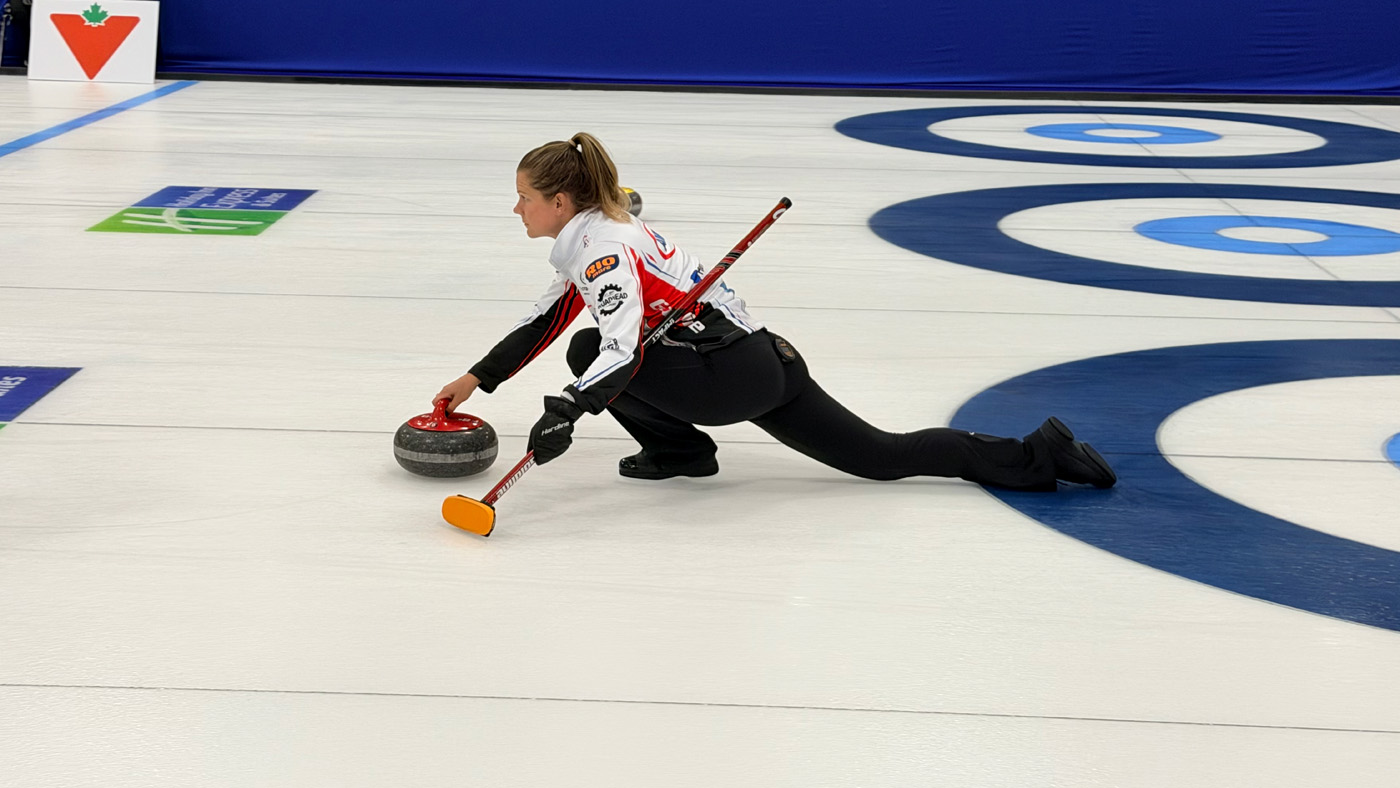
Team Rachel Homan’s Sarah Wilkes delivers a practice stone during The Battle, held at The Plex arena in Port Elgin, Ontario on 25 September 2026.
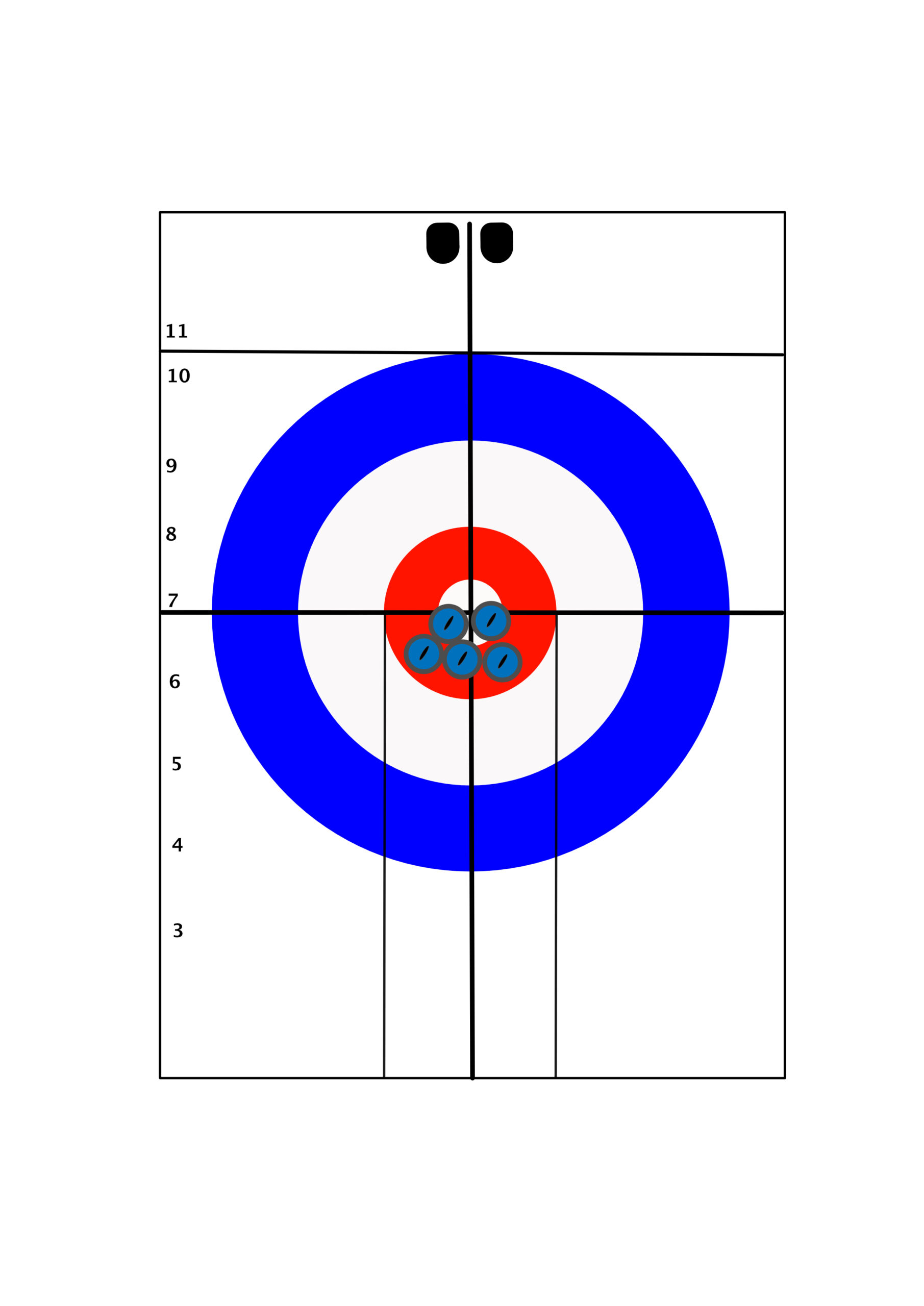
High accuracy, high precision.
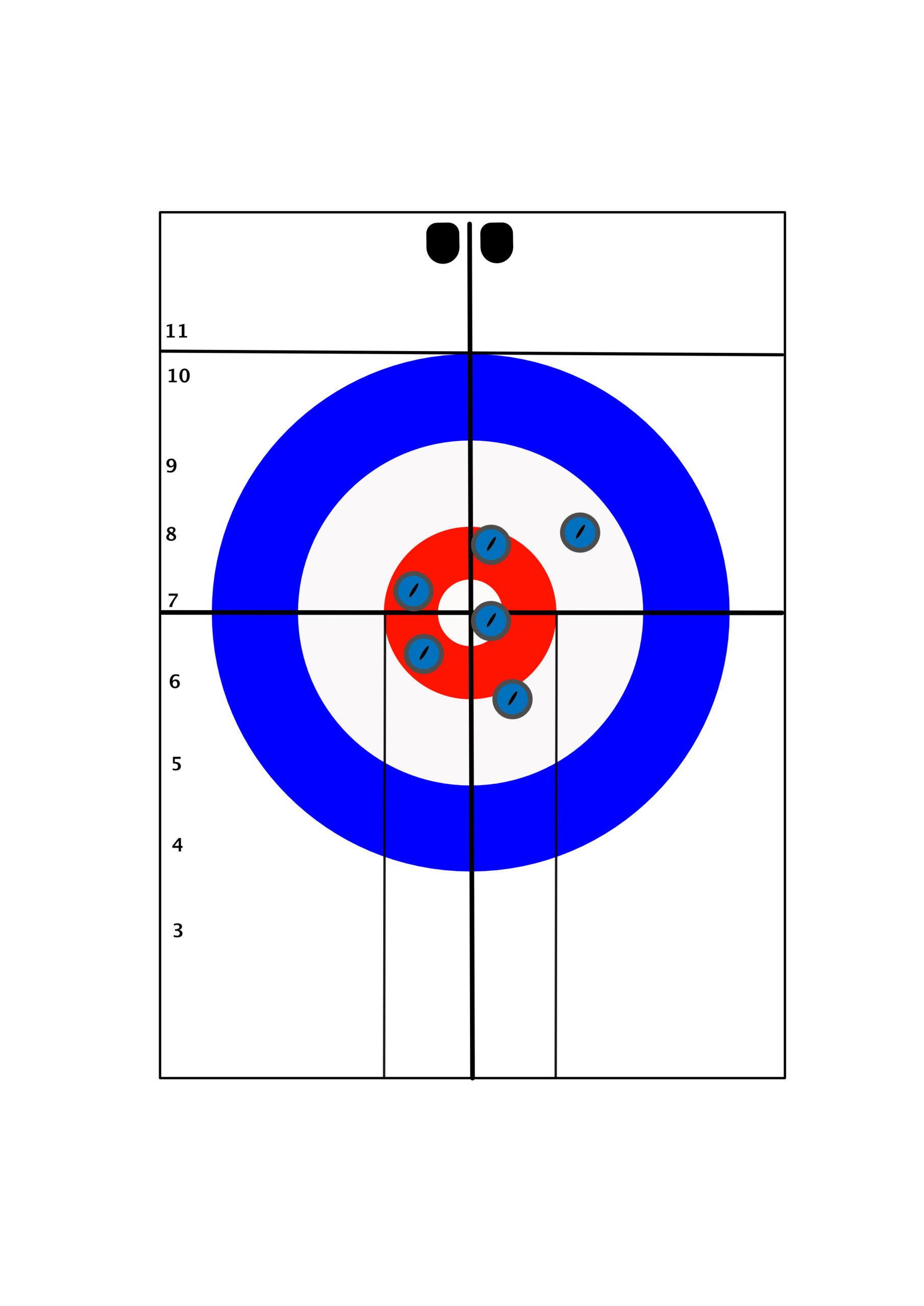
High accuracy, low precision.
Developing precision
So how do we develop precision in our game? The obvious answer is practice! The trick is knowing how to practice with purpose. The method is surprisingly simple. In fact, the KISS principle most certainly comes into play, as in Keep It Simple and Smart. Most systems work best if they are kept simple rather than made complicated. In order to implement the KISS system we need to employ a technique known as “chunking”. With chunking we take a skill and break it down to its smallest parts, then combine them progressively into a meaningful sequence, and do so one step at a time:
- mark the spot that we achieve; then
- recognize and celebrate the moment;
- pause to reflect;
- and repeat the process.
Traditionally, each shot in curling has developed its own leg drive. So Zones 1 through 11 have marginally different amounts of force released coming out of the hack plus board, bumper or barrier (your regional term preference), control, normal and peel. Therefore, we are looking at up to 15 different amounts of leg drive required for the various shots used in a curling match. Sounds like this method is neither Simple or Smart! What if we extract the 12 finesse Zone System shots – so high guard to board-weight shots – and train our bodies to utilize one leg drive for Zones 1-3 and another leg drive for Zones 4-12?
Obviously, something more needs to be added and that’s where extension comes in to play. It is much easier training the fine motor skills from our elbow to our hand than the large muscles and joints from our hips to our knees to our toes. We need to be cognizant of the overuse of the quadriceps in this phase of the finesse game. This is the role of deep and deliberate practice. This is also the role of developing sound, consistent habits and routines. We can employ kinetic memory by focusing on the process, by continually elevating our goals and receiving constant feedback from a variety of sources. Muscles are just waiting to be trained to eliminate their lack of intellect: thoughts, feelings and movements all happen between our ears and are necessary to help train our muscles to learn new skills. Again good, consistent feel is the goal! Practice helps us to feel the correctness of the movement.
Equipment required for practice
How do we make this happen? Well the process requires some assistance from equipment that will accelerate the learning zone. I use soccer markers or pylons and set them up three feet in front of the near hog line and two feet past the hog line to create a five-foot zone to train the thrower where their follow through on these shots will be completed. Zone 1 deliveries will likely be somewhat shorter than Zone 4. I also have a set of speed traps set up on the back line and another set at the top of the house (12 foot timing zone), with the timing clock set on the sideline where the thrower and coach can easily receive the feedback. For the purposes of this article, we will assume 14.5 second ice speed (hog-to-hog) for draw weight. A set of Rock Hawk lasers are set up for recording hog-to-hog times as well as for capturing stone velocity at the near hog line. I convert the Rock Hawks’ metres/second into feet/second to keep the measurements in the same terms. So here comes the fun part: after probably several thousand timed shots I have determined that on 14.5 second ice the time on your leg drive to deliver a Zone 1 stone with little or no extension is in a range from 1.75-1.80 seconds and for Zone 4 (top 12-foot), also with little or no extension, is between 1.60 and 1.65 seconds. RockHawk times appear on my iPad.
In part two of this article I will provide a chart illustrating the leg drive correlation to hog-to-hog times. I have experimented with a wide range of times (depending on ice conditions) and have found the leg drive will vary only slightly and most of the adjustment from “heavy” ice to “quick” ice can be made with extension. All these toys are used to provide feedback and to help the athlete “feel” the correctness of the movement. I arrived at the 12-foot timing zone after many different configurations. The sensors placed in this location seems to give the most precise times and is not affected by release. The brushers may use their stopwatches if they so choose to get their own times to help with brushing judgement. It is crucial that the thrower is provided multiple forms of feedback in this drill: auditory, visual, and the “feel” of the leg drive, body drop, and slide. There is no need to rush through this phase of the training; athletes love the challenge of getting perfect times on the leg drive drill. I have provided an illustration of where to set all equipment to assist the visual learners (see below).
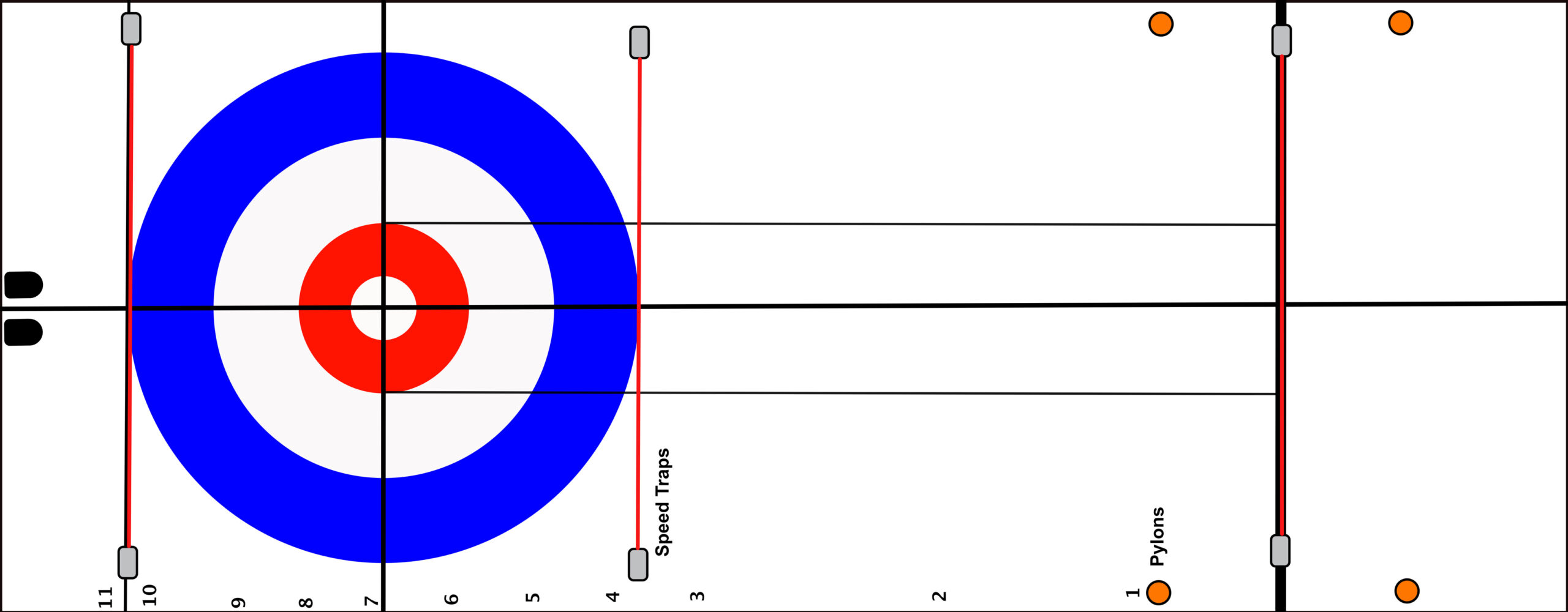
Don’t forget to set up the second set of lasers for the Rock Hawk at the far hog line. I configure the Rock Hawk to capture both hog-to-hog and stone velocity to provide a correlation and to observe the effect of the extended release. Stopwatches may also be used when speed traps are unavailable. Repetition is the key to this drill and again constant feedback in a multitude of forms. This helps to interrupt the process of forgetting!
(Note: if you wish to use a Rock System for the “speed trap” then you’ll need an additional set of two Rock Hawk lasers and a seperate, independent display. Configuring your Rock Hawk laser units to have unique names is very useful in that circumstance).
Watch the pros
The basis of this theory comes over a course of a couple of decades working with curlers of all ability levels, from national and international champions to daytime seniors and novice, once-a-week enthusiasts. Training the fine motor skills of leg drive and extension has proven to accelerate the learning curve and improve shooting percentages in the finesse game. The best draw-ers at the highest levels of our game have always been “adders”. By that I mean if you wish to conquer the curling world you need to learn to incorporate the perfect touch and feel by adding velocity to the stone with a mechanically sound, extending release. The extension plus perfect leg drive results in an extraordinary standard of success. Just witness Team Nik Edin’s 93% draw percentage at the 2019 Men’s Worlds and you will see first-hand the incredible advantages this method promotes.
With Grand Slam events now underway, enhance your viewing pleasure and watch closely the various elite performers and the technique they use in their exceptional deliveries: where do they slide to on their draw- or guard-weight follow through? Check out the assortment of leg drives used for different types of shots. Does the player use an extension on their release? Compare many of the current deliveries to games on Sportsnet and TSN from 2016-2018. How have these top curlers changed their mechanics and, more importantly, why? Consider if these techniques can help improve your game. The answer is, of course, yes!
“The relentless pursuit of perfection through innovation drives continuous improvement.” Kaizen
This article is part one of two on the topic of developing precision in your curling game. Part Two will deal with practice techniques to promote this development as well mental training, pre-shot routines and drills to improve your game.