The use of technology and AI in curling
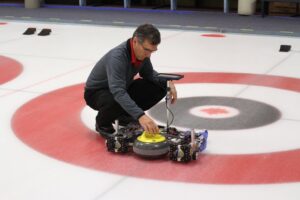
The header image for this post is a photograph of Randy Park, a practicing engineer from Hamilton, and Randy’s portable rock-throwing robot, called SweepTracker, which he constructed himself in order to conduct research on the forces involved in curling and, more specifically, the changes to those forces when a stone was brushed. In this IEEE Spectrum article by freelance journalist Elie Dolgin, Elie takes a look at some of the technologies now being used in the sport of curling. My own conversation with Elie included such things as smart glasses for weight judgment in brushing, instrumented brushes, artificial intelligence and machine learning, robotics, and analytics. Myself, Sean Maw of the University of Saskatchewan, Curling Canada’s Mick Lizmore from London, and Emily Zacharias of Winnipeg were just a few of the researchers from around the globe that Elie interviewed for this article. It’s a really good read.
Calibrating the CurlSmart instrumented brush
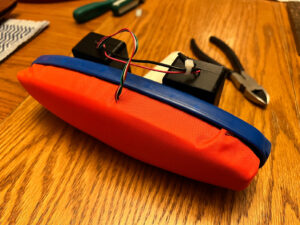
Frequently, the athletes that I work with on brushing – over 550 since the 2014-2015 season – complain about the CurlSmart instrumented brush for two reasons: it’s, well, heavy. Including the 9V lithium battery, the CurlSmart brush head weighs 534 g, somewhere between 2x and 3x the typical weight of a commercial brush head due to its steel plate construction. The black Cordura nylon fabric on the brush head, which we use for its durability, doesn’t have nearly the same “feel” as a World Curling-approved brush head. Cordura nylon is used on the CurlSmart brush because replacing the fabric on the brush head is a fairly involved procedure that requires disassembling the head, stapling in the new fabric, and reassembling. Moreover, replacing the fabric usually merits a subsequent calibration test of the brush to ensure that the procedure did not impact the brush’s accuracy. Nevertheless, we chose to replace the black Cordura nylon with SportLite+ fabric from Balance Plus in
Delivery by athletes with opposite ocular dominance
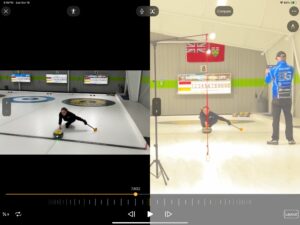
What is ocular dominance? Ocular dominance is the tendency of the brain to prefer visual input of one eye over the other. While like many other mammals human beings have binocular vision with which to judge distances, humans almost universally prefer visual input from one eye over the other. According to Wikipedia, about 70% of people are right-eye dominant, and 29% are left-eye; why this is so is still not understood. In everyday circumstances most individuals don’t give their ocular dominance much thought; but in sport, eye dominance can play a significant role, especially in highly accurate tasks such as aiming. Sports such as darts, archery, billiards, shooting, and curling can be impacted by eye dominance, particularly when the athlete’s dominant eye is the opposite of their dominant (throwing) hand, which is sometimes termed cross-dominance. Celeste Gauthier, who throws 3rd stones for Team Émilie Lovitt, throwing an out-turn draw. Note that Celeste’s left eye is directly above the centre of
Delivery analysis using OnForm Multi-cam support
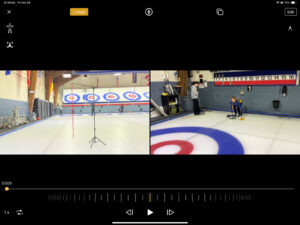
A recent feature of the OnForm video analysis platform is its support for multi-camera input. The individual devices have to be connected to the same WIFI network, but once paired a “master” device can control the recording of all of the auxiliary devices that are providing alternative camera views. In this brief article, I wish to document my equipment setup for delivery analysis. At this practice, I’m looking at two things: slide leg position, and arm extension during the release motion, that are difficult to analyze when standing either directly in front of, or behind, the athlete. Delivery Analysis Setup For delivery analysis, I use a Ryobi steel mitre sawhorse with collapsible legs, with an iPhone mount, in landscape mode, mounted in its centre. A green light laser, positioned on the far tee line, points to the hack, forming the line of delivery (LOD). The plumb line – actually just a red hockey skate shoelace with a carabiner as a
Curling brushes – Try before you buy – Part Quatre
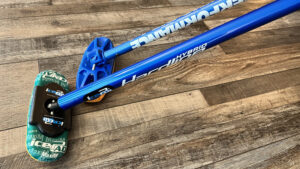
This article is joint work with Dr. John Newhook of Dalhousie University. This past weekend featured Provincial men’s and women’s championships in most of the Canadian provinces, and what was interesting to me was the number of teams who switched to Balance Plus brush heads for their respective territorial championships. As one example, Saskatchewan hosted the combined men’s and women’s provincial championships in Kindersley. All four of the teams in the men’s and women’s CURLSASK finals are regularly Hardline users (if not sponsored by the company). However, during Provincials two of the teams – Steve Laycock on the men’s side, and Nancy Martin on the women’s side – switched to using Balance Plus RS or RS XL brush heads with prismatic Hardline Hybrid handles. This situation was the reverse of a number of instances last season that saw teams (Kaitlyn Lawes in particular) use Balance Plus LiteSpeed handles with an IcePad brush head. While we are some ways away from
Curling brushes – Try before you buy – Part Trois
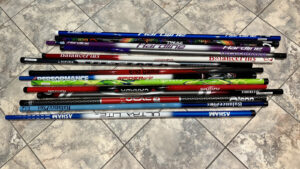
This article is joint work with Dr. John Newhook of Dalhousie University. In earlier articles, we documented the mass of commercial brush heads and in addition documented that today’s commercial brush heads distribute pressure across the brush pad in very different ways. In parts 1 and 2 of this article on “Try before you buy”, we argued that brush handle characteristics do matter and, in the second part, presented measurements of various commercial handles with respect to handle diameter. In this, the third part of “Try before you buy”, we present measurements of another important characteristic of brush handles: flex, or more properly their bending moment, or flexural rigidity. As curling equipment manufacturers continue to offer lighter-weight products, athletes may discover that there are significant differences amongst the various commercial offerings of handles in roughly two dimensions: weight and flex, in much the same way that today’s hockey sticks come in a variety of “flex” degrees as do tennis or