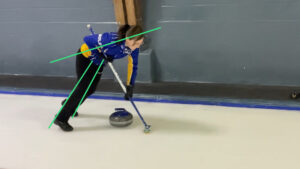
Brushing video analysis with OnForm
While an instrumented brush is ideal for capturing the force profile of an athlete, video analysis is equally essential so that the athlete can get visual feedback on their technique, and know if they have made the correct and desirable adjustments to their technique on subsequent bouts. In this article, I’m going to use Celeste Gauthier, of Team Émilie Lovitt and Toronto Metropolitan University, as a model to describe some useful tips in video analysis of brushing. What is OnForm? OnForm (formerly Hudl Technique) is a coaching application that supports recording and playback of video along with the ability to annotate video with diagramming or audio overlay to provide coach feedback. Videos are stored in the cloud (instead of on your device) and can be shared with athletes (or other coaches) on a coach license. In addition, OnForm now supports multi-camera inputs so one can capture simultaneous video from different camera angles, similar to other apps such as Switcher Studio.
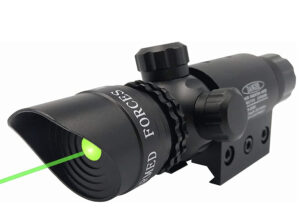
Using lasers in curling – an update
In the five years since John Newhook and I drafted this document describing the use of lasers in curling the technology has continued to improve and become more affordable, so it seemed like an update was in order. With many curling clubs moving to LED lighting for their arenas, green light lasers have now become the norm, rather than the exception, and their cost has plummeted. The lasers that I use (see below) can now be purchased from Amazon for a mere $38.69 Canadian, a significant drop from five years ago. Even a rechargeable, green laser pointer for presentations can be had for only $16, a long way from the nearly $200 I spent on a red laser pointer when I was in graduate school at the University of Manitoba. Of course, none of the lasers for sale anywhere are intended for curling, and the majority are intended for one of three use cases: for use with a firearm, usually
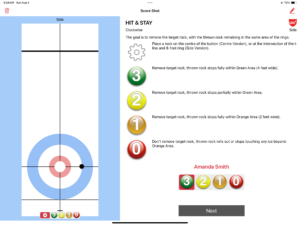
Curling Canada’s Singles App
Curling Canada’s Singles app, a free application for both Apple and Android devices, permits an athlete or a coach to evaluate their shot-making skills and record and review results through a season. In addition, athlete and team scores can be compared to other athletes across Canada. In my experience, the existence of the Singles app is unknown to many coaches, especially U15 or U18 coaches who are new to coaching; hence this article. The Singles application leads an athlete or coach through specific shots whose number and level of difficulty are pre-determined by the age range(s) of the athletes: U15, U18, U21, or U25+. The application supports two distinct operational phases: competition and practice. For competition, the athletes “compete” through a series of shots with the thrower accumulating points for shots made (one or two of their teammates brush, and another holds the broom). Shot-making points are accumulated through the exercise and the athlete with the highest number of points
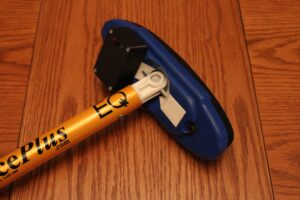
Instrumented Curling Brushes and the CurlSmart brush
I frequently receive questions about the instrumented brush that I use when testing athletes. An instrumented brush is a “game-changer” in the coaching of the sport of curling, because the effectiveness of an athlete cannot be determined statically (for example, by using a bathroom scale). Rather, brushing involves movement, and an instrumented brush is able to measure various characteristics of an athlete’s brushing profile to give essential guidance to a coach to help improve their technique. The instrumented brush that I use is a prototype developed by Dr. John Newhook of Dalhousie University, and is described in some detail in the article shown at right. In a nutshell, the brush captures (via a strain gauge) the vertical force generated through the handle at a sampling rate of 100 Hz. The force data from the brush is transmitted to a laptop Windows computer running proprietary software that (a) converts the values from the brush into “forces” in kilograms, for better understanding
Curling brushes – Try before you buy – Part Deux
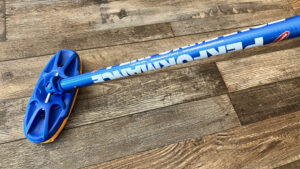
On April 13th I’ll be one of the coaches at the Ontario Curling Council U18 Academy camp at the Dundas Valley Golf and Curling Club in Dundas, ON. In the first part of this article I mentioned that one of things I like to do when coaching at a camp is to bring along a large broom bag with an assortment of brushes from my collection, so that the athletes have an opportunity to try out various brushes that are different from the one they use regularly. It is unsurprising to me how frequently an athlete will profess a liking for a particular brush in my collection that is different from the one they have. Most often that difference relates to the handle, and not the brush pad. While debate over the utility of the various brush pads from the different manufacturers continues, what is frequently overlooked are the handles, and the characteristics of a given handle does impact the
OnForm adds multi-camera support
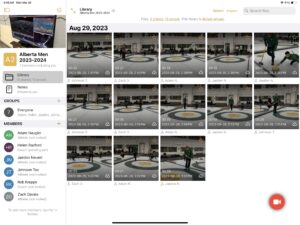
The latest version of the OnForm video analysis application, just released this week (March 18, 2024) on Apple devices now supports simultaneous multi-camera video recording from multiple devices (up to 3) on the same WIFI network. For curling coaches, being able to record simultaneous camera input of a curling delivery – for example, using a camera located behind the hack, and another in front of the athlete) can be exceedingly helpful. Other commercial applications support this functionality; Curling Canada demonstrated the use of the Switcher Studio application at the high-performance coaching summit in Edmonton in August, using three Apple iOS devices: one behind the hack, another at the side, and a third mounted on top of a sawhorse in front of the athlete. If you already use OnForm with a coaches’ license, you know the value to being able to not only record video but also annotate the video with markup or with voice-over: The disadvantage of the Switcher Studio