This is an updated version of an article that originally appeared on the Ontario Curling Council website on 4 October 2017. This is joint work with John Newhook of Dalhousie University.
We would like to thank Fraser Reid, former Canadian university champion with Wilfrid Laurier University, and Paige Bown of Team Dominique Vivier, for their demonstrations of brushing in the open stance.
As coaches, we ordinarily teach brushing in the open stance to novices. For novice players, the open stance is considerably safer than alternative tactics. In the open stance, the player faces the skip while brushing and the feet are both facing forward, making the open stance much easier to learn for beginning players.
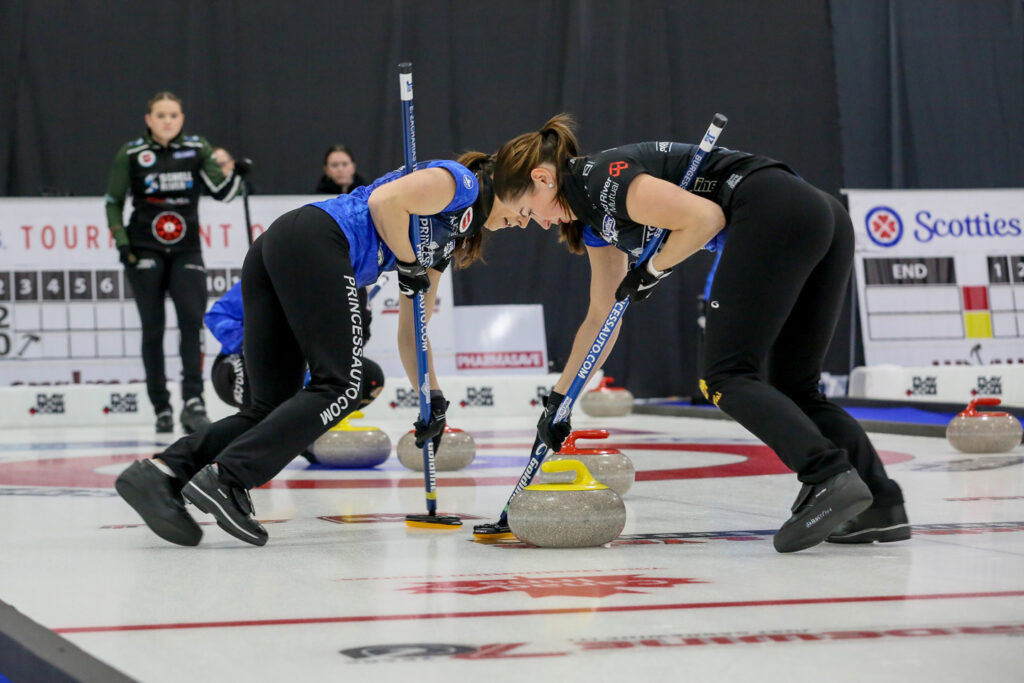
Karlee Burgess and brushing partner Emily Zacharias brush a draw during the 2023 Manitoba provincial playdowns. Both athletes are in the closed stance. Photo credit: Connie Laliberte.
Before ‘Broomgate’ in 2015, the Rules of Curling stipulated that any brushing motion had to take place fully across the face of the stone, and ‘corner sweeping’, or sweeping only a portion of a stone’s running band, was explicitly prohibited. At the time, brushing in the closed stance (see photograph above) was usually preferred by competitive players. This was because the thinking at the time was that an athlete could generate greater vertical force through the brush in the closed stance, particularly during the “pull” portion of the stroke, with the body hinged at the waist. With a flat back, accompanied by optimal closed footwork, the athlete’s chest is over the brush head throughout the stroke. While the pull portion of the stroke is always weaker than the push, an accomplished athlete can still generate vertical force numbers during the pull phase of the brushing stroke in the neighbourhood of 20%-25% of their body weight. A typical normalized mean force (mean force in kilograms over the entire bout, divided by the athlete’s body weight) for an accomplished female player would be 45% and higher. The highest normalized mean force I have measured for a female player brushing closed is 53%.
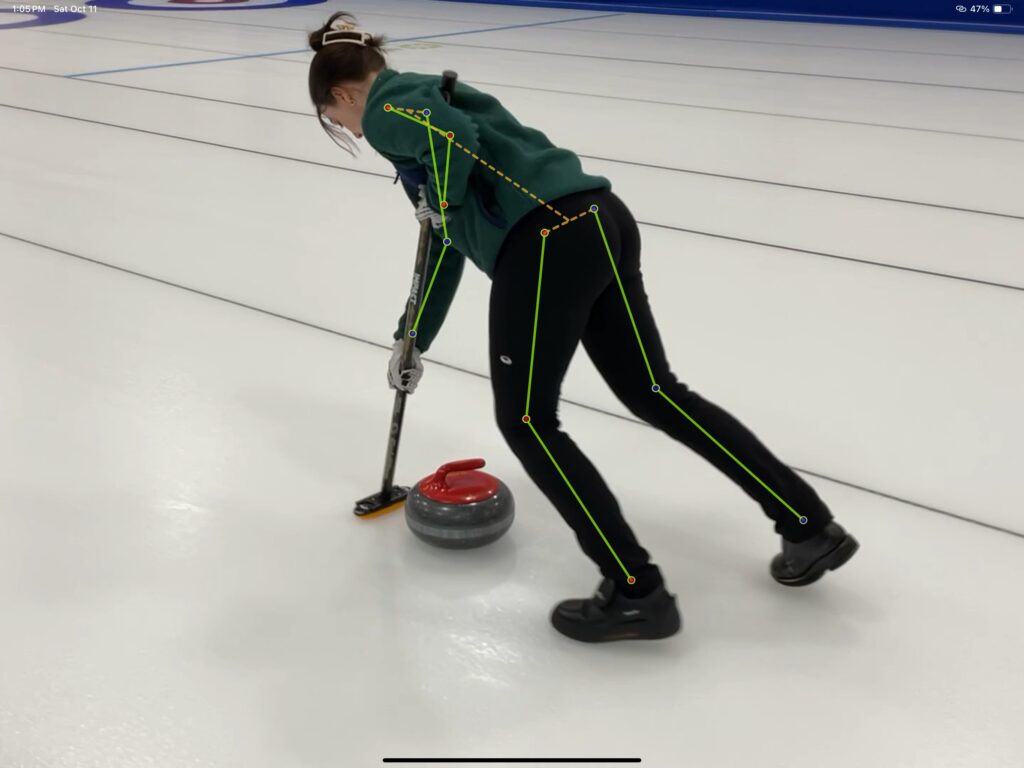
One might well ask why the closed stance is relevant today, since many competitive teams utilize a single brusher who brushes from a position behind the stone (see image at left). There are at least two reasons:
- There are moments when brushing a stone when the athlete may desire a lower attack angle, where the athlete must now move from her position behind the stone and brush across the face of the running band; and
- We are aware of multiple studies that show that two brushers are better than one for both carry and to hold a stone straighter, particularly for lightweight athletes. In such a case, the second brusher has no choice but to brush in a closed or open stance.
The issue of handedness
While closed stance was often preferred, for a typical team at least one athlete had to switch sides during an end due to the handedness of the players.
Similar to (ice) hockey, where an athlete will have a preference to shoot left or right, in curling an athlete typically has a strong hand preference for their lower hand on the brush. However, it is usually impossible to find a competitive team where every player can always brush in the closed position. The ideal situation for a team is for both the lead and second to brush closed on opposite sides of a stone, and have the third switch sides, substituting for the player throwing, during the first four stones of each end. In doing so, the third would, likely, have to brush two stones in the open stance, and two stones in the closed stance, on the opposite side of the stone. So the open stance remains relevant even in this ideal situation, and consequently the open stance is the subject of this article.
Brushing footwork in the open stance
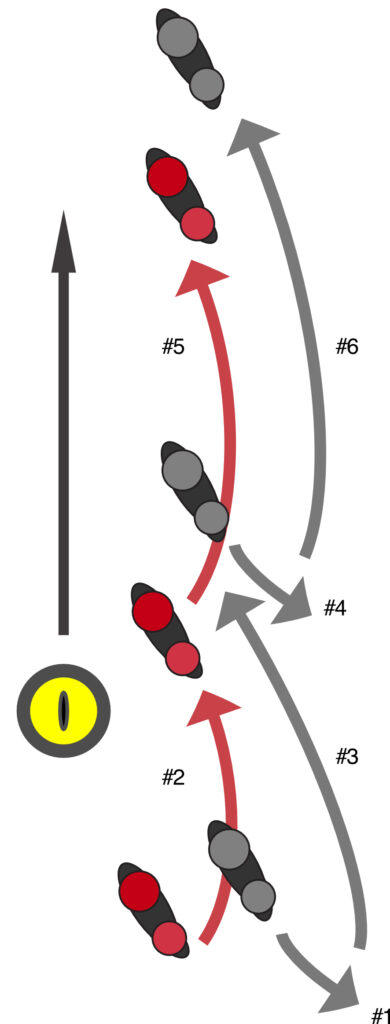
While brushing in the closed stance is often preferred, it is possible to attain excellent normalized force ratios of 45% and even higher when brushing in the open stance. The open stance is termed “open” because the player’s body is “open” to the target. Open footwork is quite different from closed footwork (see diagram at right) because in the open stance, the body is in a very different orientation. When brushing open, the player faces the skip, usually at a 30-to-45 degree angle, and brushes across the face of the stone at that angle. It can be more challenging to generate greater sustained force values – that is, during the pull portion of the stroke – when brushing open, but as we shall see it is possible to generate superb normalized force values, as it is for brushing in a snowplough position.
As with brushing closed, a higher normalized mean force does require mastery of the open footwork, and some top-quality athleticism from the athlete.
- an orientation of the body of 30-45 degrees to the line of travel;
- a somewhat higher grip on the brush to promote a stance where the athlete’s shoulders are higher – perhaps 6-8 inches higher – than their hips. One reason for this is so that the forward movement of the legs is easier. It is very difficult to move forward, holding a brush and sweeping, when bent over, hinged at the waist.
- Staying on the balls of the feet as much as possible;
- Foot movements that are straight behind the athlete, and not to either side;
- Finally, the athlete should constantly “thrust” their hips forward and downward in the direction of the stone during the bout. A higher position of the shoulders helps to do this. The thrust of the hips forward and towards the stone helps to keep the hips low and the feet behind the hips, which accomplishes three things:
- Moving forward during the bout is easier;
- The athlete is better able to generate additional vertical force by using the weight of their upper body; and
- The athlete can use their legs to strengthen the push portion of the stroke.
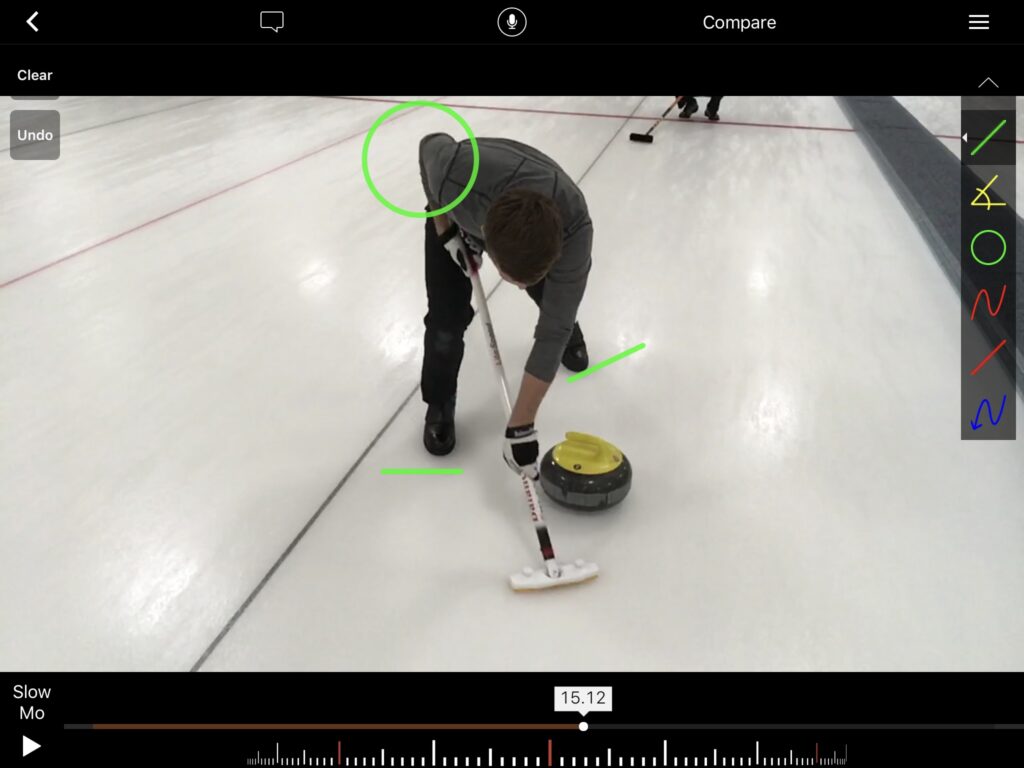
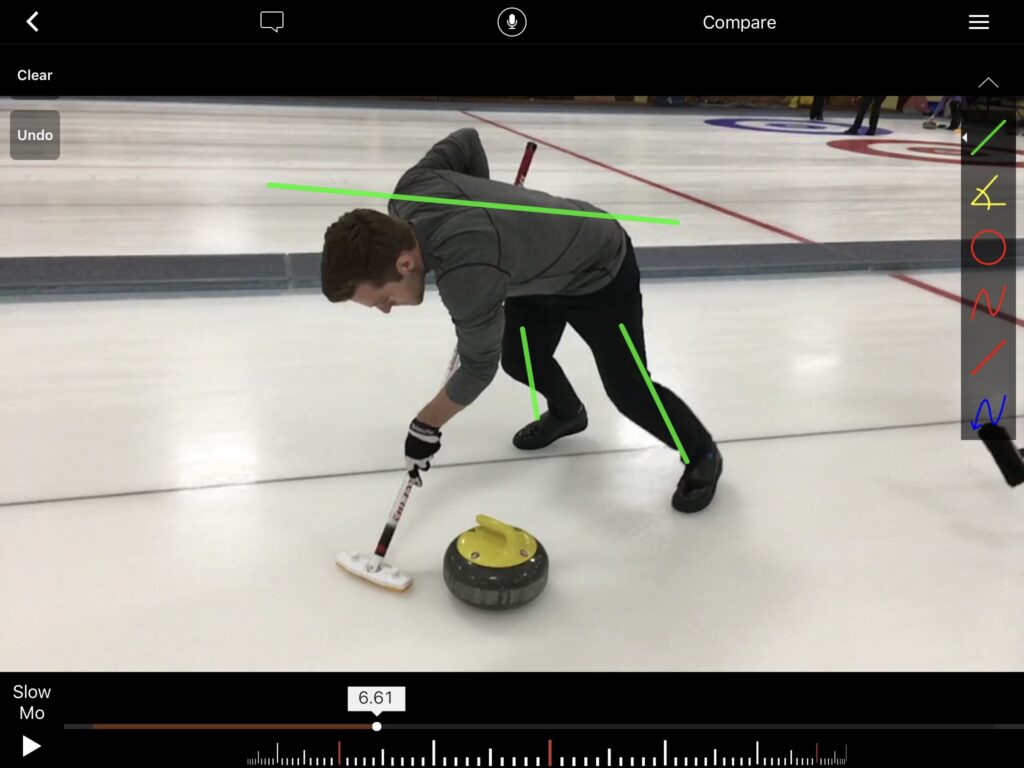
With the footwork as shown, brushing in the open position with a slider is usually counter-productive, as the athlete cannot use the slide foot to propel themselves forward as the slider foot can provide no grip. This usually leads to very awkward footwork adjustments, almost always leading to a plant of the gripper foot underneath the athlete and a corresponding loss of vertical force. Nevertheless, in a mixed doubles context such trade-offs are frequently necessary.
High-performance brushing in the open stance
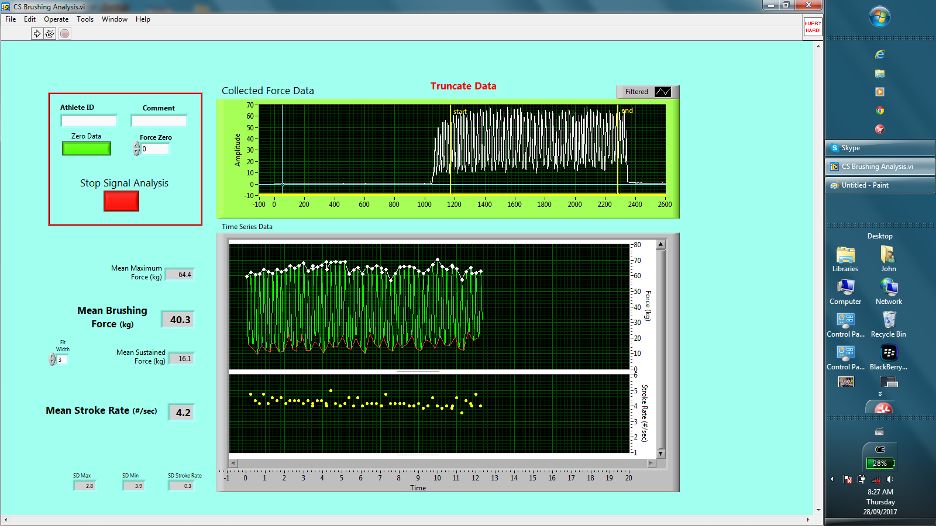
As mentioned earlier, it is possible to achieve top-ranked performance when brushing open. At right is an example of a junior-aged male athlete brushing open, from the right side. In this trial, the athlete achieved a mean sustained force of 16.1 kg, a mean maximum force of 64.4 kg, and a mean force of 40.3 kg while brushing at an average stroke rate of 4.2 Hz. At 156 lbs, this athlete has achieved a normalized mean brushing force of 56.8%, a normalized mean sustained force of 22.7%, and a normalized mean maximum force of 90.8%, rivalling the efficiency of the best players in the game brushing either open or closed.
In the CurlSmart chart above, note the periodic differences in sustained force through the bout. Graphically, the sustained forces are the height of the “valleys” at the bottom of the force curve. These slight differences are due to which foot is forward (left or right) when striding forwards, with the right foot typically being slightly more underneath the body than the left. In the right open position, the left foot tends to be kept more to the rear of the athlete, behind the curling stone. The reverse would be true on the left side.
As always, a performance such as this requires dedicated practice, fitness, and impeccable technique. Nonetheless it illustrates that high-performance brushing results can be achieved in the open stance.