This article is joint work with John Newhook of Dalhousie University. A previous version of this article was published on the Ontario Curling Council website on 12 October 2018.
In a previous article we described a simple, wheeled apparatus that an athlete could use to practice closed brushing footwork in the off-season. The closed footwork trainer assists an athlete in (1) keeping their hips closed to the trajectory of the stone while brushing, (2) holding their body upright with a considerable proportion of their body weight on their arms, and (3) practicing half-moon movements with both feet in order to keep their feet behind the hips, in order to maximize the amount of body weight on the hands, which will translate on the ice into helping maximize the amount of vertical force on the brush head.
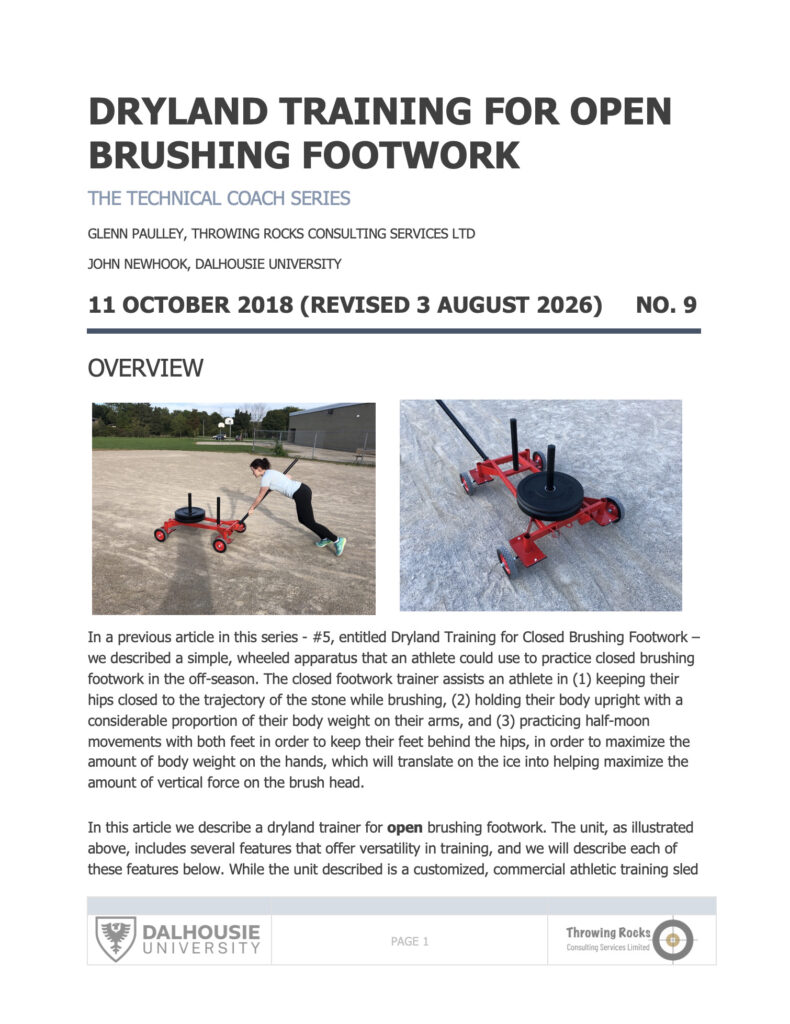
In this article, we describe a dryland trainer for open brushing footwork. The unit includes several features that offer versatility in training, and we will describe each of these features below. While the unit described is a customized, commercial athletic training sled constructed of steel, we will discuss how a trainer can be built more simply and inexpensively based on our experience with this customized, steel model and the wooden trainers for closed footwork described previously.
Click on the image above to open the PDF in a new window.
As with the closed footwork trainer, through trial-and-error we have found the best practice surface to be the soft gravel infield of a softball diamond, which provides the necessary resistance to the trainer’s wheel’s to make the athlete work harder to push the trainer forward. Harder ground makes moving the trainer easier, and yields unsatisfactory results. In such cases additional resistance is required, such as having a training partner accompany the bout, lightly pulling on the trainer in the opposite direction.
While the motions of the athlete on a gravel surface mimic the motions on-ice, the two surfaces are quite different. Nonetheless, the open footwork trainer can be helpful for young players to learn optimal open footwork and biomechanics before they step on the ice surface in the autumn.