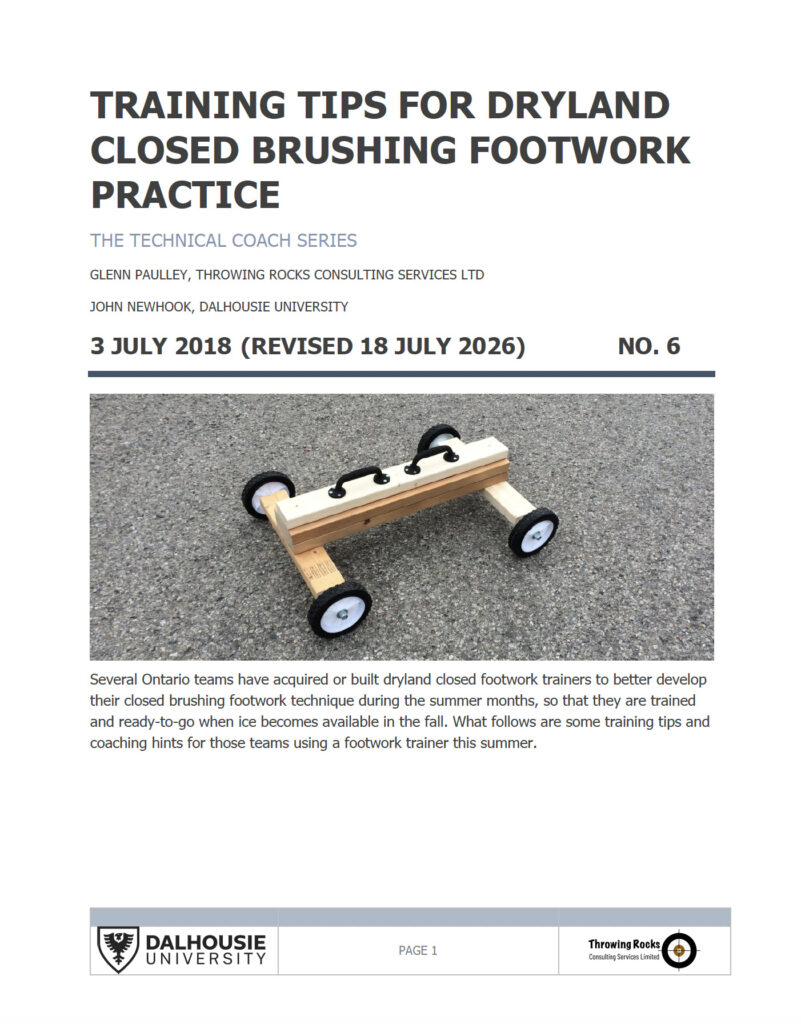
This article is joint work with John Newhook of Dalhousie University.
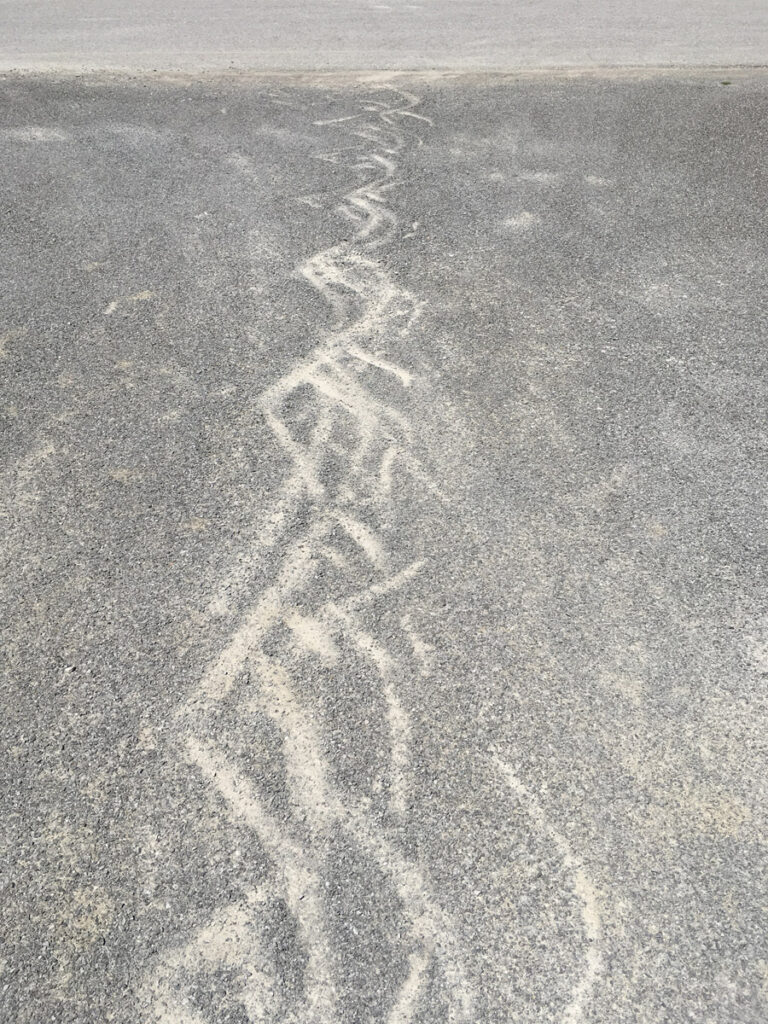
In use, through trial-and-error over the years we have found the best practice surface for dryland training to be the gravel midfield of a softball diamond. An asphalt or concrete surface hinders effective foot movement, which is required to produce the “half-moons” that optimally both propel the brusher down the sheet, and get one’s feet outside of the hip line to provide greater force through the arms and hence the brush head. A ball diamond or a fine gravel driveway permits practice with good foot movement, and moreover the athlete’s footwork evidence can be seen in the gravel after each attempt, augmenting any video taken during the training session.
It should be clear that practicing on gravel is not the same as practicing on-ice; the surfaces are quite different. Nonetheless, a gravel surface permits one’s feet to “slide” in a manner similar to what one could do on-ice, and is much better than cement or asphalt. Moreover, a gravel surface permits easy assessment of a brushing trial as the surface enables the athlete to self-assess their footwork by examining the trails left behind by their feet (see photograph at right).
Click on the title page image (above, right) to view the complete document in PDF.