Author’s note: This is joint work with John Newhook, Department of Civil and Resource Engineering, Dalhousie University. This article is an updated version of an article previously published on the Ontario Curling Council website on 29 December 2014.
Over the past several years I have had the privilege to work on a number of different engineering initiatives related to the sport of curling. One of these is the development of an instrumented curling broom, a device that permits the measurement of force and stroke rate of a player, in real time, while brushing a curling stone. In this article, I’d like to present a brief overview of the body of work surrounding the study of brushing performance in curling, and briefly describe two research initiatives that are helping to increase our understanding of how we can improve brushing performance in athletes of all ages and abilities.
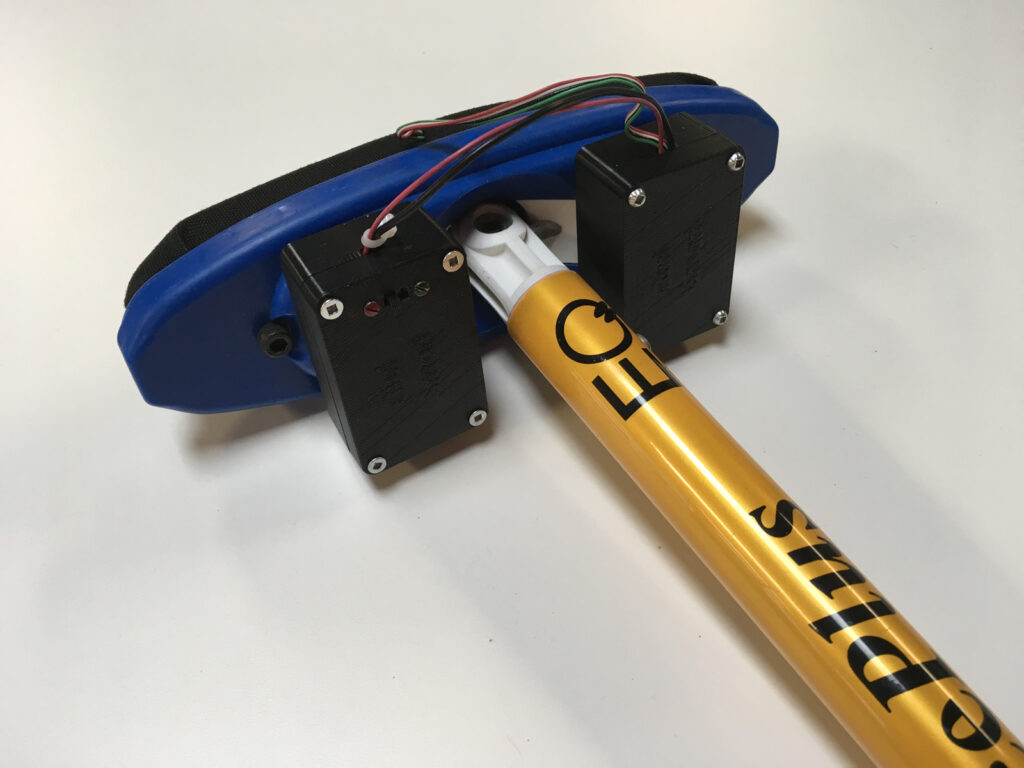
CurlSmart prototype instrumented curling brush, developed by Dr. John Newhook, Department of Civil Engineering, Dalhousie University.
What makes a curling stone curl?
One would think that in a game played for the better part of 400 years with “in-turns” and “out-turns” we would have a solid grasp on the physics behind curling stones and a complete understanding of what makes a curling stone curl. The interesting thing about curling stones is that they nominally curl in the direction of rotation, whereas other objects (say a drinking glass on a kitchen counter) will “curl” on the counter-top in the opposite direction of the rotation. This phenomena has been studied, albeit incompletely, since the mid-1920’s and thus far the results remain controversial. Bradley [1] provides a brief summary of this research. In addition to Bradley, an excellent overview can also be found in a 2016 article [9] by Norikazu Maeno of Japan, who summarizes research from the previous 20 years that encompasses a number of related, but contradictory, theories. These theories include:
- Mark Shegelski of the University of Northern British Columbia, along with several different co-authors, proposed a model [6,16-20] that is based on “wet” versus “dry” friction. In this model, the theory is that the stone’s leading edge forces a minute amount of water out of the ice, which lowers the coefficient of friction for the stone’s trailing edge and hence causes the stone to curl in its familiar direction.
- Mark Denny of BAE produced a model [4] based on left/right asymmetry of frictional force, based on the accumulation of ice (or other) debris on the surface of the stone’s running band through its travel, which he terms the “snowplow” model.
- Norikazu Maeno of Japan’s Hokkaido University proposed an “evaporation-abrasion” model [7,8] where the lower coefficient of friction for the rear portion of a curling stone’s running band is due to a combination of evaporation and ice debris generated by the front of the running band as the stone travels over the ice.
- A. Raymond Penner of Vancouver Island University proposed a slightly different model [15] than that of Shelgelski et al. in that he considered an “adhesive” effect of frictional force on a stone’s running band which results in a “pivoting” action of the stone as it rotates.
- In 2013, work by Harald Nyberg et al. [13,14] at Sweden’s Uppsala University documented “micro-scratches” in the ice caused by the leading edge of a stone’s running band, and which in turn causes angular deflection of the trailing edge that the authors claim causes the stone to “curl”.
A recent (2022) analysis [12] by Jiro Murata at Rikkyo University in Tokyo used detailed video analysis and from that analysis Murata proposed three classes of ‘pivot’ models where the stone pivots around a point on the running band. The three categories of motion are related to the velocity of a stone, which dictates the type of stone-ice interactions that alter the trajectory of a curling stone in motion.
Murata’s work appears to be in broad agreement with another analysis by Brown [2], described in some detail here. Brown proposed that the motion of a curling stone resembles a Stribeck curve. Like Murata, Brown also proposed that the motion of a curling stone could be categorized into three types of stone-ice interactions, with each type dependent on the stone’s velocity.
The summary above was designed to be neither definitive nor exhaustive, but only to represent the uncertainty in our understanding of the physics of curling, which is both very complex and very difficult to measure empirically.
We have even greater uncertainty when we consider what physics can explain about the brushing of a stone, something the Scots realized 150 years ago yet which we cannot – still – completely explain. Moreover, most of the models above fail to account for any relationship between the vibration of a curling stone as it moves over pebbled ice and its trajectory (it is a stone’s vibration that makes the “roar” in the roaring game). This relationship of stone behaviour to changes in vibration is currently being studied at the University of Saskatchewan.
Development of instrumented curling brooms
It has been known for some time that one of the impacts of brushing (sweeping) in front of a curling stone is to lower the coefficient of friction of the ice surface through the generation of heat [1,3]. Through the use of infrared cameras, a study undertaken for the Canadian Curling Association by Tom Jenkin at the University of Western Ontario in 2009 demonstrated this effect using Olympic-calibre athletes. We know from Jenkin’s study and subsequent studies that carry distance is correlated with mean brushing force, and typically men can outperform women, not because that women aren’t good athletes, but that men tend to have more body mass which results in greater vertical force down the brush handle.
In our experience, most athletes have little idea how much vertical force they produce in brushing. Instead, they judge their performance by how much effort they put into each bout. In coaching, it is important to provide meaningful measures to athletes that are directly tied to their performance. Instrumented curling brushes capture metrics such as vertical force and stroke rate and use these as proxy variables, rather than the heat generated, in measuring athlete performance. Our specific research interest is in determining which metrics to capture, the utility of each metric, and how one can use these metrics in the coaching of the sport.
To our knowledge, the development of the first instrumented curling broom (or “sweep ergometer”) was undertaken by Marmo, Buckingham et al. at the University of Edinburgh [3,10-11] in 2005-6. The original prototypes captured information through a wired connection to a personal computer, rendering the device somewhat impractical but later versions transmitted the data wirelessly. This brush captured vertical force, stroke rate, brush head acceleration and velocity (used to compute the length of each stroke). Among other observations, the authors confirmed that the vertical force generated by an athlete is greatest when beginning the “push” portion of the stroke, and they used a mathematical model of the thermal dynamics of ice to illustrate the temperature impact during a stroke (see image at right).
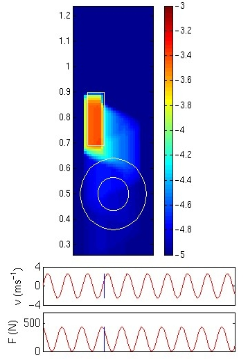
Simulation of the thermal image of a brush in front of a curling stone on the ice from [11] and re-published by Bradley [1].
Another instrumented brush prototype comes from Japan [21]. Hitoshi Yanagi and colleagues from the Kitami Institute of Technology developed an instrumented broom that captured horizontal and vertical force, stroke rate, and, perhaps most interestingly, broom handle angles. The force values and stroke rate data captured by the brush were then compared to the data captured from a calibrated force plate:
A commercially available curling brush (Tapered Ultra-Light Carbon Fiber Brush, BalancePlus) was used to develop the device in the study. It consists of a head and a shaft with a joint combined to it. Eight strain gauges (N11-MA-10-1000-11, SHOWA) were attached to the shaft 200 mm away from the joint center to detect the loads in the direction of the shaft axis and in the direction perpendicular to it. Two angular velocity sensors (CRS07-02S, Silicon Sensing) were attached to the shaft to detect the shaft angle between the shaft and the ice surface and the roll angle about the shaft axis. The amplified signals from the strain gauges and the output signals from the angular velocity were digitized and sampled by the A/D converter at the rate of 200 Hz. The angles of the brush were calculated by using time integration of the angular velocities measured.
The forces on the brush were calculated as the forces applied to the ice surface vertically (FV brush) and horizontally (FH brush) based on the output from the strain gauges and the angles. The vertical (FV fp) and the horizontal ground reaction forces (FH fp) on the force plates (KYOWA) were also recorded at the rate of 200Hz during the sweeping simultaneously.
Unfortunately, the empirical studies that accompany the descriptions of both of these prototypes involve a very small number of subjects. One of the goals of our research includes the development of normative data so that we can compare an athlete to norms for their gender, age group, skill level, or other criteria.
The CurlSmart instrumented brush
The CurlSmart instrumented brush, developed by Dr. John Newhook at Dalhousie University, uses a strain gauge to capture vertical force values and software analysis to determine stroke rate, sampling at 100 Hz. Other prototypes have been constructed at Dalhousie since then with various refinements. Later brushes have captured additional metrics, such as horizontal force, and the most recent brushes use technology that permits interchangable brush pads and places the electronics within the handle, to reduce the pendulum effect of the additional weight.
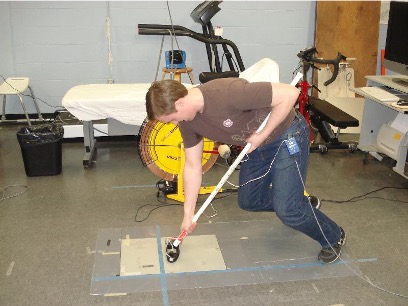
Calibrating an early version of the CurlSmart instrumented brush in the BenLab at Dalhousie University, circa 2013.
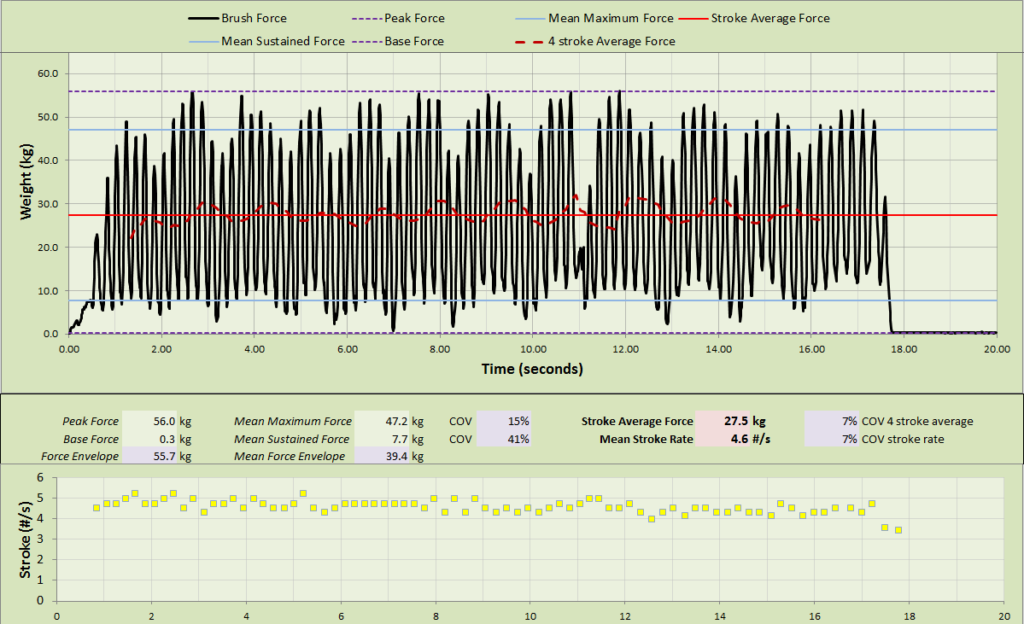
CurlSmart instrumented brush output of a bout by a male athlete using a slider. Note the periodic loss in vertical force production (in some cases, to near zero). This is entirely due to the player using a slider on his lead foot while brushing, rather than the recommended method using grippers on both feet. Any body weight applied to the slide leg to slide down the sheet of ice is, naturally, not able to be applied through the brush head into the ice. It is precisely this detailed, accurate feedback that makes an instrumented curling broom a “game changer” in the coaching of the sport.
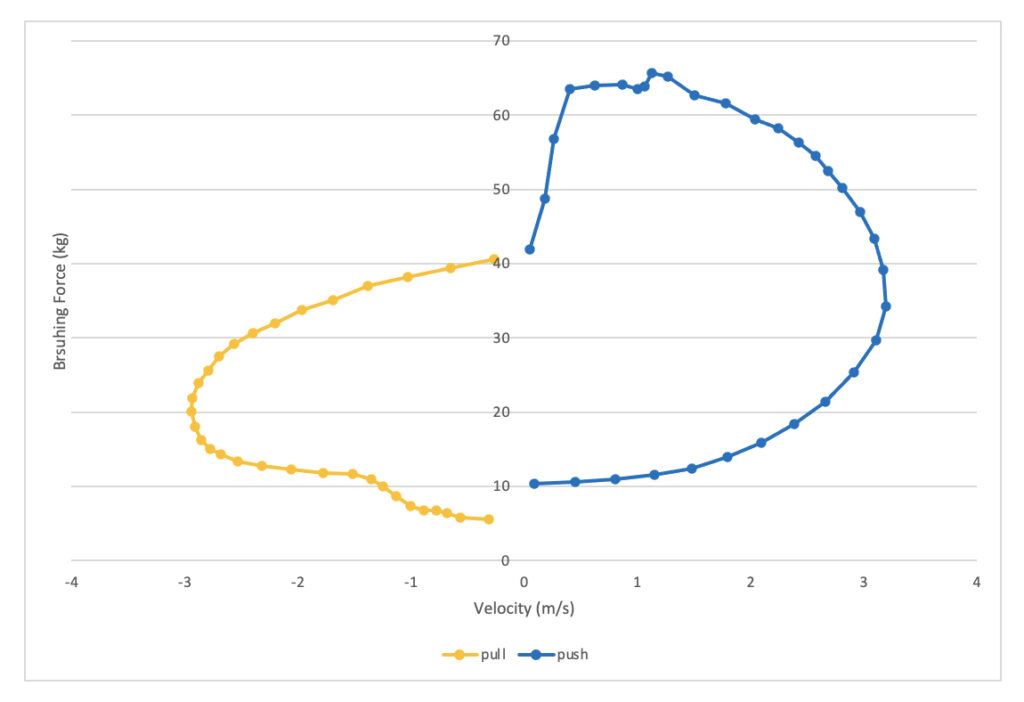
Plot of brush head velocity to vertical force, with the ‘push’ portion of the stroke in blue and the ‘pull’ in yellow. In brushing, brush head velocity tends to be very similar for both stroke components.
In addition to the above, we are aware of a number of additional instrumented brush prototypes from around the world. Miyakoshi Katsumi and Yanagi Hitoshi patented their brush in 2013; Korean researcher Lee Sang Chul patented his brush design in 2019; and there are likely others. Yanagi’s brush is interesting in that it reports the the 3-dimensional brush handle angle throughout a bout, in our experience an extremely important metric for coaching athletes.
Commercial instrumented brooms
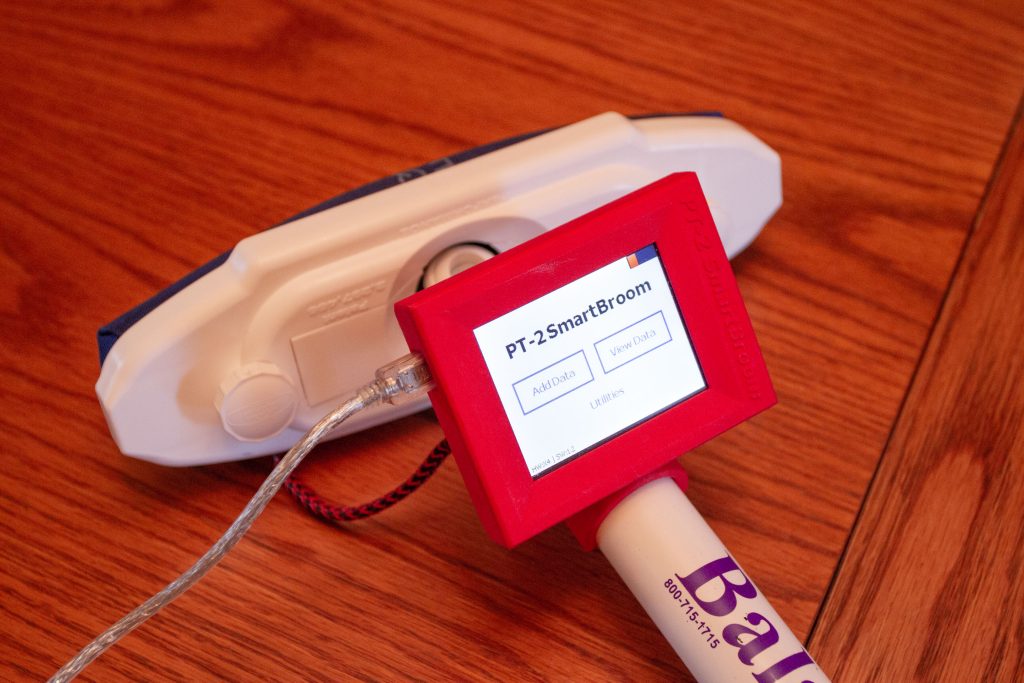
At right: the PT-2 featured a re-chargeable, on-board integrated display with touch screen entry attached to a standard Balance Plus broom. The PT-2 captured both stoke rate (via an on-board accelerometer) and force, through two load sensors cemented into a customized Balance Plus EQ brush head.
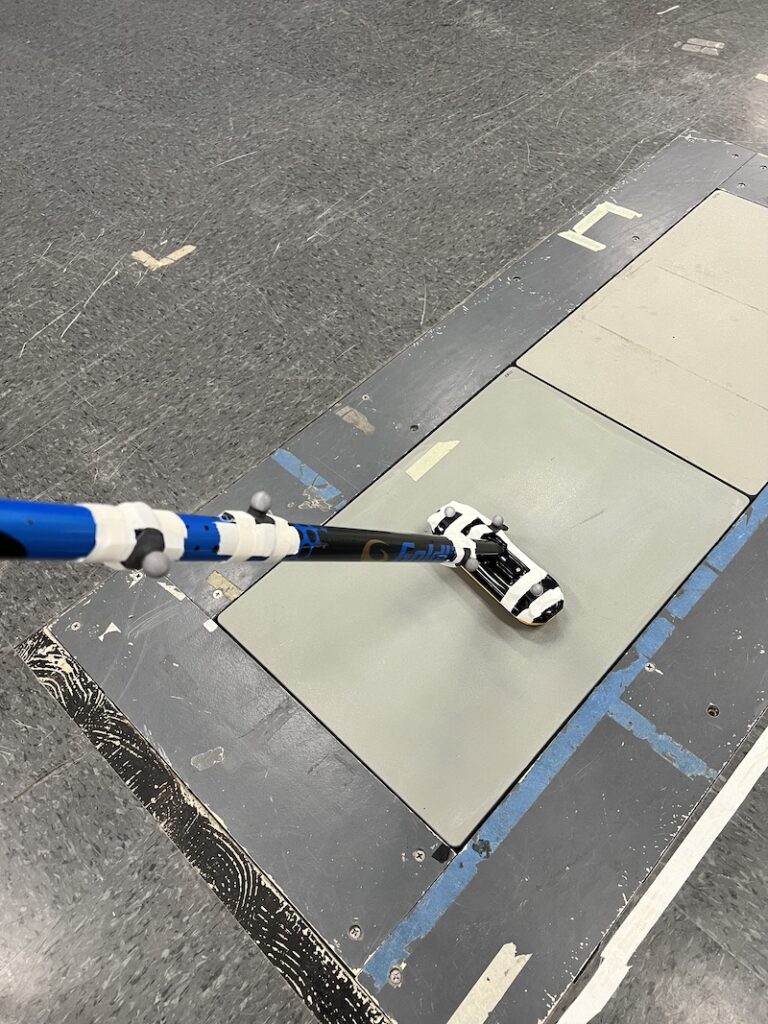
We are aware of two commercial instrumented brooms in Canada. Canadian Curling Tools Ltd., based in Kitchener, Ontario, initially developed their first instrumented brush called the PT-2 (below) in 2013. It featured an onboard display and reported force values and stroke rates every 1/2 second. A subsequent model, termed the SmartBroom (left, with motion capture markers for testing within the BenLab at Dalhousie) used a shim between a Goldline Air brush head and a standard Goldline Air pad. The SmartBroom communicated with an iPhone app via Bluetooth for real-time display, and so could be tracked from a significant distance away from the athlete.
In 2025, Canadian Curling Tools began the distribution of the 3rd iteration, a brush with entirely native components and approved for use by World Curling for competitive play.
The other commercial instrumented brush comes from Gerald and Jennifer Sande of Winnipeg, who patented their design in 2013 (Canadian patent 2787216). Rather than utilizing a strain gauge to measure vertical force, the Sande patent describes the use of capacitive sensors distributed across the brush pad. This is done so that the brush can report pressure in KPa across the pad, rather than report the vertical force in Newtons.
Future work
As stated earlier, one aspect of our research is to determine precisely what metrics from an instrumented curling broom should be captured, and what technology is required in order to make that possible (and with what error guarantees). For example, while capturing vertical force seems like a straightforward idea, colleague Michel Ladouceur of Dalhousie University has suggested a power metric may be more appropriate. Power, however, requires movement, so additional instrumentation to capture the displacement (distance) of each brush stroke would be necessary.
A second aspect is to develop better coaching and instructional methods that can utilize the feedback from the broom in the most effective way for any athlete, regardless of where that athlete falls in Curling Canada’s Long-Term Curler Development Model (LTCD). A third goal is to develop common nomenclature so that the outputs of various devices can be usefully compared. Finally, a fourth goal is to develop a set of normative data for a wide variety of athletes so that individual athletes can be compared against other athletes of similar characteristics.
For normative data, when we began this research more than a decade ago we had to rely on published results with exceedingly small sample sizes. Today, between John Newhook and myself we have worked with over 850+ individual athletes and have recorded more than 3000 brushing bouts – so we now have a very good idea of the spectrum of brushing performance across all LTCD levels.
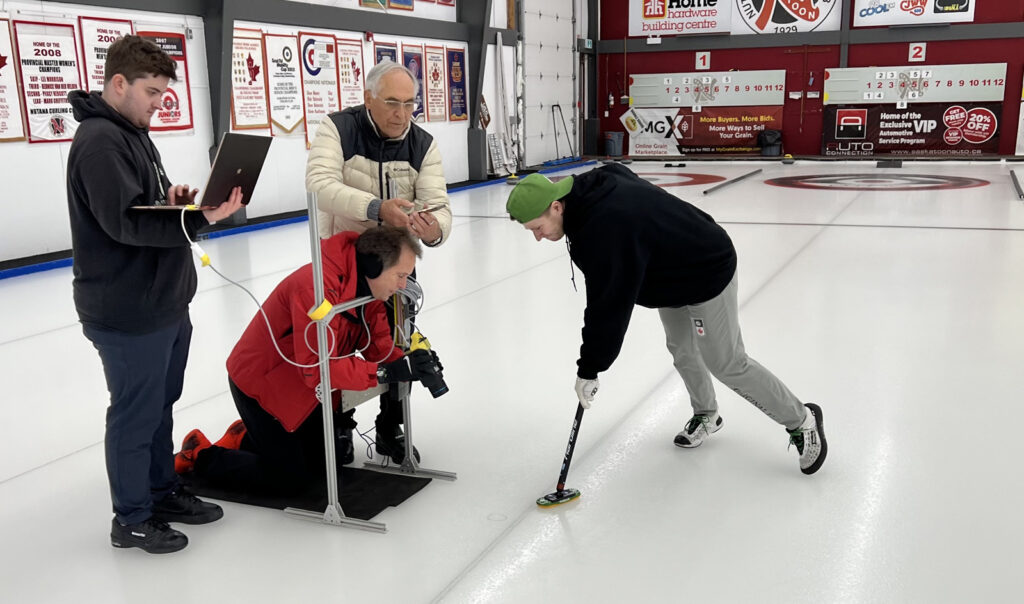
February 2026. Capturing video and infrared imaging of a knifing brush stroke at the Nutana Curling Club in Saskatoon with Eugene Hritzik, Sean Maw, and student researcher Corin Acton.
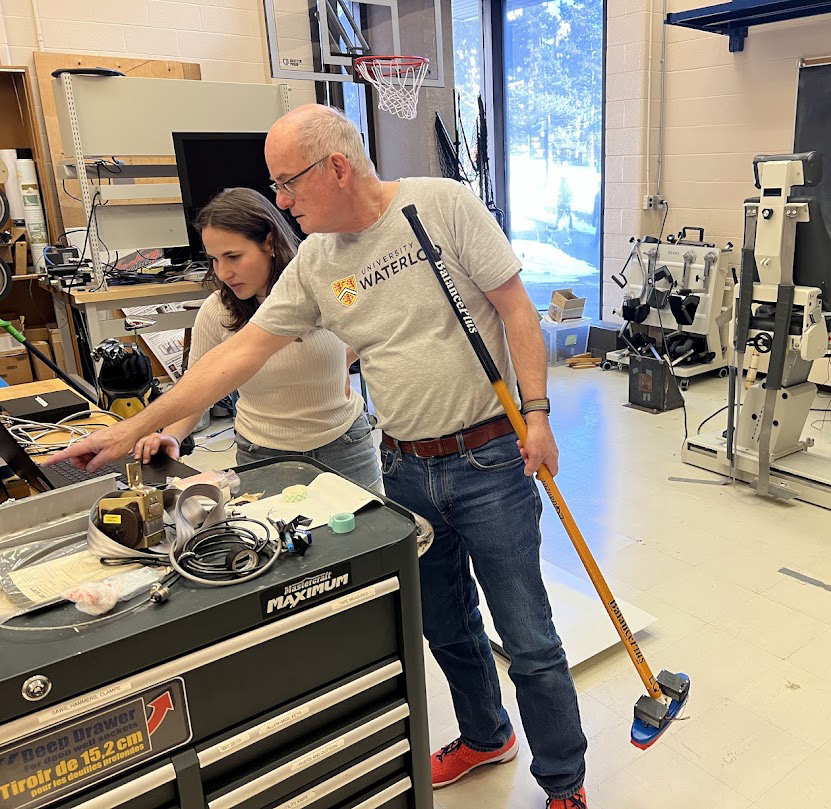
February 2026. Calibrating the CurlSmart instrumented brush in the lab with University of Waterloo Engineering PhD student Bianca Simone. Photo credit: Dr. John McPhee, Canada Research Chair in System Dynamics, University of Waterloo.
Acknowledgements
We would like to thank Balance Plus for their generous sourcing of SportLite+ fabric for the CurlSmart instrumented brush, and two LiteSpeed curling brushes for testing; Curling Geek for their financial support of a prototype instrumented brush project at Conestoga College in Kitchener; John Newhook and his staff and graduate students at Dalhousie for numerous discussions and generous Maritime hospitality; TrainSmart for Curling of Halifax; Dr. John McPhee and PhD student Bianca Simone of the University of Waterloo; Andrew Flemming and Matt Hamilton of Canadian Curling Tools; the coaches and athletes at Wilfrid Laurier University; Gary Crossley; and the Ontario Curling Council (now Curling Ontario) and Curling Canada for sponsoring some portions of this work.
References
[1] Bradley, J. L. 2009. The sports science of curling: a practical review. Journal of Sports Science and Medicine 8:495-500.
[2] Brown, Alex C. (December 2024). Correlations between curling stone frictions and tribology’s Stribeck curve: concepts to consider. Canadian Journal of Physics 102(12), pp. 633-645. DOI: https://doi.org/10.1139/cjp-2024-0095.
[3] Buckingham, M.P., B. Marmo, and J. Blackford. 2006. Design and use of an instrumented curling brush. Proceedings for the Institution of Mechanical Engineers, Part L. Journal of Materials: Design and Application 220(4):199-205.
[4] Denny, M. 2002. Curling rock dynamics: towards a realistic model. Canadian Journal of Physics 80:1005-1014.
[5] Denny, M. 2003. Comment on “The Motion of a Curling Rock”. Canadian Journal of Physics 81(6): 877-881.
[6] Jensen, E. T., and M. R. A. Shegelski. 2004. The motion of curling rocks: experimental investigation and semi-phenomenological description. Canadian Journal of Physics 82:791-809.
[7] N. Maeno. 2010. Curl Mechanism of a Curling Stone on Ice Pebbles. Bulletin of Glaciological Research 28:1-6.
[8] N. Maeno. July 2013. Dynamics and curl ratio of a curling stone. Sports Engineering 17:33-41.
[9] N. Maeno. February 2016. Assignments and progress of curling stone dynamics. In Proceedings, Institution of Mechanical Engineers Part P: Journal of Sports Engineering and Technology 2023, 237(2):79-84. DOI: https://doi.org/10.1177/1754337116647241
[10] Marmo, A. A., I. S. Farrow, M-P Buckingham, and J. R. Blackford. 2006. Frictional heat generated by sweeping in curling and its effects on ice friction. Proceedings of the Institution of Mechanical Engineers, Part L.: Journal of materials: Design and Applications 220:189-197.
[11] Marmo, B. A., M-P Buckingham, and J. R. Blackford. 2006. Optimising sweeping techniques for Olympic curlers. The Engineering of Sport 6(3):249-254.
[12] Murata, J. 2022. Study of curling mechanism by precision kinematic measurements of curling stone’s motion. Scientific Reports 12(15047). https://doi.org/10.1038/s41598-022-19303-4
[13] Nyberg, H., S. Hogmark, and S. Jacobson. 2012. Calculated trajectories of curling stones sliding under asymmetrical friction. Conference Paper from the 16th Nordic Symposium on Tribology pp. 12-15.
[14] Nyberg, H., S. Alfredson, S. Hogmark, and S. Jacobson. 2013. The asymmetrical friction mechanism that puts the curl in the curling stone. Wear 301:583-589.
[15] Penner, A. R. March 2001. The physics of sliding cylinders and curling rocks. American Journal of Physics 69(3):332-339.
[16] Shegelski, M. R. A. 2001. Maximizing the lateral motion of a curling rock. Canadian Journal of Physics 79:1117-1120.
[17] Shegelski, M. R. A. and R. Niebergall. 1999. The Motion of Rapidly Rotating Curling Rocks. Australian Journal of Physics 52:1025-1038.
[18] Shegelski, M. R. A. and M. Reid. 1999. Comment on: Curling rock dynamics – The motion of a curling rock: inertial vs. noninertial reference frames. Canadian Journal of Physics 77:903-922.
[19] Shegelski, M. R. A., R. Niebergall, and M. A. Walton. 1996. The motion of a curling rock. Canadian Journal of Physics 74:663-670.
[20] Shegelski, M. R. A., M. Reid, and R. Niebergall. 1999. The motion of rotating cylinders sliding on pebbled ice. Canadian Journal of Physics 77:847-862.
[21] Yanagi, H., K. Miyakoshi, M. Fukuoka, and N. Yamamoto. 2012. Development of Curling Brush for Measuring Force Exerted During Sweeping. Proceedings, 30th Annual Conference of Biomechanics in Sports, Melbourne, Australia, pp. 354-356.