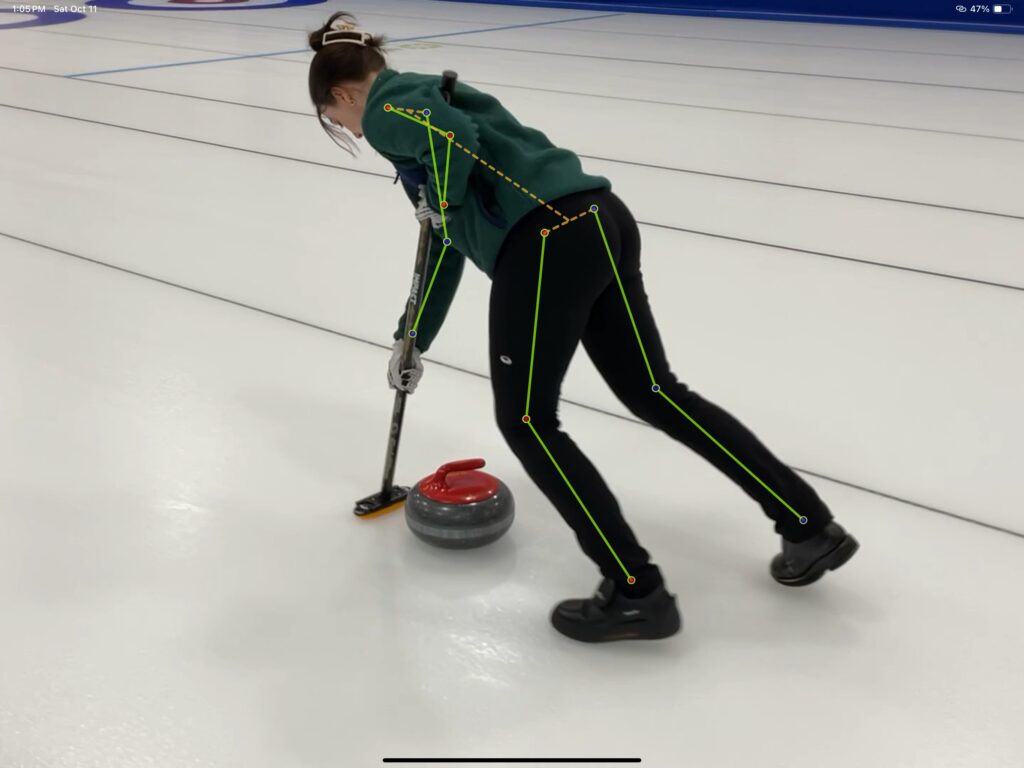
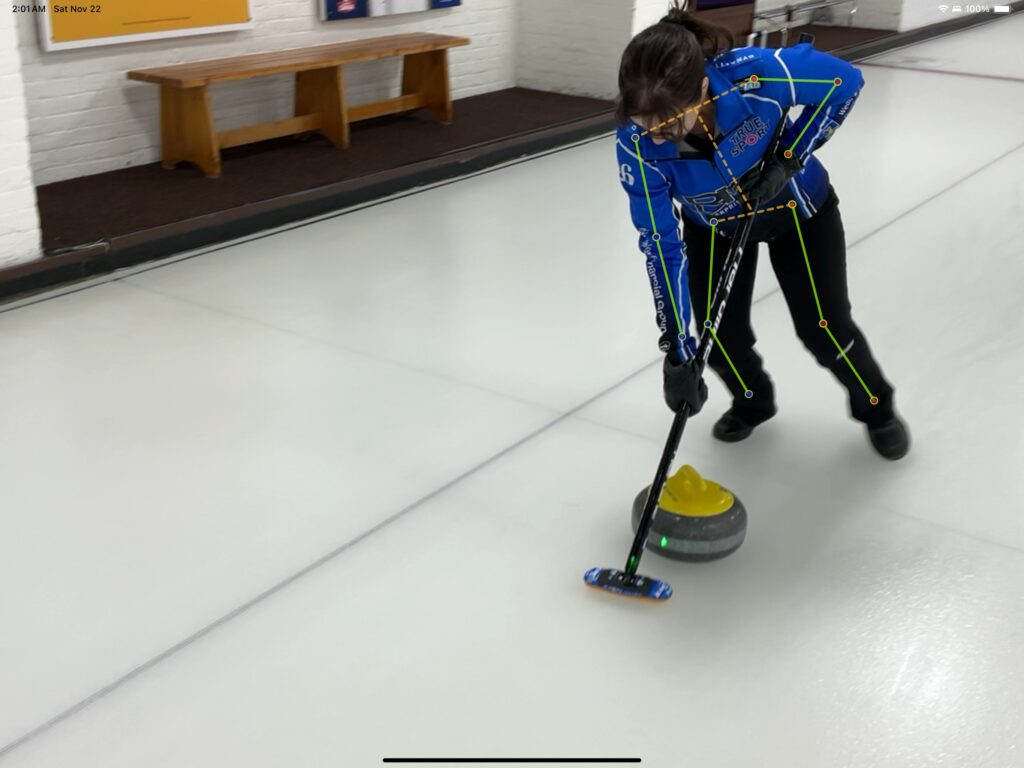
One of the critical biomechanical skills to develop in brushing is to ensure that neither the shoulders, nor the hips, “bounce” as one strides down the sheet. One can term this as “isolating the chassis”: the shoulders, back, and hips (the “chassis”) should remain relatively still, while the athlete uses their arms, shoulders, and back muscles to push and pull the brush head, while the legs propel the athlete to keep up with the stone.
Why is this important? It’s because vertical oscillation (bouncing) of the shoulders and/or hips will result in a loss of vertical force as the shoulders and/or hips are raised. The effect is less pronounced with the shoulders, in part because the hip/pelvic area constitutes a greater percentage of the athlete’s body mass. The cause of vertical oscillation is usually variable flexion in the knees: the hips will dip if the knees are bent, but this hips will rise if the legs are subsequently straightened during the next stride. If vertical oscillation occurs, then vertical force will almost certainly be lost with every bounce.
Below is an example of what happens to vertical force output when vertical oscillation of the hips occurs. Here, the athlete has deliberately chosen to periodically elevate the hips and drive them downwards into the ice, timing the movement with every other ‘push’ portion of the brush stroke.
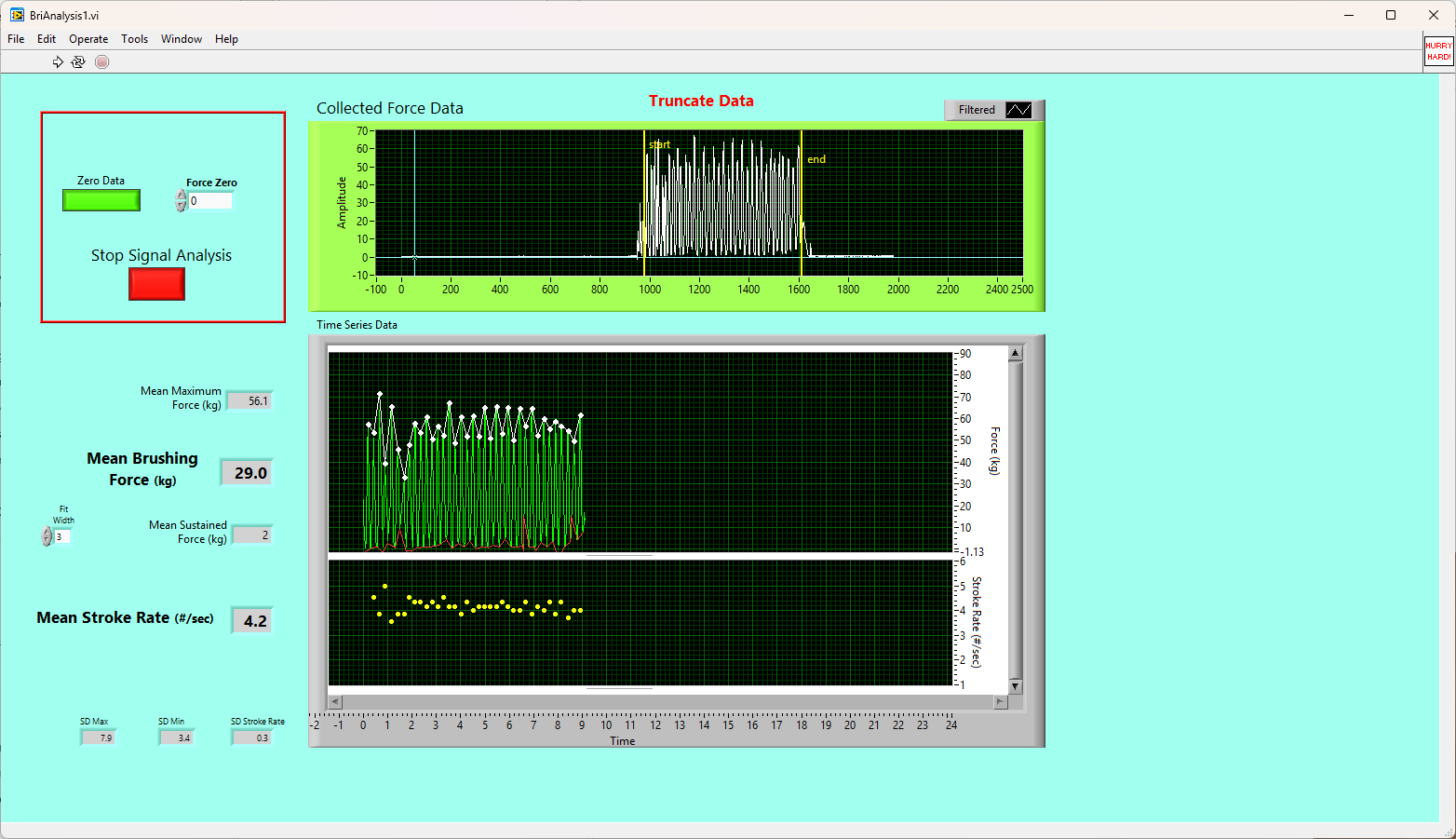
CurlSmart instrumented brush output for a bout by a male athlete deliberately causing vertical oscillation of their hips in an attempt to generate additional vertical force during the “push” portion of a stroke. The CurlSmart brush captures and reports data at 100 Hz. Click on the image for an enlarged view.
Analysis
Similar to bunny-hop brushing, the idea behind deliberately causing vertical oscillation of the hips is for athletes to maximize their mean maximum forces when brushing.
However, the CurlSmart instrumented brush force profile above illustrates the problem: only every other stroke receives the benefit of the downward motion of the hips. Because the athlete’s mean stroke rate is 4.2 Hz, the athlete is unable to oscillate the hips at the same rate, and so performs the movement with every other stroke. Consequently, each subsequent stroke is begun when the hips are rising, resulting in a loss of between 15-20 kg of vertical force during the “push” portion of each of those strokes.
Overall, the athlete’s mean maximum force is slightly higher than when measured this spring with a stable “chassis”. Moreover, the effort to maximize the “push” portion of each stroke has led to a brushing technique with minimal sustained forces during the “pull” portion of the stroke. In this case, the athlete’s mean sustained forces has dropped to an extremely low 2 kg.
Video is useful here
The negative impact of vertical oscillation may not necessarily be seen in the output of all instrumented curling brushes, because different instrumented brushes report brushing outputs at different frequencies (the CurlSmart brush outputs data at 100 Hz).
Slow-motion video footage of athletes, particularly from the side, is a useful tool to recognize and correct vertical oscillation during brushing. OnForm’s markerless skeletal modelling (see images above, at right) are ideal to use in slow-motion to determine the extent, if any, of vertical oscillation.