Data scientists begin to look at curling
In recent years we have witnessed the application of both computer video analysis coupled with powerful analytics engines to provide insight into strategy and tactics in a variety of sports. As examples, five sports that have seen a lot of analytics applied to them are football (soccer), NFL football, basketball, baseball, and ice hockey. It is no surprise that these sports are in leadership positions since they are large enough to afford the data science expertise and computer technology to analyze the massive amounts of data that are captured during a game. Ice hockey lagged the other major sports in analytics. However, most, if not all, NHL teams now have data scientists on their staffs, and NHL teams use a variety of tools (such as NHL Edge) and software providers to provide insights into shooting, passing, goaltending, puck possession, power play, and defence strategies. Academic researchers have also been part of the mix: as an example, my friend Tim Brecht,
The Battle at Port Elgin – September 2026
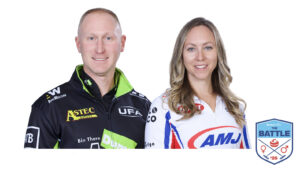
A marquee battle-of-the-sexes series of games between Canadian champions Brad Jacobs and Rachel Homan will take place in Saugeen Shores from September 25-27, 2026 at The Plex in Port Elgin. Games between the two teams will include regular play, skins, and mixed doubles games. Fundraising for local curling clubs Organizers Doug Flowers, Maurice Wilson, Dave Middleton, and Stu Silcox are hosting this world-class event to help build the sport of curling in their local communities, including Port Elgin, Southampton, Kincardine, and other clubs in the area, and to help fund critical curling club projects planned or already underway. The Plex seats 1200 spectators and the organizers are hoping for a full house for all of the games. 10% of net profits will go to a charity of the winning team’s choice, 5% of net profits to a charity of the runner-ups choice, and the remaining 85% will be used for infrastructure upgrades at area clubs. 3-day Adult Curling Camp Additionally,
Delivery by athletes with opposite ocular dominance
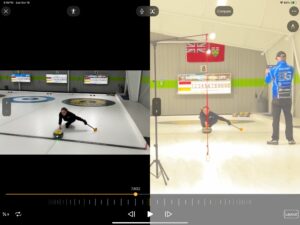
What is ocular dominance? Ocular dominance is the tendency of the brain to prefer visual input of one eye over the other. While like many other mammals human beings have binocular vision with which to judge distances, humans almost universally prefer visual input from one eye over the other. According to Wikipedia, about 70% of people are right-eye dominant, and 29% are left-eye; why this is so is still not understood. In everyday circumstances most individuals don’t give their ocular dominance much thought; but in sport, eye dominance can play a significant role, especially in highly accurate tasks such as aiming. Sports such as darts, archery, billiards, shooting, and curling can be impacted by eye dominance, particularly when the athlete’s dominant eye is the opposite of their dominant (throwing) hand, which is sometimes termed cross-dominance. Celeste Gauthier, who throws 3rd stones for Team Émilie Lovitt, throwing an out-turn draw. Note that Celeste’s left eye is directly above the centre of
A brush is not a rock magnet
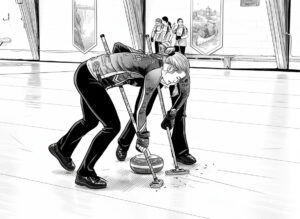
A brushing tactic I continue to see being used by younger teams is to brush the ice adjacent to the stone when trying to ‘carve’ or accentuate curl. I’m not sure where this tactic began, but there is no point in brushing ice that the running band of the stone will not pass over as the stone continues its trajectory. Brushing to increase curl requires brushing ‘high-side’ (in the direction of the stone’s rotation). Precisely where the stroke begins and ends for optimal effect depends on a number of factors, the most important being the velocity of the stone and the force profile of the athlete(s) doing the brushing. But there are several other variables that may play a role, including the roughness of the stone’s running bands, the ice conditions, and environmental factors (temperature, humidity, dew point) to name just a few. These variables are not completely understood, and we know from testing – at different clubs with various
Foamgate, existing, and forthcoming research
At this point, many competitive curlers in Canada should be familiar with the recent announcement from World Curling about the withdrawal of specific foams in a small selection of brushes from World Curling’s approved equipment list for competitive play for the upcoming 2025 – 2026 season. World Curling came to their decision based on the outcome of brush testing in Morris, Manitoba during the Victoria Day weekend, along with feedback from the researchers on World Curling’s equipment advisory group, of which I am a member. To a significant extent, World Curling really didn’t have a choice but to try to address the concerns first brought to their attention with the players’ manifesto that was put together just prior to the Grand Slam event in Guelph this past January at the WFG Masters. The players who signed onto the manifesto were concerned that the brushes approved for competitive play this past season were too good: either they permitted additional carry above reasonable

Book review: Practical Applications in Sport Nutrition
Eating well to properly fuel your body for competition has to be one of the most overlooked aspects of curling for most young teams. To be sure, being fit and ensuring that you get enough sleep during both training and in competition are important too, but it’s difficult to play at your best on championship Sunday when you’re already tired. And it’s hard to concentrate on the game if you’re thinking about lunch. Curling Canada does have resources for coaches to learn about the importance of nutrition for their teams, and a module in the Competition Development program, entitled Health and Wellness, put together by Master Coach Developer Karen Watson RN, is a great place to start. To supplement that module, or to provide some guidance for athletes, there are many books and materials are sports nutrition available and this is one: Practical Applications in Sports Nutrition, by Heather Fink and Alan E. Mikesky. Here, I’ve reviewed the 5th edition