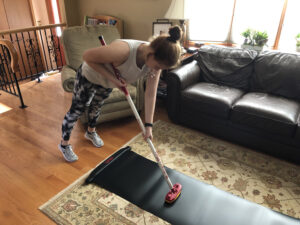
Can I use a bathroom scale to test brushing performance?
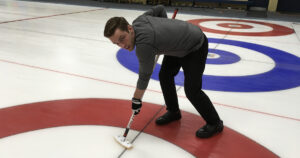
Recently I was asked if one could use an ordinary bathroom scale to test an athlete’s brushing performance. Obviously doing so would constitute a static test, so its usefulness is limited since brushing is an activity of movement; so much of brushing performance is dependent on one’s body position and footwork when one is moving with the stone down the sheet. Moreover, we also know that brushing performance (typically both stroke rate and vertical force) tails off with stones thrown at higher velocities. And, finally, we also know from mechanics that, formally, there is no generation of power without movement. In a static test with the brush on the scale, no movement is produced. Nonetheless, a static test using a bathroom scale can give an athlete an idea of the vertical force they can generate down the handle of the brush in a stationary position. It is extremely unlikely that this force will be duplicated on an ice surface, but
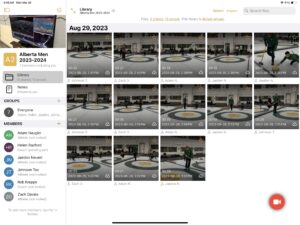
OnForm adds multi-camera support
The latest version of the OnForm video analysis application, just released this week (March 18, 2024) on Apple devices now supports simultaneous multi-camera video recording from multiple devices (up to 3) on the same WIFI network. For curling coaches, being able to record simultaneous camera input of a curling delivery – for example, using a camera located behind the hack, and another in front of the athlete) can be exceedingly helpful. Other commercial applications support this functionality; Curling Canada demonstrated the use of the Switcher Studio application at the high-performance coaching summit in Edmonton in August, using three Apple iOS devices: one behind the hack, another at the side, and a third mounted on top of a sawhorse in front of the athlete. If you already use OnForm with a coaches’ license, you know the value to being able to not only record video but also annotate the video with markup or with voice-over: The disadvantage of the Switcher Studio
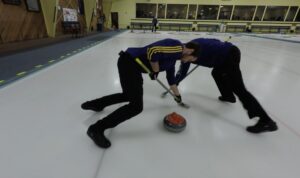
A short analysis of brushing studies
This article is joint work with Professor of Engineering John Newhook of Dalhousie University in Halifax. Click on the image above to view the PDF. Since we began our collaboration during the winter of 2013-2014, John Newhook and I have been compiling normative data on brushing, John in Nova Scotia and the Maritimes and myself largely in Ontario and occasionally in Saskatchewan. We felt that this work was important since the few studies of brushing performance of which we were aware had very small sample sizes and had predominantly illustrated the performance of male athletes. Since our initial trials in February 2014, John and I have together recorded over 2500 bouts for approximately 775 athletes across Canada. Many of these are Junior-aged athletes that we have worked with multiple times through annual high-performance camps, but we have also worked with younger athletes and with high-performance athletes who play on the Tour. As a result, from our study we have a
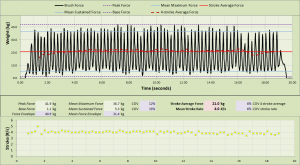
The Anatomy of a Brush Stroke
This article is joint work with Professor of Engineering John Newhook of Dalhousie University in Halifax. Click on the image above to view the PDF. In 2018 we documented the vertical forces and other characteristics of a brush stroke in order to better convey our understanding of the mechanics of brushing and how we might use this information to improve the coaching of the sport. This article, the first in our Technical Coach Series, is certainly not the first to document the variability in the forces achieved when brushing. To our knowledge, it would appear that researchers in the School of Engineering at the University of Edinburgh (B.A. Marmo, I.S. Farrow, M-P Buckingham, and J.R. Blackford) were the first to document the variability of forces during a brush stroke, and how these forces are generated on the ice, in various papers in 2005-2006 (see references below). Their results were later confirmed by other researchers in 2010-2012 in both Canada and
Curling brushes – Try before you buy – Part Un
No self-respecting golfer would simply walk into a golf pro shop or retail outlet to buy a new set of clubs without going through the process of getting fitted. Fitting is an assessment process that involves the analysis of a golfer’s swing and physiology to ensure that the golf clubs under consideration “fit” the player, enabling the player to strike the ball square in the middle of the club face with a shaft whose flex matches the player’s swing speed, among other trade-offs. A summary of factors involved in golf club fitting can be found in this article entitled “Clubfitting 101” by MyGolfSpy. While the MyGolfSpy article covers the details of club head variations that can suit different types of players and their style of game, the article also covers consideration of the choice of club shafts, particularly: shaft flex. Simplistically, higher swing speeds warrant stiffer club shafts though this is an overgeneralization. Other factors include release pattern and shaft
Some thoughts on practice for student-athletes
To achieve sufficient skill as a competitive student-athlete, coaches will often recommend or insist that athletes spend a certain amount of time practicing on their own. Sometimes this practice will be done with a partner, perhaps even with the entire team, or sometimes the student-athlete may prefer to work on their own. The point here is that the practice is self-directed – it’s not undertaken with the supervision of a coach. So what should this practice look like? I think that many student-athletes have actually little idea about what a self-directed practice should entail. When I’m at my local club I frequently see the following: If the practice involves multiple teammates there is often far too much unproductive chit-chat. Sometimes those conversations can be helpful, say to address a team dynamics issue, but far too often I will overhear conversations that would better be held off the ice, rather than use expensive ice-time. If you feel somewhat guilty reading this,