In this second article of his two-post series, guest contributor Maurice Wilson outlines practice elements to help athletes develop their finesse game. A version of this material was previously published on the Ontario Curling Council website.
Addition by subtraction
In Part One of this article we discussed the merits of leg drive and arm extension in the pursuit of improving precision in our finesse game. Part Two will focus on the practice techniques that can and will enhance that learning process. The same equipment may be used for all of the drills discussed in this document: speed traps, clock, iPad, RockHawk timers, and pylons as well as the charts to record data that I will provide. The length of the practice will depend on the ability, expertise and attention spans of your athletes. I have had sessions from 30 minutes to four hours in length and with productive results.
The key to all successful training sessions is pace and of course, good constructive and varied feedback for all participants. As I mentioned in the previous article, all of these practices have at the very least auditory and visual feedback as well as feedback from the speed traps, Rock Hawk, pylons and quite often, video analysis. The Learning Zone becomes much bigger and more effective with this abundance of support and data at our disposal. The simplicity of the skill can be enhanced within the complexity of the path to success! That is the beauty of the “chunking” process: breaking down the skill into small, manageable, easily learned steps and then re-building them into the improved technique.
Training for precision should also involve the mental side including relaxation techniques such as deep breaths prior to the execution of shots to help the process and improve outcomes. Mindfulness and staying in the moment or “clearing the hack” as I like to refer to it. This is the ability to eliminate or at least reduce the “brain chatter” during the pre-shot routine phase of the delivery. It also assists in improved focus. So what does training for precision look like? How can we elevate our finesse game and start working towards improving our draw weight to championship standards?
Drills
The following drills can be used to accompany the practice techniques I illustrated in Part One of this article. These drills may be done in a random order or sequentially as is your preference.
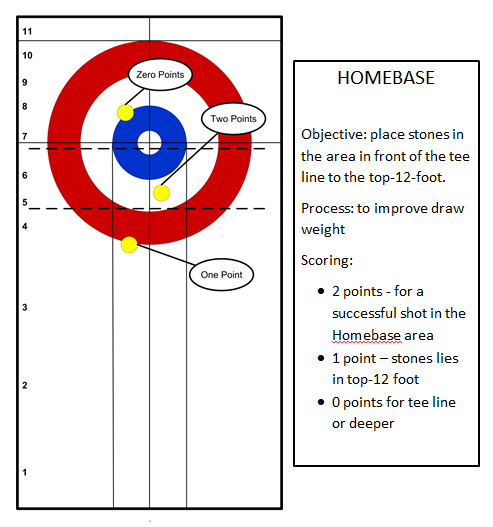
Home Base is designed to train the thrower and sweepers to recognize and develop front house weight (Zones 4-6).
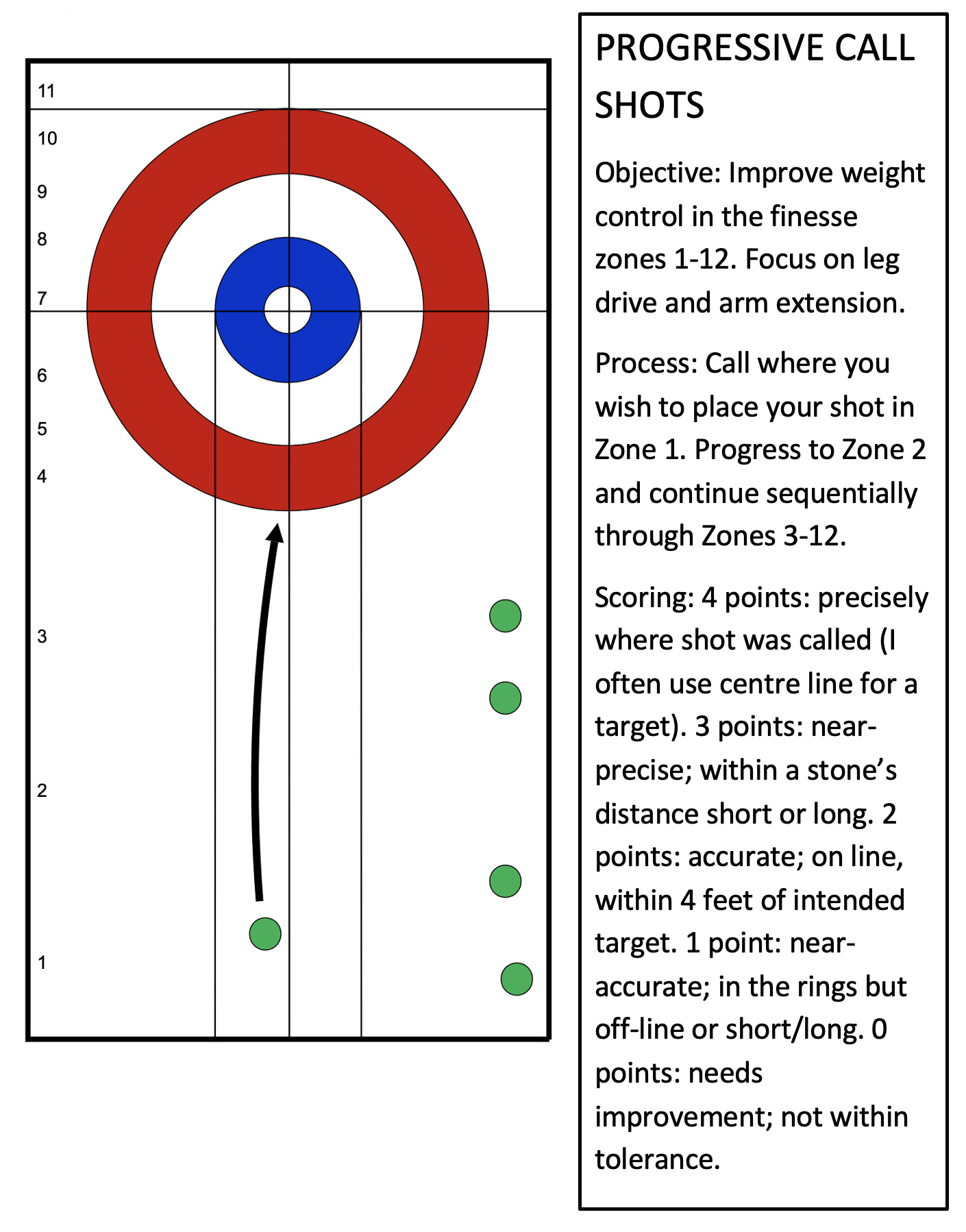
Progressive Call Shots develops precision in shots in Zones 1~12 and also promotes strong communication skills before, during and after shots amongst all team members.
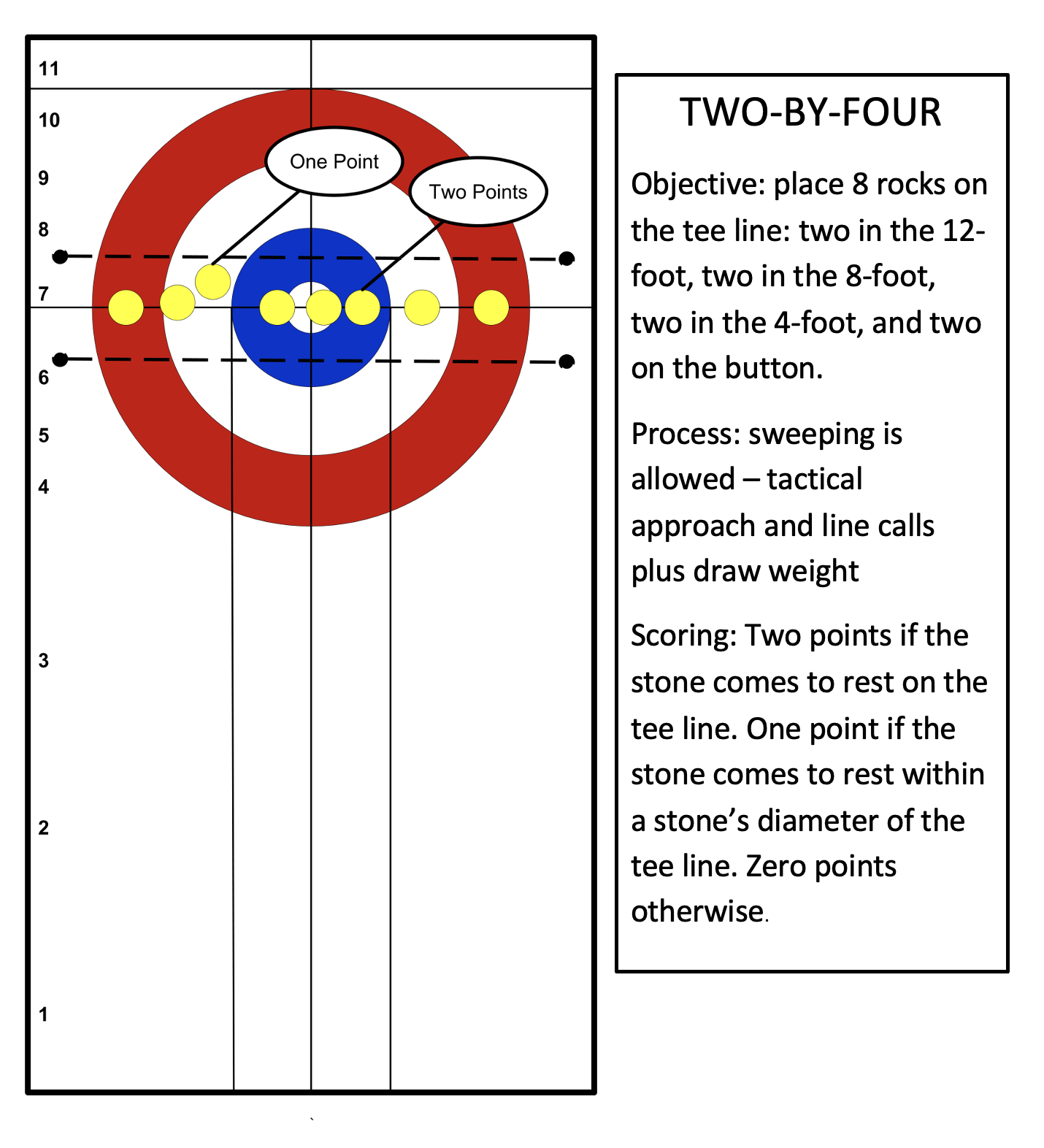
Two-by-Four assists the thrower in developing kinetic memory for shots to the tee line and again communication with all team members is essential.
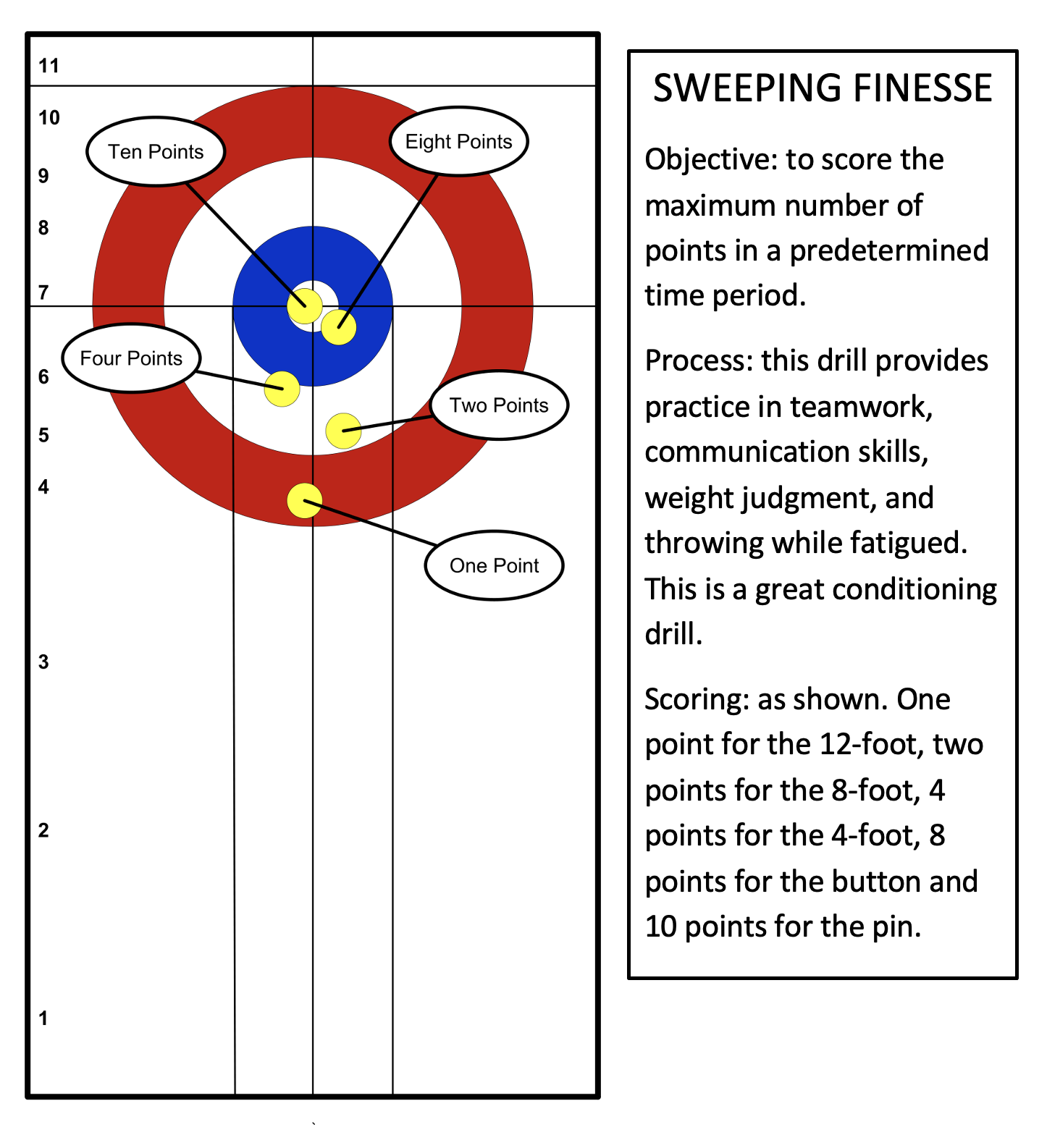
One of my all time favourite drills is Sweeping Finesse! This drill is a great end of practice exercise that promotes fitness, focus, throwing while fatigued and communication skills between thrower and sweepers. Rotation for this drill should be throw one, sweep two and rest on the fourth shot, then do it all again for the time limit. Setting goals of total points scored in usually 15 or 20 minute intervals enhances the training experience.
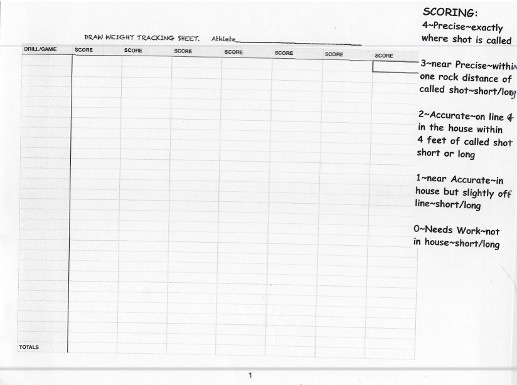
The Draw Weight Tracking Sheet
The Draw Weight Tracking Sheet provides a data tracker and the scoring for Progressive Call Shots is on the right side of the page, but the tracking sheet can be used for all the drills presented above to make the experience more meaningful and measurable. Scoring:
- 4 pts: Precise: stone comes to rest exactly where called
- 3 pts: near-Precise: within a one-stone difference of the called shot (either short or long)
- 2 pts: Accurate: on-line and within four feet of the call
- 1 pt: near-Accurate: off-line and within four feet
- 0 pts: Needs work: off-line and outside of the four feet of tolerance
Timing correlations
This final chart deals with my research into the correlation of leg drive times (back line to top-12 line) to a stone’s hog-to-hog time assuming (1) little-to-no extension on release and (2) a typical deceleration of the athlete during the delivery. When deriving your own table it is helpful to include the stone’s velocity at the near hog line, since it is the stone’s velocity after release that really matters, and provides an important training cue. The Rock Hawk system can report the stone’s velocity but its calculations are based on a stone’s diameter, typically at the striking band where the laser would be directed on the stone. Stone diameter is a setting in the Rock Hawk app that can be altered to suit the particular rocks being used in practice. The Rock Hawk default for stone diameter is 27.46375 cm. (10.8125 inches). Your stones may vary from this default value.
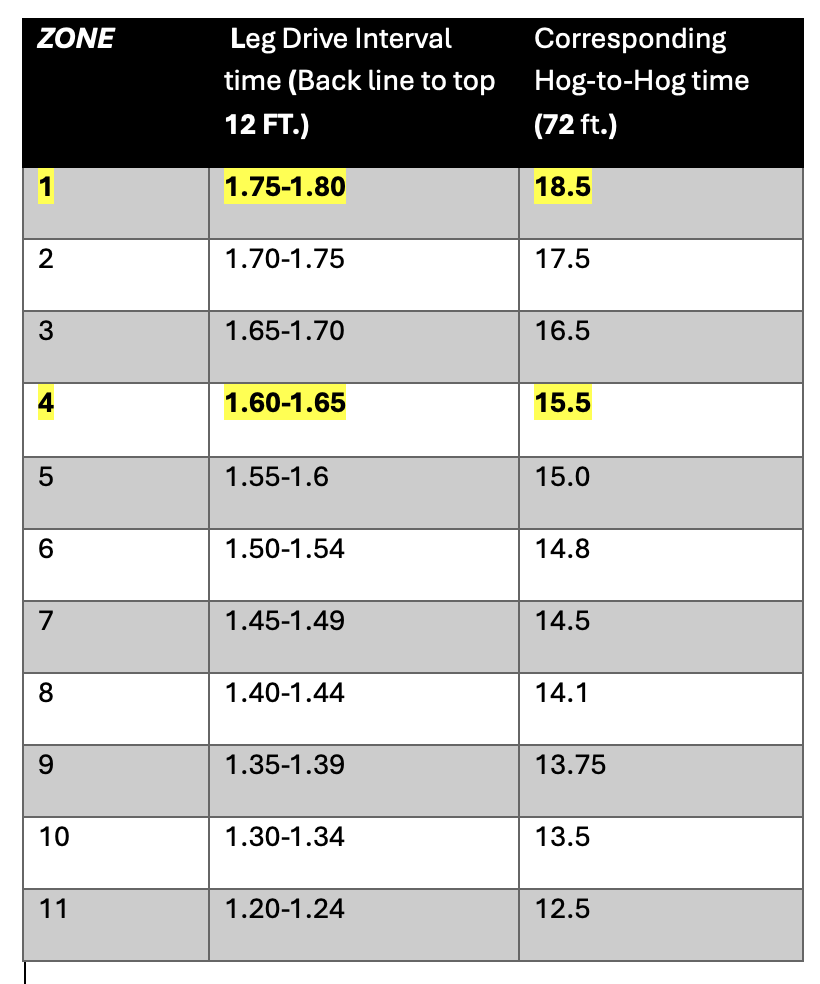
Naturally the hog-to-hog times in the chart are dependent on ice conditions, characteristics of the stones (a stone’s mass, roughness of the running bands) and potentially other factors. Roughly, a difference of 0.05 seconds in the leg drive will result in a difference of 0.5 seconds in the hog-to-hog time, but this relationship is not linear (see the articles Mapping delivery split times to hog-to-hog times and Ten reasons why an interval time might be inaccurate for examples). The times shown are for 14.5 second (hog-to-hog) ice at a local club, but your times may differ.
Note the times highlighted in yellow, for Zones 1 and 4. For finesse shots, the approach outlined in this article is for the athlete to master their leg drive to suit just those two throws, and rely merely on a positive extension to achieve Zones 2-3 with a Zone 1 leg drive, and Zones 5-11 with a Zone 4 leg drive, rather than have to master all twelve different leg drive times to achieve a precision shot to the intended target.
I offer all these drills and data collection as food for thought for developing improved draw weight with your athletes.
Developing an action plan
Deliberate practice requires a great deal of hard work, but also a great deal of smart work (hence the KISS method discussed in Part One). Athletes who have a high level of success make practice playful, fun and interesting. They seek a level of mastery (precision) that sets them apart from their competitors. They stop, correct mistakes, and go on. The process is what is important to them, not being focused on potential outcomes. Targeted, mistake-focused practice is meaningful and reflective.
Take the time to reflect about your practice.
Evaluate by reflecting after the performance and thinking back on what was learned and attempted during and after the training session. Discuss what you learned with your teammates and coaches. Learn from your mistakes; as one of my mentors often says, “failure is fertilizer if you’re paying attention.”
In conclusion, let me bring you back to Part One of this article when I suggested you do a bit of binge-viewing during the upcoming Grand Slam events. Watch carefully the finely crafted technique the vast majority of these throwers have developed: the consistent leg drive, the smooth point of elbow to the ice extensions on release, and the smooth consistent follow through after release. Compare the percentages of your favourite players with their opponents; how do their deliveries and approaches vary? Could they benefit from subtracting some extraneous leg drive and adding a smooth and well developed extension to the process? Very poignant questions that can lead to insightful challenges in developing new and improved skills. Take the time and watch the very best adders collect the $$$$!!